
From the Minors to the Korner: Santucci and Voit Reflect on Award-Winning Seasons


There are a lot of ways to get to Citi Field. Some arrive through the Jackie Robinson Rotunda wearing a Mets uniform. Others arrive through the media entrance, carrying a laptop, a credential and enough memories to fill a book.
And then there are those who arrive for the first time with their families, carrying the kind of hardware that might eventually become a regular part of their professional lives.
For Jonathan Santucci and Mitch Voit, Monday was one of those days.
The two Mets prospects were honored on the field before Monday night’s game against the Baltimore Orioles, accepting the organization’s 2026 Player Development Awards. Santucci was named the Mets’ Pitcher of the Year, while Voit took home Player of the Year honors.
For both, it was a celebration of a season spent learning, adjusting and taking another step toward the major leagues. It was also a chance to share a very special moment with the people who helped get them there.
“It's super awesome,” Santucci said when asked what it meant to be at Citi Field. “First time at Citi Field. Get to experience it with my whole family.”
Voit echoed that sentiment.
“It's incredible, and it's really a moment for me to share with my family,” he said. “And they've been my support staff this whole time, so I'm just incredibly proud to have them here to share this moment with them.”
And both have given the Mets plenty of reasons to be excited.
Santucci, 23, was selected by the Mets in the second round of the 2024 First-Year Player Draft out of Duke University. In his second professional season, the left-hander made 26 starts between Double-A Binghamton and Triple-A Syracuse, striking out 157 batters.
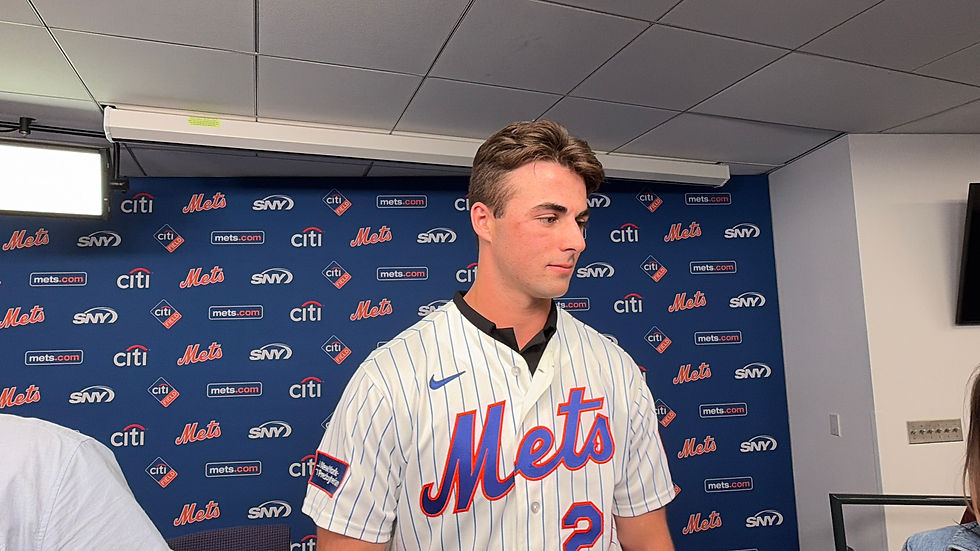
That total was tied for third-most among all minor league pitchers in 2026 and the most by a Mets left-handed pitcher in the minors since 1997.
His season began with the Rumble Ponies, where he posted a 3.57 ERA over 90.2 innings in 19 starts. On July 19 against Akron, he recorded a career-high 13 strikeouts. His 120 strikeouts with Binghamton were the most among all Double-A pitchers before his promotion to Syracuse on July 28.
He earned his first career Triple-A victory on September 1 against Rochester.
But while the numbers tell you what Santucci accomplished, they don't necessarily tell you how he got there.
“The biggest key to my development this year?” he said. “I think just taking every step as a learning curve. And kind of just going through every experience for the first time.”
That mindset has been especially important as Santucci has moved through the professional game. The jump from college baseball to the minors isn't simply a matter of facing better hitters. There are more scouting reports, more mechanical details, more resources and, perhaps most importantly, more time to think.
Too much time, sometimes.
Santucci and I had previously discussed one of his biggest adjustments coming out of college: learning how to handle the free time that comes with professional baseball. In college, the schedule is structured. In the minors, there are hours to fill, and if you aren't careful, baseball can occupy every one of them.
“Just knowing when to focus on certain things,” Santucci explained. “And it's definitely a different experience. A lot more detail goes into the scouting part of it. Mechanical things and a lot more things are for your resources. So just learning everything on that end is different than college.”
Then comes the part that every baseball player eventually learns, sometimes the hard way.
“Knowing when to shut your brain off from baseball,” he said. “Because you know how mental of a game that is. You can't be thinking about it all the time or it's going to drive you crazy.”
His solution? Golf, spending time with friends and having conversations that don't involve pitch shapes, launch angles or the latest scouting report.
“Finding things to do on that end like golf or things like that with my buddies,” Santucci said. “Or just having a good time and a different conversation in the dugout.”
In other words, sometimes the best way to become a better baseball player is to stop talking about baseball for a few hours. Revolutionary concept. Somebody alert the analytics department.
Santucci has long been known as a fastball-slider pitcher. This season, however, he has worked to make his curveball and changeup more prominent parts of his arsenal.
“The curveball is definitely taking a big adjustment this year,” he said. “That and the changeup.”
The changeup has been particularly important against right-handed hitters, giving him another pitch that moves away from the barrel and can produce different types of swings and contact.
“Just seeing the types of swings and balls in play against it,” Santucci said. “And just having that confidence with it.”
The curveball, meanwhile, is a pitch he added last year and believes has taken significant strides this season.
“Throwing it firmer,” he said, “and just seeing the results of it. And how it tunnels off my fastball and slider.”
The idea is that the pitches look similar out of the hand before moving in different directions, making it harder for hitters to recognize what is coming.
For Santucci, it is all part of the next step.
“I think that's a big emphasis moving forward,” he said, “is just relying on those pitches a little bit more.”
The ultimate goal is not simply to have four pitches. It is to have four weapons that allow him to navigate a major league lineup multiple times.
“Having multiple other options,” Santucci said, “it's going to be really good to be able to get through a big league lineup three times.”
That is the assignment. The Mets, like every organization, are looking for pitchers who can get major league hitters out not once, but again and again.
Santucci believes the stuff is there. Now comes the continued development and the confidence to use it.
One of the most encouraging parts of Santucci's season has been watching fellow Mets pitcher Zac Thornton make his own journey to the majors.
Santucci and Thornton were teammates in Brooklyn last year and again with Binghamton this season. Watching Thornton succeed in New York has provided a close-up look at what is possible.
“It's awesome to see him and all of his success,” Santucci said. “I just love the way he attacks hitters.”
That aggressive approach is something Santucci admires, particularly because it is so simple.
“Just being in the strike zone with everything,” he said of Thornton. “And knowing that, like I said, hitting is hard.”
Then came the line that might be the most important baseball philosophy of the day.
“Good things happen when you do that.”
Santucci has been trying to take that same approach into his own outings, particularly during his recent time in Triple-A.
“Just being on the attack and knowing that my stuff is going to be good enough to get anybody out,” he said.
That is the mindset the Mets want from a pitcher who hopes to join the organization’s growing group of young arms.
And while Thornton's success has been encouraging, Santucci isn't sitting around waiting for somebody to hand him a roadmap.
He is building his own.
If Santucci's story is about learning to attack hitters, Voit's is about learning how to attack the pitcher.

The 21-year-old infielder was selected by the Mets in the first round of the 2025 First-Year Player Draft, 38th overall, out of the University of Michigan.
He began 2026 with the High-A Brooklyn Cyclones, where he hit .745 OPS with 11 home runs, 12 doubles, 41 RBI, 47 runs and 36 stolen bases in 76 games.
Then came the promotion to Binghamton on July 27.
And then came the kind of introduction that makes minor league managers check to see if the player is actually eligible for the league.
Through his first 12 games with the Rumble Ponies, Voit batted .533, going 24-for-45 with a home run, a triple, eight doubles, nine RBI, 21 runs, 10 walks, six stolen bases and a 1.440 OPS.
He won back-to-back Eastern League Player of the Week honors on August 2 and August 9.
In 29 games with Binghamton, he slashed .347/.430/.517 with two home runs, 12 doubles, a triple, 18 RBI, 33 runs and a .947 OPS.
Among Mets farmhands, Voit finished first in stolen bases and hits and third in runs.
Not bad for a player whose first full professional season was supposed to be about learning the ropes.
But when asked about the biggest adjustment that led to his success, Voit didn't mention a new bat, a mechanical tweak or some secret formula discovered in a darkened hitting lab.
He talked about his approach.
“I'd say the biggest adjustment and the adjustment that led me to the most success was a change in my approach at the plate,” Voit said. “And that was a huge, huge stepping point for me to be able to develop as a hitter and take better at-bats, take, you would say, more professional at-bats.”
The change was not necessarily mechanical. It was mental.
Voit wanted to stop reacting to every pitch and start making the pitcher work within his plan.
“Really just being able to, I guess, make the pitcher come into your plan,” he explained. “Sticking to your approach in the box, knowing where you want the ball, knowing what you have to do against certain guys, and just being able to be so consistent with that on a day-to-day basis.”
That consistency has been a major part of his success.
The next question was obvious: What exactly did he change?
“I'm trying to figure out my strengths in the box,” Voit said, “and how do my strengths match up against this pitcher, and how can I maximize this at-bat to bring the most value in that moment.”
It is a mature approach for a 21-year-old, especially one who has already experienced the kind of success that can tempt a young hitter into thinking he has everything figured out.
Voit isn't there yet. He knows it.
And that is a good thing.
The most interesting part of Voit's explanation came when he was asked whether the change in approach also involved a change in mechanics.
“It wasn't really mechanics,” he said.
Instead, Voit decided to focus on the decision-making process.
“There was a point in the season where I just was like, I'm going to focus on my decision-making,” he said. “I'm going to get into a comfortable spot in the box, and it's going to be about the decision.”
The decision.
“It's not going to be about the swing path or anything,” Voit said. “It's going to be, do I make a good decision?”
And then?
“Start off comfortably, make a good decision, put a good swing on the ball.”
That sounds simple. It is not.
Anyone who has watched a hitter go through a slump knows how quickly the mind can become a crowded place. Voit has found a way to simplify the process, and the results have followed.
Voit's versatility has also been a major part of his development.
The Mets have been giving him extensive time at shortstop, and he has embraced the challenge.
“Honestly, it's been pretty simple,” he said when asked about the transition.
That might sound surprising, but Voit credits the organization’s coaches and coordinators for making the move as smooth as possible.
“We have coordinators, coaches, everybody working with me every day,” he explained. “And I've been able to play so many games there and get so many reps to where I can feel so comfortable just basically during these stretches playing as an everyday shortstop.”
The more he plays, the more comfortable he becomes.
“And, you know, just being able to own that position.”
That versatility could prove valuable as the Mets continue to build their roster.
Voit understands that earning a major league opportunity isn't always about finding one position and waiting for a vacancy. It is about becoming the kind of player an organization wants to find a place for.
“Who can really tell the future, right?” he said when asked about his fit in the Mets’ future.
His focus is on creating value.
“Being able to play shortstop in the minor leagues on a day-to-day basis so that, you know, I'm able to be there.”
Then came the kind of statement that sounds like it belongs on a scouting report.
“If you can play shortstop, you can play anything.”
Voit knows that versatility gives him options.
“If I am able to earn opportunity, a position will be the least of my worries.”
That's the attitude of a player who understands that the road to the majors is rarely a straight line.
Sometimes you have to take the long way around the diamond.
Voit has spent time with Carson Benge and A.J. Ewing, two young Mets who have already made their presence felt at the major league level.
He knows what it means to watch teammates move ahead of him.
And rather than viewing it as a source of frustration, he sees it as inspiration.
“It's a huge testament to them because they're paving this way for all of us,” Voit said.
“All of us in the minor leagues. We're looking at those guys like these guys stepped up. They had success. This is exactly what we're able to do, right?”
That is the beauty of a minor league clubhouse. Players compete against one another, but they also share the same dream.
Every promotion is a reminder that the door is open.
The challenge is getting the opportunity.
“And so it's how do you get that opportunity,” Voit said, “and how do you take it back the way that they did?”
Benge and Ewing have provided an example. Voit wants to follow it.
But first, there is more work to do.
For Voit, the offseason will begin with meetings in Port St. Lucie and a plan for the next stage of his development.
“You never stop getting bigger, stronger, and faster,” he said. “That's, I mean, building that foundation.”
He will sit down with the organization’s coordinators and map out the road ahead.
“What's your path to success next year and how will you be able to make an impact in the big league?”
That is the question every player in the minor leagues wants answered.
For Voit, it is not about making a prediction. It is about preparing for the opportunity when it arrives.
The same can be said for Santucci.
Both players have already taken significant steps in 2026. Both have received recognition from the organization. Both have watched teammates make the jump to New York.
And both know that the award is not the finish line.
It is a marker along the way.
Voit finished the season among the Mets’ minor league leaders in stolen bases, but he insists he did not enter the year with a specific numerical goal.
“I didn't have a specific numerical goal,” he said. “Really just taking the opportunities where it makes sense for you to go.”
That sounds like a pretty good philosophy for a player who describes himself as a math guy.
“It's really a game of math,” he said.
The Mets have worked with him on reading pitchers, recognizing tells and understanding the timing of the game.
“It's when certain pitchers have certain tells or certain times, being able to take advantage of that,” Voit explained.
Then he offered an example that sounds like it could have come directly from a late-inning playoff game.
“Maybe being able to be like, you're the only guy that can get this bag. It's the bottom of the ninth. We need you to do this here.”
And then the important part.
“Being able to execute on that, that's something I take pride in.”
That is the difference between simply being fast and being a good base stealer.
The speed gets you noticed. The decision-making gets you to second base.
There was a time when a minor league award meant little more than a plaque, a handshake and perhaps a nice dinner.
For Santucci and Voit, Monday was something more.
It was a day to share with their families. A day to look back at the work that got them there. A day to appreciate the organization that has helped them develop.
Santucci spoke about the learning curve. Voit spoke about the staff and the community of the Mets organization.
“Credit to their staff,” Voit said. “I've been able to develop as a player in every single area of my game. I'm significantly better than I was a year ago when I was here, and we put in so much work together.”
Then he added a line that might be the best summary of the day.
“The community and the organization of the Mets is so strong and ironed, sharply ironed, and that's really what has allowed me to be here today.”
The wording may have been a little unconventional, but the sentiment was clear.
For Mets fans, the hope is that Monday's ceremony was not the last time they see these two players on the Citi Field grass.
For now, Santucci and Voit will return to the work.
Santucci will continue refining his four-pitch arsenal and learning how to attack hitters with confidence.
Voit will continue developing his approach, his defense and his versatility.
And somewhere down the road, perhaps not too far away, the next award ceremony might involve a different stage, a different uniform and a much bigger audience.
The journey from the minors to the majors is a long one. But as Santucci and Voit reminded us Monday, sometimes the best part is getting to share the journey with the people who helped make it possible.
Here are the full media availabilities :


Comments