
Kiners Korner Chronicles, No. 9: The Fight at Second Base


Rose and Harrelson, a whiskey bottle, and the wildest afternoon Shea ever saw — Shea Stadium, October 8, 1973
Welcome to the Kiners Korner Chronicles.
This site is dedicated to Ralph Kiner and the legacy of the greatest sports postgame show ever, Kiner's Korner.
While researching our book, Down on the Korner, my co-author Howie Karpin and I tracked down as many surviving episodes of Kiner's Korner as we could find. Now, you can watch those treasured broadcasts right here on this site and relive the conversations, the characters, and the unforgettable moments that made Ralph's show so special.
But our search also taught us something heartbreaking: for every conversation we recovered, dozens more were lost — taped over, thrown out, or gone forever.
So we're doing the next best thing. Through the power of AI and deep research into the old games, we hope to recreate a little bit of that magic. The game recaps are real, built from the box score. The interviews that follow are our best imagining of the conversations that were lost — what Ralph would have asked, and what his guest might have answered.
The Game
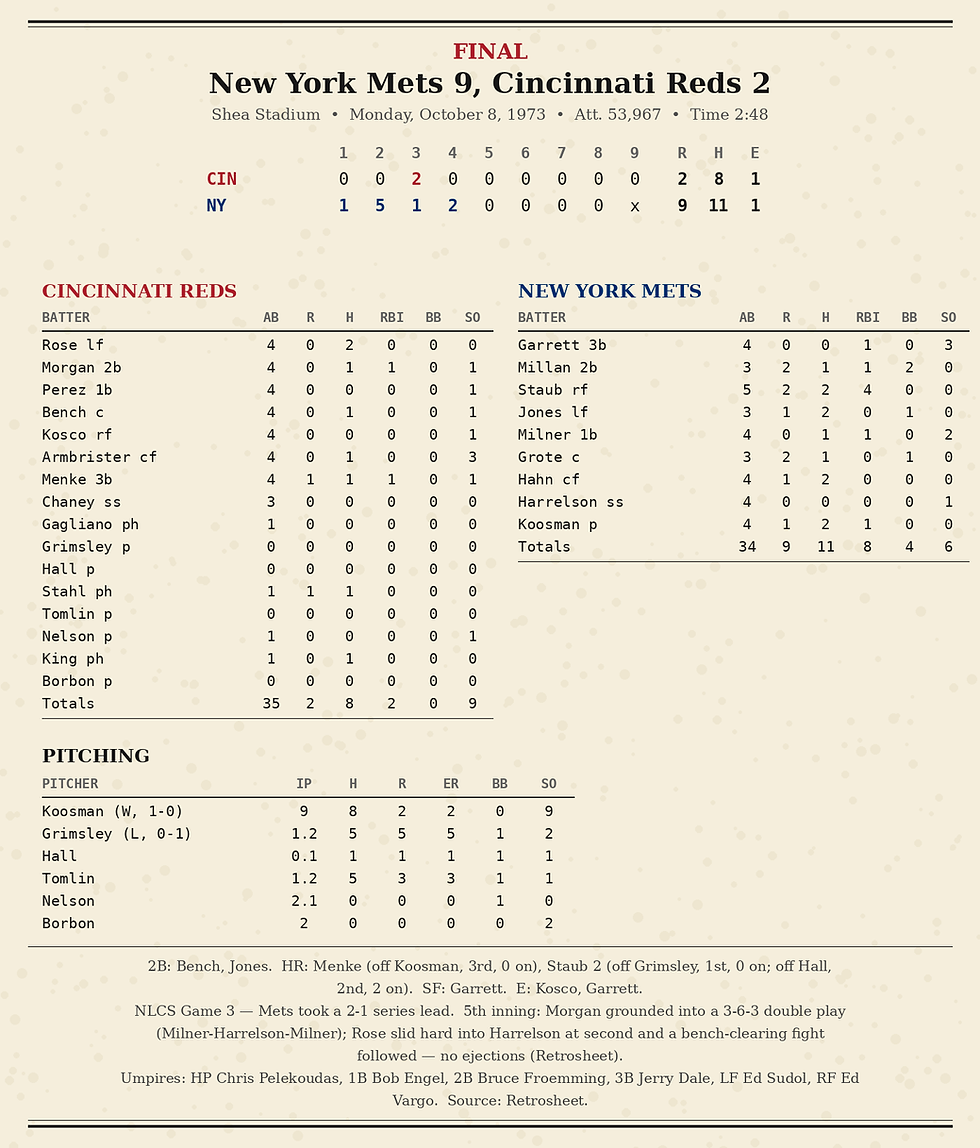
FLUSHING, N.Y. — Game 3 of the 1973 National League Championship Series was a 9-2 Mets rout that nobody remembers for the score. They remember the fifth inning. But the rout came first, and Rusty Staub built it. With two out in the first, Staub homered off Ross Grimsley. In the second, the Mets sent nine men up and scored five times: Jerry Grote walked, Don Hahn singled, Wayne Garrett's sacrifice fly brought in one, Felix Millán singled in another, Grimsley was gone — and Staub greeted Tom Hall with a three-run homer, his second of the afternoon and third of the series. It was 6-0 before the Reds had batted three times, and Jerry Koosman was cruising toward a complete game — nine innings, eight hits, nine strikeouts, and not a single walk.
Cincinnati's only answer came in the third: Denis Menke led off with a home run, pinch-hitter Larry Stahl singled, Pete Rose singled him to second, and Joe Morgan singled Stahl home. 6-2. The Mets stretched it in the third on Koosman's own RBI single, and in the fourth when Cleon Jones doubled and Felix Millán scored on Andy Kosco's error in right — an error, not an RBI double, whatever the legend says — before John Milner singled Jones home. 9-2. The ballgame was, for all practical purposes, over. The afternoon was not.
The fuse had been lit the day before, when Bud Harrelson, celebrating Jon Matlack's two-hit shutout in Game 2, quipped that Matlack had made the Big Red Machine look like Harrelson himself hitting. Before Game 3, Morgan confronted Harrelson at the batting cage and warned him Rose had taken it personally; Staub, Morgan's old Houston teammate, talked everyone down. It didn't hold. Top of the fifth: Roger Nelson struck out, Rose singled to center, and Morgan grounded to Milner at first. Milner to Harrelson at second for the force, Harrelson back to Milner — a 3-6-3 double play to end the inning. Rose slid hard and late into Harrelson at the bag. Who escalated first is something the two men disputed for the rest of their lives; what is certain is that they ended up on the ground together, both benches and both bullpens emptied onto the infield, and — remarkably — nobody was ejected. Retrosheet's own game note says it plainly: "Pete Rose slid hard into Bud Harrelson; fight ensued but no ejections."
The bottom of the fifth was worse. Rose went back out to left field and the Shea crowd showered him with debris — programs, cups, cans — and a whiskey bottle thrown from the stands nearly hit him. Sparky Anderson pulled the Reds off the field. National League president Chub Feeney told the Mets to restore order or forfeit the game. So a peace delegation walked out to left field — manager Yogi Berra, Willie Mays, Tom Seaver, Cleon Jones and Staub — and talked 53,967 people down off the ledge. Play resumed. Koosman finished what he started, getting Phil Gagliano on a fly to center for the final out, and the Mets took a 2-1 lead in the series. Rose finished 2-for-4 with two singles — and with the loudest October afternoon New York had ever given a visiting player. Final score: Mets 9, Reds 2.
Ralph's Guest
The Reds' leadoff man and left fielder — 2-for-4 on the day, the man in the middle of the fight at second base and the storm in left field, and the beating heart of the Big Red Machine.

The Interview (imagined)
What follows is a dramatic recreation. The game was real. The conversation is our imagining of the Kiner's Korner segment that might have aired that afternoon — and given the day's events, perhaps the most remarkable booking in the show's history.
Ralph: Pete, I'll be honest — I didn't think you'd come out here after that ballgame. Your club loses nine to two, there's a fight at second base, and then the crowd nearly gets the game forfeited throwing things at you in left field. And yet here you sit. Why?
Rose: Because you asked me, Ralph, and because I don't run from a bad day. We got beat. Koosman was better than us, Staub was better than us. That's the game story. The other stuff is the stuff everybody's going to talk about, so let's talk about it.
Ralph: Then let's do the baseball first, because there was a game in there. Staub homers in the first, and then that second inning — five runs, capped by Staub's second homer, off Hall, with two on. Six to nothing. What does a dugout do with a start like that?
Rose: You tip your cap and you start over the next inning. We scratched back — Menke homers, Stahl singles, I single, Joe singles Stahl in, it's six to two, and Koosman snuffs it right out. And give Koosman his due: nine innings, no walks. You cannot beat a man who never gives you a free base. We hit into everything all day.
Ralph: Now the fifth inning, and I'll walk it carefully, because the facts matter. Nelson strikes out. You single to center — your second hit of the game. Morgan grounds to Milner, who goes to Harrelson for the force on you, and back to Milner for the three-six-three double play. You slid hard into Bud at second. The double play was completed — you didn't break it up. And then there was a fight, both benches emptied, and nobody was thrown out. Pete, what happened at that bag?
Rose: I slid hard, Ralph. I've slid hard my whole life and I'm going to slide hard tomorrow. That's how you play this game in October — you make the infielder earn the throw. Bud took exception, words were said, and it went from there. Who said what first, who grabbed who first — Bud's told it his way and I've told it mine, and I suspect we'll tell it our ways forever. What I know is nobody was trying to end anybody's career. Two ballplayers, a pennant on the line, and the temperature got too high. And I'll say this for the umpires: they let it burn out and threw nobody out. That was the right call.
Ralph: Bud had said something after Game Two — that Matlack made the Big Red Machine look like him hitting — and Joe Morgan carried a warning to Bud at the batting cage before the game — that you'd taken it personally. Was this afternoon ever really about one slide?
Rose: Ralph, it was about a pennant race compressed into one week. We're the Big Red Machine. They were picked to finish last and here they are beating us in their park. There's pride on both sides and a quote in the newspaper, and it all boils over at second base in the fifth inning of a nine-to-two game. That's not an excuse. That's just October.
Ralph: And then you had to go back out to left field for the bottom of the fifth, and forty thousand people who'd been drinking in the sun decided you were the villain. Debris coming down, a whiskey bottle landing near you. Sparky pulls the whole club off the field. Chub Feeney says the Mets forfeit if it doesn't stop. And out walks Yogi Berra, Willie Mays, Tom Seaver, Cleon Jones, Rusty Staub — walking to your outfield, Pete, to save your ballgame. What goes through a man's mind standing out there for that?
Rose: Humility, for one thing. Look, I love fans who care. I've never asked a crowd to love me — in Cincinnati they do and everywhere else they don't, and that's fine, that's the deal. But a bottle can kill a man, and nobody wants that on their conscience. And those five men walking out there — Willie Mays, Ralph. When Willie Mays asks a crowd to settle down, the crowd settles down. I owe those men a thank-you, and their ballclub too, because a forfeit helps nobody. We came back out and finished the game like professionals, all of us.
Ralph: You finished two for four, two singles, and you flew to center your last time up in the seventh. Tomorrow is Game Four, and this series is two games to one. Last word, Pete — does an afternoon like this change anything about how you play tomorrow?
Rose: It changes nothing, Ralph. I'll lead off, I'll run hard, I'll slide hard. If Buddy's standing at second base I'm coming in the same way — and if he turns the double play, I'll tip my cap and run harder next time. That's the only way I know. See you at the ballpark.
Ralph: Pete Rose, folks — two hits, one fight, and an afternoon nobody at Shea will ever forget. Thank you, Pete.
Rose: Thank you, Ralph.
Recreation of the lost Kiner's Korner interview — not an authentic broadcast still. Box score and play-by-play: Retrosheet (game B10080NYN1973), cross-checked against The Baseball Cube. Fight and crowd-incident accounts: SABR Games Project and the 1973 NLCS record; the question of who escalated the fight first is disputed by the principals and is presented that way above. The audio companion to this article — the Flag of Victory Polka, the disclaimer, and the full imagined interview — is available with this post.


Comments