
Pete Alonso’s Hall of Fame Case Exists Mostly in Pete Alonso’s Head


There are baseball players who think they’re legends.
There are baseball players who act like legends.
And then there are baseball players who apparently believe Cooperstown is just waiting for them to pull into the parking lot while the valet shines the bronze plaque.
Which brings us to Pete Alonso.
According to a recently surfaced report about his negotiations with Mets president of baseball operations David Stearns during the 2025 offseason, Alonso allegedly said:
“When my career is being evaluated for the Hall of Fame years from now, you’ll still be fiddling with your fucking formulas.”
Now listen.
I loved Pete Alonso the player.
I appreciated Pete Alonso the person. Every time I ever approached him for an interview, he was gracious, accommodating, and professional with me. One of my favorite baseball photos ever is me standing on the field with Pete after the Mets beat the Phillies. That picture means something to me.

But sometimes you have to separate affection from reality.
And reality here is this:
Pete Alonso once again revealed something Mets fans keep trying desperately not to see.
This isn’t about loyalty.
This isn’t about Queens toughness.
This isn’t about blue collar grit.
This is about ego.
The same ego I called out when Pete posted what I referred to at the time as his “Polar Bear S@#T” goodbye Instagram letter. The same me-first tone wrapped in Hallmark-card sincerity. The same “look at me” energy disguised as emotional connection.
And now we have this.
Hall of Fame?
Cooperstown?
Pete… buddy… unless you’re buying a ticket and standing in line behind a guy wearing a Dale Murphy jersey and eating a twelve-dollar hot dog, you’re probably not getting in.

Mets Hall of Fame? Absolutely possible.
National Baseball Hall of Fame?
Not even remotely close.
And this is where the numbers — yes, those scary “formulas” — become important.
Because baseball history is filled with players who hit home runs, made All-Star teams, and became beloved local heroes. The Hall of Fame is supposed to separate greatness from popularity.
Pete’s current Hall of Fame profile looks less like Willie McCovey and more like a very nice section of the team yearbook.
Here are Pete Alonso’s Hall of Fame metrics:
Black Ink: 12
Gray Ink: 75
Hall of Fame Monitor: 65
Hall of Fame Standards: 17
JAWS: 24.1
For context, the average Hall of Fame first baseman scores:
Black Ink: 27
Gray Ink: 144
Hall of Fame Standards: 50
JAWS: 53.5
Translation?
Pete isn’t “a little short.”
Pete is standing at Exit 43 on the Long Island Expressway while Cooperstown is somewhere north of Albany.
So let’s explain these numbers in English instead of Baseball Nerd speak.
Black Ink measures how often a player led the league in important categories. Back in the newspaper days, league leaders appeared in bold black type — thus “Black Ink.”
Home runs. RBIs. Batting average. Slugging.
Hall of Famers dominate eras. Pete’s score of 12 is less than half the average Hall of Fame first baseman. That means despite all the home runs and all the noise, Pete really hasn’t spent much time being the best player in baseball at anything consistently enough.
Gray Ink is similar, except instead of leading the league, it measures how often you merely finish in the Top 10.
Pete’s 75 sounds decent until you realize the average Hall of Famer is almost DOUBLE that at 144.
Again: very good player. Not historic player.
Hall of Fame Standards is basically a career résumé score. Think of it as the baseball version of a credit report.
Did you pile up enough hits?
Enough RBIs?
Enough homers?
Enough on-base percentage?
Enough longevity?
The average Hall of Famer scores around 50.
Pete Alonso?
17.
Seventeen.
That’s not “future Hall of Famer.”
That’s “guy Mets fans remember fondly while arguing at a diner at 2 AM in Wantagh.”
Then there’s the wonderfully named Hall of Fame Monitor, which attempts to measure how likely a player is to actually get elected based on awards, milestones, postseason visibility, All-Star appearances and statistical accomplishments.
A score of 100 suggests a strong Hall of Fame possibility.
130 means basically automatic.
Pete sits at 65.
That’s not Cooperstown territory.
That’s “Hall of Very Good.”
Maybe even “Hall of Hit Some Huge Homers and Made Citi Field Shake.”
And finally there’s JAWS, which sounds like a movie where a shark learns WAR calculations.
JAWS compares a player directly to existing Hall of Famers at his position using career WAR and peak WAR.
Pete Alonso’s JAWS score: 24.1.
Average Hall of Fame first baseman: 53.5.
That’s not a small gap. That’s the Grand Canyon wearing a Rawlings glove.
And if Mets fans still think I’m being too harsh here, let’s put Pete Alonso’s Hall of Fame profile next to some former Mets first basemen.

Not Keith Hernandez, because Keith’s defense, MVP award, batting titles, and overall résumé exist on a completely different planet.
I’m talking about Mets first basemen fans loved… but never seriously confused with Cooperstown immortality.
Take Lucas Duda.

Big power.
Beloved by fans.
Could hit a baseball approximately halfway to Yonkers.
Career WAR: 17.0.
Pete Alonso currently sits at 24.2.
Better? Absolutely.
Hall of Fame better?
Not remotely.
Then there’s Carlos Delgado.

Now Delgado was actually a far more serious Hall candidate than Pete currently is.
Delgado finished with:
473 home runs
1,512 RBIs
A .546 slugging percentage
44.4 career WAR
And even Delgado barely survived one Hall of Fame ballot before disappearing faster than a Shea Stadium upper deck beach ball during a September rainstorm.
Or take John Olerud.

One of the sweetest swings Mets fans ever saw. Batting champion. Elite defender. Career .398 on-base percentage. Quietly excellent for years.
Career WAR: 58.0.
Still not in Cooperstown.
Think about that for a second.
John Olerud — who absolutely dwarfs Pete Alonso in overall value — still isn’t in the Hall of Fame.
Even Donn Clendenon, forever immortalized in Mets history for helping win the 1969 World Series and capturing World Series MVP honors, isn’t remotely considered a Hall of Famer.
Because Mets legend and Hall of Fame legend are two entirely different zip codes.
And here’s where this gets even more awkward for the “future Hall of Famer” narrative.
Pete’s numbers don’t really compare to Hall of Fame first basemen.
They compare far more closely to players like Ryan Howard, Prince Fielder, Mo Vaughn, and Chris Davis.
Big power.
Big personalities.
Big moments.
Not Hall of Famers.
Take Ryan Howard.

Howard won an MVP award. He was Rookie of the Year. He led the league in home runs twice and RBIs three times. He won a World Series. At his peak, he looked like somebody had built a left-handed slugger in a laboratory underneath Citizens Bank Park. He received 2.0% of the vote (8 votes) in his only year on the Baseball Writers' Association of America (BBWAA) Hall of Fame ballot in 2022, falling short of the 5% threshold required to remain on the ballot. As a result, he was removed from future BBWAA consideration
Mo Vaughn actually won an MVP award too. Mo Vaughn became eligible for the National Baseball Hall of Fame in 2009 but was dropped from the ballot after receiving only six votes (1.1%) from the Baseball Writers' Association of America (BBWAA).

Prince Fielder finished with 319 home runs and six All-Star appearances. Prince Fielder appeared on the 2022 Baseball Hall of Fame ballot but did not receive enough votes to remain eligible, falling off the ballot in his first year of eligibility. He received 2 votes out of 394 ballots cast (0.5%)

And perhaps the most devastating comparison of all:
Even Don Mattingly — an MVP, batting champion, Yankees captain, nine-time Gold Glover, and one of the most beloved players of his generation — still can’t get into Cooperstown.

If Don Mattingly can’t get through the door, Pete Alonso probably shouldn’t be measuring for plaque space yet.
And here’s the uncomfortable truth Pete doesn't want to hear:
Pete’s best years are probably behind him.
Power hitters who provide limited defensive value and little speed generally do not age gracefully. They age like milk left in a car trunk during a July doubleheader.
That doesn’t erase what Pete meant to Mets fans.
He’s one of the great homegrown sluggers in franchise history. He gave us unforgettable moments. He made Citi Field explode. He embraced the spotlight. He mattered.
But there’s a massive difference between beloved and immortal.
And honestly? The most revealing part of this entire story may not even be the arrogance of the comment itself.
It’s the contempt for the numbers.
The irony here is almost beautiful.
Pete mocked “formulas” while discussing the Hall of Fame… even though the Hall of Fame itself is built almost entirely on formulas. Statistics. Historical comparisons. Career value. Peak dominance. Longevity.
Nobody gets a bronze plaque because they hit tape-measure home runs and growled into microphones during the Home Run Derby.
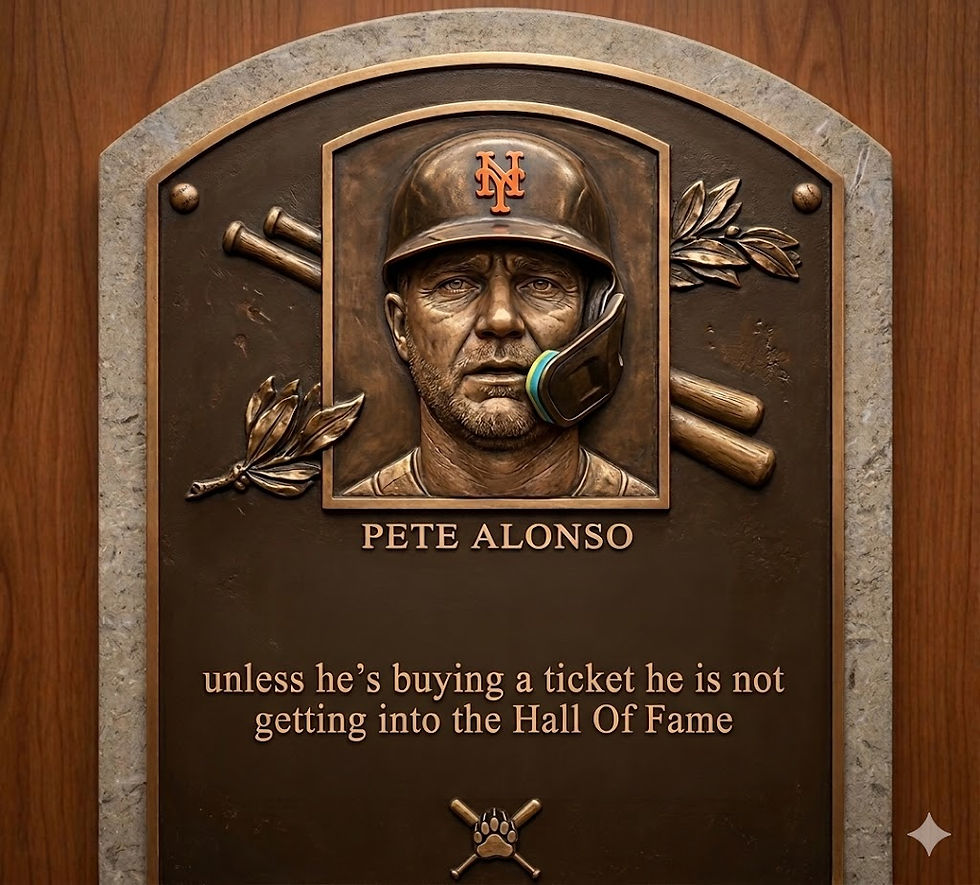
You earn Cooperstown.
And right now, Pete Alonso isn’t remotely close to earning it.


The figures that Alonso refers to, and that Stearns probably used in negotiating with him, are very likely similar to the figures I worked up about how poorly Pete's most comparable players performed in their mid-30s. My three articles are on Authory--this is the first one: https://authory.com/StevenGoldleaf/a/a7b7f7de76447491baf45cc62b7b0dd41?c=c2b732fa64aa54b95a93fc3752ffaf7b6