
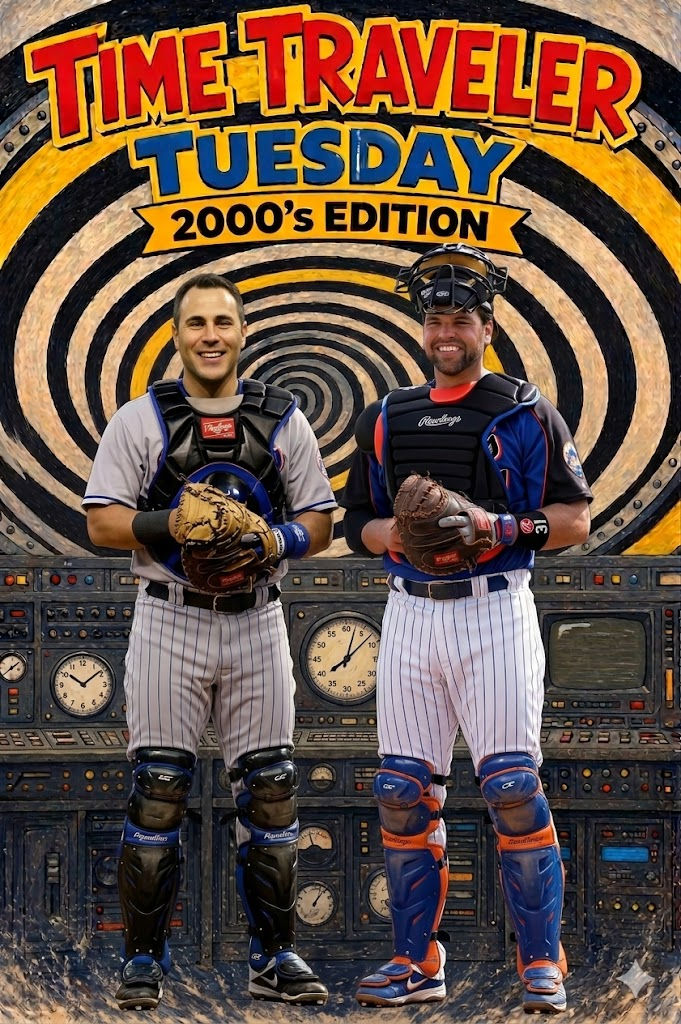
Time Traveler Tuesdays :Piazza and Lo Duca: Two Catching Stories From the 2000s Mets
The Mets’ catching story in the 2000s begins with Mike Piazza, the face of the position and one of the defining hitters in franchise history. By the time the decade opened, Piazza was already the centerpiece of the Mets’ lineup, but the 2000 season turned that status into something larger. He was not merely a productive catcher. He was the emotional and offensive anchor of a pennant-winning team.
In 2000, Piazza gave the Mets one of the great offensive seasons in club history. He hit .324 with 38 home runs and 113 RBI, carrying a lineup that reached the World Series for the first time since 1986. His swing was the constant threat in the middle of the order, the thing opposing pitchers had to work around, and Mets fans waited for. On a team remembered for big postseason moments, Piazza’s regular-season dominance was the foundation.
The next two seasons continued that run. Piazza hit 36 home runs in 2001 and 33 more in 2002, giving the Mets three straight years of elite power from behind the plate. His production made the catcher spot feel different at Shea Stadium. It was not a place where the Mets were simply hoping for defense, game-calling, and the occasional big hit. With Piazza, catcher was a star position.
As the decade moved forward, Piazza’s role began to change. Injuries limited him in 2003, and by 2004 and 2005, the wear of catching had started to show. He still had power, still had presence, and still gave the Mets dangerous at-bats, but the years of carrying the offense night after night were fading. His final Mets season in 2005 felt like the closing of an era. He hit 19 home runs, received a long farewell from the Shea crowd, and left as one of the most beloved players the franchise had ever had.
Piazza’s Mets story was about more than numbers. It was about identity. He arrived in the late 1990s and helped turn the Mets into a serious contender. In the early 2000s, he remained the player most associated with their biggest stage, their loudest moments, and their belief that they could stand with anyone in the National League. For Mets fans, Piazza was not just the catcher. He was the star around whom the entire period revolved.
After Piazza’s departure, Paul Lo Duca became part of a new Mets chapter. He arrived before the 2006 season, joining a roster that had been built to win immediately. The team had stars throughout the lineup, a new sense of energy, and real expectations. Lo Duca stepped into that environment as a veteran catcher with a different kind of job: guide the staff, keep the lineup moving, and bring steadiness to a team trying to turn talent into a division title.
Lo Duca’s first season in Queens fit the moment. In 2006, he hit .318, made consistent contact, and gave the Mets a reliable presence near the top of the order. He was not a classic power hitter, finishing with five home runs, but that was not the point of his game. He was at his best putting the ball in play, taking competitive at-bats, and helping create traffic for the bigger bats behind him.
That 2006 Mets team won 97 games and captured the National League East. Lo Duca became one of the recognizable personalities of that club: intense, emotional, fiery, and fully engaged in the rhythm of the season. He caught the pitching staff, handled the daily grind, and played with the edge that matched the mood of a team trying to push deep into October.
His postseason was part of that larger ride. The Mets swept the Dodgers in the Division Series, then played a tense seven-game National League Championship Series against the Cardinals. Lo Duca was right in the middle of that run, part of a team that came painfully close to the World Series. The 2006 season remains one of the great “almost” years in Mets history, and Lo Duca’s presence is tied closely to its personality.
The following year was more difficult. In 2007, Lo Duca’s production fell, and the Mets’ season ended with one of the most painful collapses in franchise history. His batting average dropped to .272, and the offense he provided in 2006 was harder to sustain. But his two seasons with the Mets still belong to a specific and memorable period: the brief, intense window when the club looked built to win the National League.
Lo Duca’s Mets story was not about a long tenure. It was about timing. He was the catcher for one of the most talented Mets teams of the 2000s, a veteran voice on a roster full of big names and big expectations. His best season in New York came at exactly the right time, helping give the 2006 Mets the shape and toughness of a contender.
Together, Piazza and Lo Duca represent two distinct catching chapters from the decade. Piazza’s story was the story of a franchise icon finishing his Mets prime and saying goodbye to Shea Stadium. Lo Duca’s story was the story of a veteran catcher arriving for a short, heated run with a team built to win right away. One chapter carried the memory of the Mets’ early-2000s identity; the other belonged to the urgency and heartbreak of 2006 and 2007.


Comments