
Saturday Seasons: 2001, A Chase Odyssey


For the fourth time in franchise history, the Mets entered the 2001 season as a defending champion (1970 and 1987 at defending World Champions, 1974 and 2001 as defending National League Champions).
A sluggish start put the Mets season in an early hole but they battled back and nearly made a miraculous run to what would’ve been a third consecutive post season berth.
The Mets opened the season on April 3rd, with a ten inning, 6-4 win over the Braves in Atlanta. Robin Ventura hit two home runs. His first one off of Mets villain John Rocker gave the Mets a 4-2 lead in the eighth.
Ventura's second home run of the game, a two-run shot in the tenth, provided the winning margin.
With the proverbial “bullseye” on their back, the Mets were 2-4 when they opened the home season at Shea on April 9th against the Braves.
With the pageantry of the NL Championship banner being raised, the Mets scored a 9-4 win. Newly acquired Kevin Appier pitched seven strong innings to earn his first win in a Mets uniform. Mike Piazza, who was off to a fast start, slammed two home runs giving him four on the young season while Japanese import Tsuyoshi Shinjo hit his first Mets home run.
The Mets got off to a sluggish start as they finished April with a 10-15 record. The month of May would be more of the same.
On May 2nd, the Mets dropped a 10-inning, 6-5 decision to the Houston Astros at Shea. In the 10th, closer Armando Benitez gave up back-to-back solo home runs to Lance Berkman and Moises Alou. The Mets loaded the bases with nobody out against future Met and Astros closer Billy Wagner, but could only plate one run as they fell to 11-16.
A week later, the Mets were in Colorado where they were shutout by former Met Mike Hampton, who signed with the Rockies as a free agent.
(Note: The Mets received a compensatory pick in the 2001 draft for Hampton signing with Colorado. On June 5th, the Mets used the 38th pick to select third-baseman David Wright from Hickory High School in Chesapeake, Virginia)
The Mets were 12-17 in May and after two months, they were 22-32, 13 games behind the first place Philadelphia Phillies.
Things seemed to be turning around in June as the Mets won 7 of 11 to start the month but they dropped the first two games of the rematch of the 2000 World Series and first installment of the Subway Series at Shea and appeared to be on the verge of being swept in the finale on June 17th.
The Mets trailed the Yankees 7-2 but staged a big time rally as they scored six runs in the bottom of the eighth to pull out an 8-7 win. Mike Piazza's two run bomb off of Carlos Almanzar capped off the rally.
That win led to a four game winning streak but the Mets couldn’t sustain their success and dropped six in a row as their record fell to 33-45.
After losing two of three to the Yankees in the Bronx in early July, the Mets limped into the All Star break at 38-51, 13 games out of first place.
The Mets finally got going as they won six of seven after the All Star break, capped off by an 11-inning, 4-3 win over Florida on Shinjo’s walk off, RBI double in the 11th.
On July 27th, the Mets traded pitchers Turk Wendell and Dennis Cook to the Phillies for pitcher Bruce Chen and minor leaguer Adam Walker who never appears in a game. The next day, Wendell gave up a walk off home run to Robin Ventura leading off the ninth as the Mets beat the Phillies, 4-3.
The Mets made it back-to-back walk off wins the next day when Mike Piazza homered off Rheal Cormier in the bottom of the ninth for a 6-5 victory.
The Mets went 14-11 in July (the first month they finished over .500) and were 49-58, 11.5 GB first place Atlanta, 11.5 behind WC leader Arizona.
In mid-August, the Mets went on a seven game losing streak that remarkably preceded their best stretch of the season.
On August 17th, the Mets were in Los Angeles when they lost 8-3 to the Dodgers for their seventh consecutive defeat. When the smoke cleared, the Mets were 54-68, 13.5 out of first, but little did they know what was to come.
The next day, the Mets beat the Dodgers, 5-4 to snap their losing skid. Over the next 40 days, the Mets were on an arc (unlike Noah) where they would win 25 of their next 31 games.
On the final day of August, the Mets beat the Marlins at Shea, 6-1. Al Leiter not only tossed eight strong innings to even his record at 10-10, he slammed the only triple of his big league career (FYI: I was the official scorer for that game). With one month remaining, the Mets had climbed to 64-71 and in just over two weeks, they had picked up five games in the standings and were 8.5 out of first place.
Things were looking up as the Mets won 15 of their first 18 games in September to pull within three games of the first place Braves with a three game series on tap.
Before that however, the baseball world and the entire world was shocked by what took place in lower Manhattan on September 11th. The world changed after a terrorist attack destroyed both towers of the World Trade Center and killed nearly 3000 people.
The Mets were in Pittsburgh when the schedule was called off. No one knew when or if the schedule would resume but the Mets were very active in relief efforts. Shea Stadium was used as a staging center and players helped load boxes with supplies for first responders and rescue workers, among the many things they did to ease the pain for New Yorkers.
The schedule resumed on September 17th. The Mets were originally scheduled to play the Pirates at Shea on that date, but since it was being used in a rescue effort, Major League Baseball decided to play that first series in Pittsburgh. The subsequent series against the Pirates would be moved to Shea to begin the month of October as the games that were postponed after 9/11 would be played at the end of the season.
The Mets continued their September surge as they swept the three game series at PNC Park and then it was time to come home and play the first game in New York since the attacks occurred.
On Friday, September 21st, the Mets hosted the Atlanta Braves in what was a surreal atmosphere at Shea Stadium. Fans went to the ballpark in a bit of a daze. What kind of reaction would there be? Would there be cheers or even silence?
Before the game, the teams lined up along their respective baselines for a solemn ceremony that brought forth tears from the players and the over 41,000 fans on hand. NYPD bagpipers played “Amazing Grace,” while Diana Ross and Marc Anthony sang “God Bless America” and the “National Anthem,” respectively.

After the ceremony, the Mets, who wore first responder hats, shook hands and exchanged hugs with their hated rivals as a sign of unity for the country.
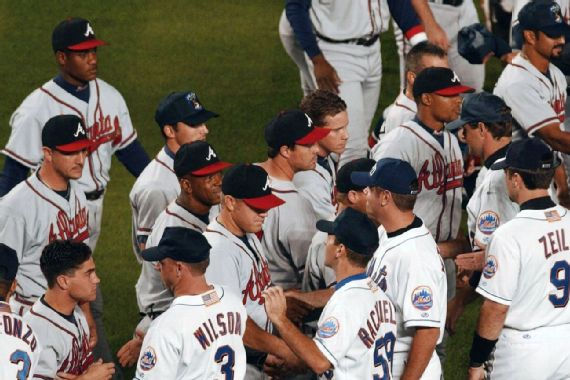
Throughout the game, chants of “U-S-A, U-S-A” broke out from the stands as the teams went scoreless for the first three innings.
The Braves took a 1-0 lead in the top of the fourth but after the Mets tied the game on a sacrifice fly by Tsuyoshi Shinjo, fans had their first opportunity to offer some cheers.
During the 7th inning stretch, Liza Minelli gave a rousing performance of “New York, New York.” As Minelli sang, members of the NYPD and NYFD kicked their legs in a makeshift chorus line while fans waved American flags and held up patriotic signs.

After Minelli was done, she walked over to Jay Payton, who was on deck waiting to hit, and gave him a hug and a kiss on the cheek.
The Braves scored a run in the top of the eighth to take a 2-1 lead, setting the stage for one of the most memorable moments in not just New York Mets history, but also New York City history.
Steve Karsay, a local kid, took the mound for the Braves and with one out, he walked Edgardo Alfonzo. Desi Relaford pinch ran for Alonzo and Mike Piazza stepped to the plate.
Piazza took the first pitch for a strike. Karsay threw the 0-1 pitch and Piazza swung and lifted a long drive that carried over the wall in left-center-field for a two run home run and a 3-2 lead. As if they had just been given permission to start cheering again, the crowd went wild and urged Piazza to come out for a curtain call.
Armando Benitez retired the side in order in the ninth and the Mets had one of the most memorable wins in franchise history.
The Mets won the next game and were on the verge of a three game sweep that would’ve pulled them to within 2.5 games of the Braves but it wasn’t meant to be.
The Mets had a 4-1 lead heading to the ninth, but Benitez could not close it out. With two out and one on, Brian Jordan slammed a two run homer to make it a 4-3 game. Benitez walked Dave Martinez on a close 3-2 pitch and then gave up a single to Andruw Jones.
On a 0-2 pitch, B.J. Surhoff lined a game tying, RBI single to send the game to extra innings. John Franco relieved Benitez to get the final out, but the damage was done.
John Smoltz was brought in and the Hall of Famer retired 9 of the final 10 Mets hitters that he faced as Atlanta dealt the Mets a crushing blow with an 11-inning, 5-4 win.
The euphoria of the first two games back at Shea was wiped away, as the Mets fell 4.5 games back with 12 to play.
The Mets swept the next three games against Montreal to keep their hopes alive heading into a three game series in Atlanta.
The Mets had to sweep to have any shot but the Braves took the first game and then dealt a second crushing blow in less than a week in the middle game of the series.
The Mets had a 5-1 lead in the ninth, but the Braves rallied for 7 runs to steal an 8-5 win that essentially ended the season.
Once again, it was Benitez who blew up.
After the Braves had cut the Mets lead to 5-4 against the Mets closer and had the tying run in scoring position with two outs, John Franco relieved Benitez and walked Wes Helms to load the bases for noted Mets killer Brian Jordan.
Franco got out in front but Jordan unloaded a 0-2 pitch for a walk off, grand slam home run that left the Mets five back with seven games left.
The Mets salvaged the finale of the series but it was too little, too late.
The Mets returned home and went 2-4 in their final six games of the season as they finished in third place in the NL East with an 82-80 mark.
Mike Piazza had a terrific season as he led the team in batting average (.300), HRS (36), RBI (94) and OPS (.957).
Kevin Appier, Al Leiter and Steve Trachsel all won 11 games while Leiter was the ERA leader (3.31).
After the season ended, the Mets reshaped their roster with a number of moves before the calendar turned to 2002.
On December 7th, the Mets traded Robin Ventura to the Yankees for outfielder David Justice and then dealt Justice a week later to the A’s for pitchers Tyler Yates and Mark Guthrie.
On December 11th, the Mets acquired All Star second-baseman Roberto Alomar in a multi-player deal with the Cleveland Indians.
In mid-December, Tsuyoshi Shinjo and Desi Relaford were dealt to the Giants for pitcher Shawn Estes.
Late in the month, Kevin Appier was sent to the Anaheim Angels in exchange for first-baseman Mo Vaughn.


Comments