
Saturday Seasons: Randoph Gets the Axe, but 2008 is deja vu all over again


The Mets began 2008 with Willie Randolph on the hot seat, but by midseason, Jerry Manuel would be warming the manager’s chair. And no matter who was at the helm, the ending would be the same as 2007: a September collapse (although not of 2007’s magnitude) leading to a win-or-go-home final game that ended with the resurgent Florida Marlins breaking Mets’ fan’s hearts.
General manager Omar Minaya had once again put together a veteran team in win-now mode. While, as expected, Tom Glavine declined his option to return to the Atlanta Braves and the Mets let catcher Paul LoDuca walk, Minaya responded in late November 2007 by trading for defensive backstopper Brian Schneider and outfielder Ryan Church, giving up former top prospect Lastings Milledge – the same Lastings Milledge the Mets declined to include in a trade two years previously that could have brought them Manny Ramirez or Barry Zito and the same Lastings Milledge who had embarrassed the Mets by appearing in a rap song by a childhood friend, Manny D., that contained offensive language.
Minaya went to the winter meetings looking for a starting pitcher to replace Glavine, with the most prominent names being Eric Bedard, Dan Haren, Joe Blanton or Rich Harden. Reports as the meetings were about to begin had the biggest name pitcher potentially on the trading block, Johann Santana, headed to the Yankees or the Boston Red Sox. The Twins kept on holding out for more from both teams, and when the Yankees and the Bosox backed off in January, Santana essentially fell into the Mets’ laps.

As Newsday’s Wallace Matthews wrote: “I must credit the Minnesota Twins, who overplayed their hand beautifully. They blew a chance to add Phil Hughes and Melky Cabrera from the Yankees or get either Jon Lester or Jacoby Ellsbury from the Red Sox. Either of those deals would have been better than Carlos Gomez and Phil Humber, but that’s what you get from being indecisive, greedy or both.”
As Newsday’s news story about the trade noted, “The Mets can’t change history, but they certainly made it easier for everyone to forget the unfortunate events of last September by agreeing yesterday on a trade for Johann Santana.”
Santana, signed to a long-term contract, produced as expected, and so did most of the hitters: Carlos Beltran would hit 27 home runs and drive in 112; David Wright, 33 and 124; Carlos Delgado, 28 and 115. Called up as a mid-season injury replacement, Daniel Murphy would force his way into the lineup and hit .313 in 49 games. Jose Reyes, who was booed at the end of 2007, would end the year with a .297 average and 56 stolen bases, although the reawakening seemed to come in the second half of the season.
The biggest culprit over the course of the year was the bullpen, which blew an amazing 15 leads after the eighth inning. Part of it was the quality of the pen, obviously, but another excuse could be overwork: Duaner Sanchez, back from his 2006 taxicab mishap, appeared in 66 games; Scott Schoeneweis, 73, Aaron Heilman, 78, the immortal Joe Smith, 82, and everyday Pedro Feliciano, an incredible 86. It was probably January before he was able to lift a toothbrush to his mouth without a cortisone shot.
Closer Billy Wagner, while notching 27 saves, also had his share of blown ones, including three in five days just before Randolph’s dismissal.
Injuries, too, took their toll. Moises Alou again spent more time in the DL than in the dugout, appearing in 15 games. Ryan Church, the presumptive first-string right fielder, only made it into 90 games while being shelved with both a concussion and post-concussion syndrome after a May 20 collision with Braves shortstop Yunel Escobar’s knee while trying to break up a game-ending double play. Others, too, spent time on the DL, not an unexpected outcome for a team that was the oldest in baseball.
Nevertheless, the overwhelming sentiment coming from the executive offices was that the manager, Randolph, was failing to get the most out of what had been expected to be a contending team. As the team hovered around the .500 mark in mid-May, reports began appearing in the local sports sections that Randolph had lost control of the clubhouse. As Bob Klapisch reported in the Bergen Record in mid-May: “Twice Billy Wagner has called out his teammates; first, Oliver Perez for mailing in a 1 1/3 inning performance against the Pirates, and again on Thursday, when he accused ‘certain players’ of hiding from the tough postgame questions…Wagner’s outbursts are symptoms of a team in distress and a manager who’s lost his touch.”
Management called Randolph in for a meeting with Minaya and chief operating office Jeff Wilpon that the Mets tried to portray as a “pep talk,” but the media characterized as an indication of Randolph’s lack of job security.
And then, another story appeared on May 19, also in the Record, in which columnist Ian O’Connor tried to portray Randolph in a favorable light, but in which Randolph further angered management by contending that SNY intentionally used its camerawork to show him in a bad light and saying racism could be at the root of criticisms of his managerial demeanor as too calm. “I’m as animated and as demonstrative and as involved and as intense as any manager in baseball,” Randolph told O’Connor, wondering why the type of calm admired in Yankees manager Joe Torre was a knock on him. “Is it racial?” Randolph was quoted in the story as saying. “Huh? It smells a little bit.”

It took Randolph three days to apologize to management, in a handwritten note because the Wilpons refused to take his calls. Randolph finally met with the Wilpons and Minaya on May 26, after which the Mets went into a slump lowlighted by a four-game sweep by the San Diego Padres and Wagner’s blown saves. With news reports swirling about Randolph’s imminent demise, Minaya told Randolph on June 15 that he was going to make a final decision the next day on whether Randolph would get the axe or finish out the season. The Mets flew to California to play the Angels in a night game that they won, after which they returned to their hotel and –as the newspapers back on eastern time noted – Minaya fired Randolph in the middle of the night. Why, the papers wondered, did he make Randolph and also-fired coaches Rick Peterson and Tom Nieto fly to the west coast just so they could be fired? Any why did Minaya wait until the team got back to the hotel? (He said it was because he didn’t want to fire anyone in uniform.)
The best two comments came from Peterson, the pitching coach Randolph inherited from the Art Howe regime, and Randolph’s successor, interim manager Jerry Manuel.
Peterson: [The Wilpons] welcomed me into their home and the home is going through renovation. I grew up in the baseball business, and I’m the hardwood floor that’s getting ripped out and they’re going to bring in the Tuscan tile.”
Manuel: “At the end of the year, when Omar comes through looking for me, he says he won’t fire nobody in uniform, I’m going to stay in mine, take it right to the house.”

The Mets did experience a significant dead coach bounce after Manuel took over. Their record was 34-35 when Randolph got the axe; they went 55-38 after that and were in first place with a 3 ½ game lead on September 10. But they went 7-10 after that while both the Phillies and the Brewers got hot, creating a déjà vu moment: a final game against the Marlins which they had to win to secure a wild card spot.
One day after Santana seemed to have saved the Mets’ season by pitching a three-hit shutout on three days’ rest, and after Perez kept the Mets in a scoreless tie into the sixth inning, also on short rest, the bullpen again proved to be the Met’s downfall. Schoeneweis and Luis Ayala surrendered back-to-back homers to pinch hitter Wes Helms and Dan Uggla and the Mets were toast, losing 4-2.
Should Manuel have called on starter Mike Pelfrey to relieve instead, or brought in Pedro Martinez, whom Manuel was saving to start the one-game playoff the next day? Manuel defended his pitching choices, but the debate raged all through the offseason.

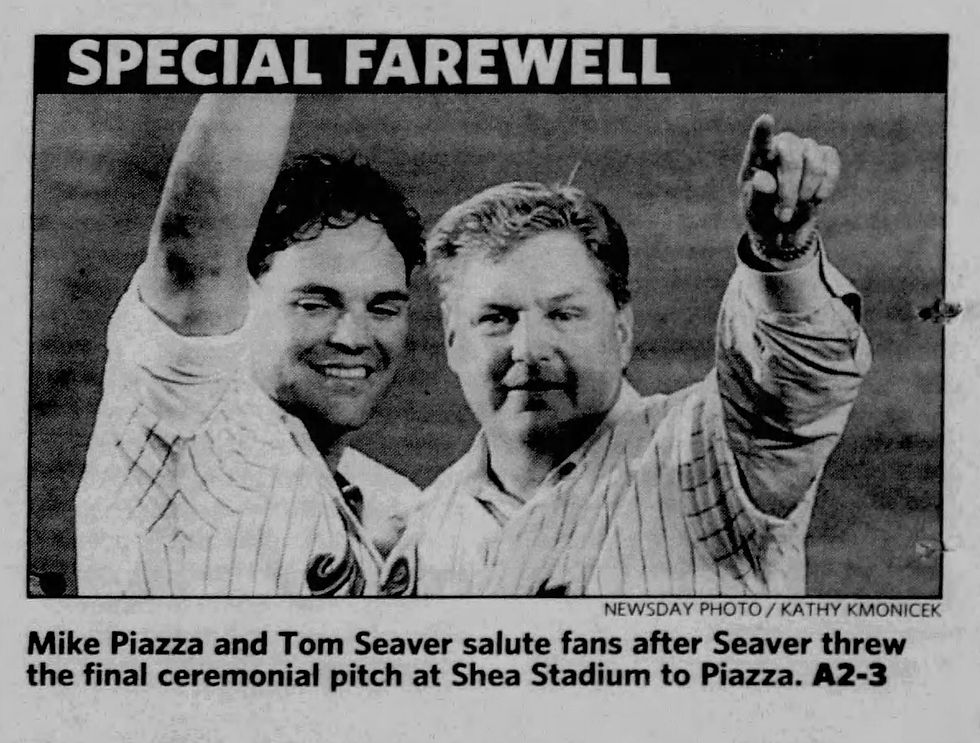
Not only was it the final game of the year for the Mets, it was the final game at Shea Stadium. As Newsday’s David Lennon noted, “Maybe what the Mets need is a change of scenery. They can only hope for better luck at Citi Field.”


Comments