
Saturday Sounds: Lenny Dykstra — Reservations for Life

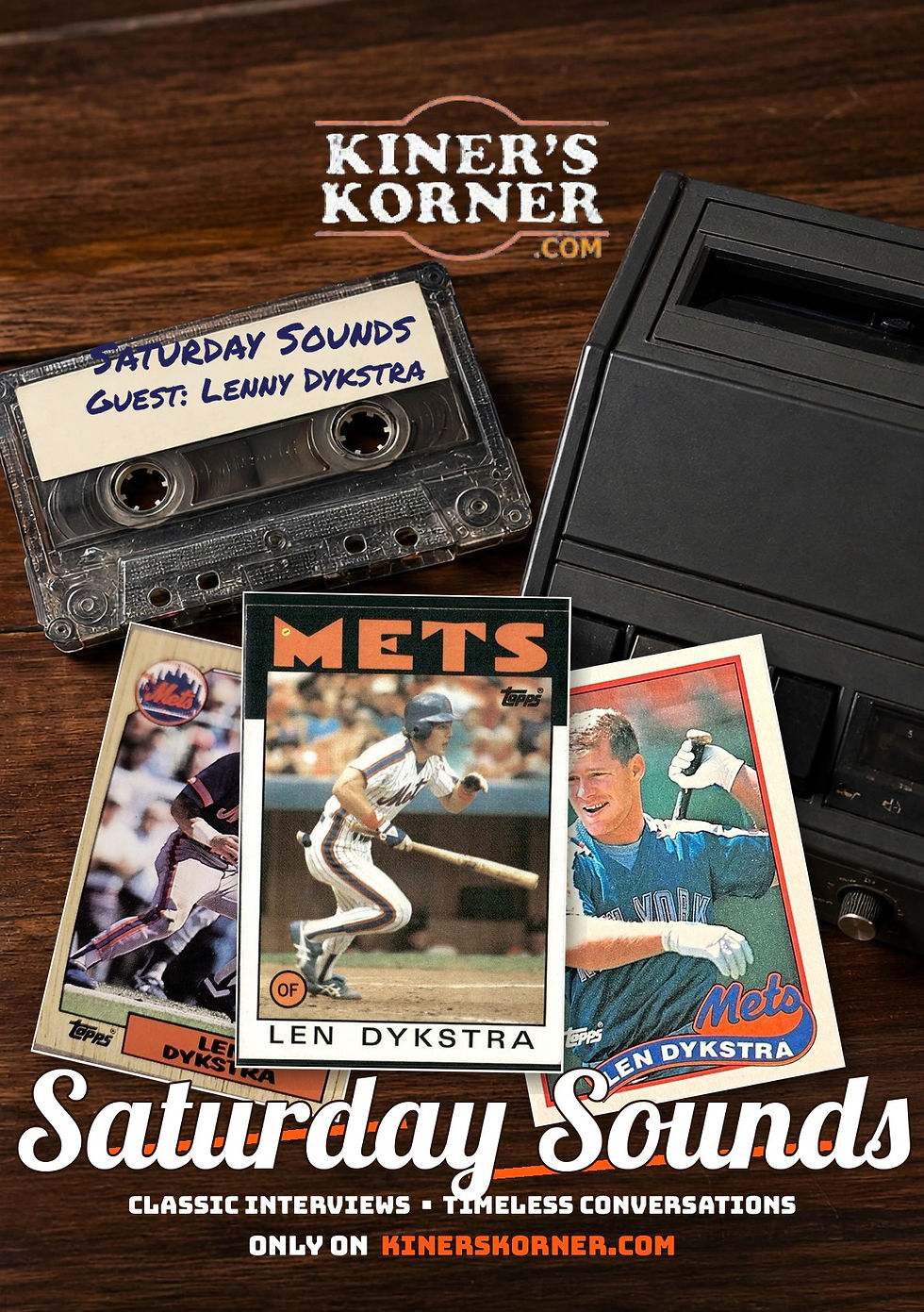
The first two stops in this vault were 1969 — Ron Swoboda, then Cleon Jones. This week we change decades, because the other team that lives in every Mets fan's heart has a leadoff hitter, and his name is Lenny Dykstra. This conversation is from April 2018, one of Lenny's many visits to the show, and it's the full Nails experience: the '86 stories you've heard, a couple you haven't, and a detour or two that only Lenny Dykstra could take you on.
A quick word on what you're hearing: we've given the interview a new Saturday Sounds introduction and retired the old show open, but the conversation itself is exactly as it aired in April 2018.
Start with the introduction I gave him that night, because I meant every word: the man who got every ounce of talent out of his 5-foot-10, 160-pound body over a 12-year major league career. A 13th-round draft pick in 1981 — the 315th player taken — who simply refused to be outworked. By 1986 he was the Mets' leadoff man and center fielder, hitting .295 with 31 stolen bases, and the toughest out on a team full of them. Number four in your program, number one in your hearts. That was the introduction. He loved it. He always did.

Dykstra's 1986 Topps card — the season of the walk-off.
The first caller, Paul, goes straight to the moment: October 11, 1986, Game 3 of the NLCS at Shea. The Mets, who trailed Houston 4–0 early, are down 5–4 in the bottom of the ninth, and Dave Smith is trying to close it out. Lenny's memory of the pitch never changes: a hanging forkball, "like a BP fastball." All he was trying to do was tie the game. Instead he hit the first walk-off home run in Mets postseason history, and as he puts it on this tape, that swing "turned into basically getting me reservations anywhere in New York City for life." Thirty-two years later, people were still stopping him to talk about it. They still are.
Then Lenny tells you the hit he ranks even bigger — and it isn't a home run. Game 6, the Astrodome, ninth inning: Bob Knepper has a one-hitter going, the Mets are three outs from facing Mike Scott in a Game 7, and Scott, in Lenny's telling, was throwing "90 mile an hour scuff balls" that nobody was going to hit. Davey Johnson had told him Knepper wasn't holding him close. Lenny led off the ninth with a triple, scored the tying run, and the Mets won the pennant in 16 innings — and never had to see Scott again. "That's quite exciting," he says, in the understatement of the interview.
The story that might stay with you longest has nothing to do with the Mets. Lenny grew up in California riding his bike to Anaheim Stadium, where his hero, Rod Carew, put his cap in his back pocket — so young Lenny put his cap in his back pocket. One day he tried to sneak down into the dugout to meet Carew, got himself caught by the stadium police, and got sent home in disgrace. Then the phone rang. It was Rod Carew. "That's what made me always take the time for the fans," Lenny says, "because the fans are everything." The kid who wore his cap like Carew became the player who signed until the last kid in line went home.
About halfway through, I play him a piece of tape I dug out of my own archives — and suddenly this episode has a vault inside the vault. It's 1986, the night the Mets clinched the Eastern Division, and Tim McCarver is interviewing a young Lenny Dykstra, with Ralph Kiner himself up in the booth to take it back. The kid on the tape is polite, composed, crediting Davey Johnson and Wally Backman and Mookie Wilson. Lenny, listening to himself 32 years later, can only laugh: "Sounds like two different people."
The 1986 of it all keeps coming. He tells the Keith Hernandez story — a game in Montreal where Lenny ran on contact, got hung out to dry coming back to the bag, and got back to the dugout to find Keith grabbing him by the shirt and lifting him up: "That will never happen again." That's how the captain taught. And his summary of that whole club is the best one I've heard: "There was always a different hero... all the way from the one hitter to the nine hitter." A week later at Fenway he led off Game 3 of the World Series with a home run off Oil Can Boyd, and the comeback was on. But it's the team he keeps coming back to.
The 2018 Mets talk is its own time capsule now. Lenny defends Sandy Alderson's hire of Mickey Callaway — a first-time manager, yes, but one who'd sat next to Terry Francona in Cleveland and learned how to win. And then A.J. asks about Matt Harvey, mopping up in the ninth inning of a 14–2 game that very night. Lenny doesn't hesitate: "Matt Harvey will not finish this season in New York." Eight days after this show aired, Harvey was traded to Cincinnati. Say what you want about Lenny Dykstra — the man could read a clubhouse.
There's more, because there's always more with Lenny: a Fantasy Camp caller who got married in 1986 and is still married, which earns him the ultimate Dykstra compliment — "You are my idol... you're only supposed to get married once." And if you want still more Lenny after this, he's Howard Johnson's guest on the 1986 Time Machine (Episode 13) over on our YouTube channel — HoJo and Nails, two of the young guns of '86, talking shop.
Press play — and when you're done, come tell us your Lenny Dykstra memories over in Talkin' Mets on the Korner. More from the vault next Saturday.
Listen here:


Comments