
Sunday School: Forgotten Faces of Flushing #71 : The Most Magical Place in Shea Stadium


Last week in Forgotten Faces of Flushing, we talked about Derek Bell, a man who once famously said baseball “is a business” and somehow managed to make Mets fans simultaneously laugh, groan, and reach for antacids.
This week’s Forgotten Face isn’t a face at all.
It’s a place.
And for me, beginning sometime around 1968, it was sacred ground.
Long before the first pitch.
Long before I understood batting averages, earned run averages, or why my father occasionally yelled things at umpires that would have gotten me suspended from elementary school.
Before any of that… there was the escalator.
If you grew up going to Shea Stadium, you already know the one.
You handed your ticket to the usher, walked through the turnstile into that glorious concrete cathedral, and immediately — almost magically — there it was to the right of the escalator:
The scorecard vendor.
He stood there like the first priest at the Church of Mets Baseball.
Scorecards stacked neatly to his right.
A little cardboard box filled with miniature pencils on the left — red or blue, “New York Mets” stamped in gold lettering like they were tiny pieces of royal jewelry instead of instruments designed to record Ron Swoboda grounding out to second.

And the vendor always barked the same line:
“You can’t tell the players without a scorecard!”
Which, as a child, sounded less like a sales pitch and more like a terrifying warning.
Without this scorecard, I might have never known who Cleon Jones was.

Within thirty seconds of entering Shea Stadium, I already had two treasures in my hands:
A scorecard.
And a Mets pencil.
Life was perfect.
Then came the escalator ride itself.
Kids today will never understand this because modern stadiums are all craft beer bars, artisanal tacos, and twenty-seven places to charge your phone. Shea Stadium had concrete, chaos, cigarette smoke, and magic.
As the escalator carried us upward, you could already hear the low roar of batting practice somewhere beyond the walls. The fluorescent lights hummed overhead with all the warmth of a Queens subway station in July.
And then you reached the top.
To the right.
The souvenir stand.
Glorious.
Radiant.
Hypnotic.
Honestly, if Disney Imagineers had designed a stand specifically to separate children from their fathers’ wallets, it would have looked exactly like that Shea Stadium souvenir stand.
It practically glowed.
Not metaphorically.
I mean physically glowed.
I’m fairly certain NASA could’ve used those fluorescent bulbs to land Apollo 11.
My father would guide me over there before almost every game, and I treated choosing a souvenir with more seriousness than most adults put into buying a house.
Should I get the player button?
The picture pack?
The yearbook?
The facsimile autograph baseball?
The Mets pennant?
The felt banner?
The decal?
The baseball cap?
My father was an incredibly generous man.
He was also not a patient man.
This was not a combination that favored fiscal responsibility.
After approximately eleven seconds of me agonizing between a Tom Seaver button and a autographed baseall , my father would usually say something along the lines of:
“Ahhh, get both already.”

Which is how I often walked away carrying enough Mets merchandise to open a moderately successful kiosk in Roosevelt Field Mall.
And this ritual repeated itself game after game.
Season after season.
Eventually with my own kids.
Because baseball fandom is inherited. But ballpark rituals? Those become family religion.
The amazing thing looking back now is just how wonderfully bizarre some of the merchandise actually was.
I recently found one of those old souvenir catalogs, and it reads like the inventory list from a department store designed entirely by fever dream.
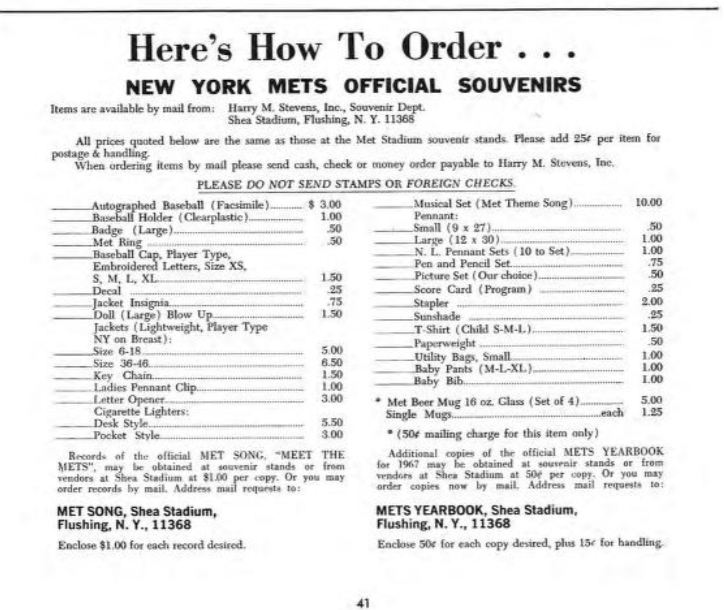
For example:
You could buy an embroidered letter jacket.
A Mets cigarette lighter.

A desk-style pocket schedule.
A ladies pennant clip.
A utility bag.
Baby bibs.
Baby pants.
Because apparently in 1969 there existed newborns already emotionally prepared for bullpen collapses.
There was even a “Musical Set (Mets Theme Song)” for ten dollars, which in 1969 was approximately the GDP of a small island nation.
And then there were the prices.
Player buttons: 50 cents.
Yearbooks: 50 cents.
Scorecards: 25 cents.
Picture packs: 50 cents.
A felt pennant: one dollar.
An autograph baseball: three bucks.
Three dollars!
Today you can’t buy a bottle of water in a stadium for three dollars. At Citi Field, three dollars gets you perhaps half a napkin and a meaningful conversation with your financial advisor.
But what I remember most isn’t the merchandise itself.
It was my dad.
It was the ritual.
The routine.
The familiarity.
The comfort.
There was something beautiful about knowing exactly how the evening would begin.
Ticket taker.
Scorecard vendor.
Escalator.
Souvenir stand.
Then baseball.
As a kid, you never realize these moments are becoming memories. You assume they’ll always be there waiting for you.
And then one day Shea Stadium is gone.
Demolished.
Reduced to rubble and parking spaces.
People saved seats.
Pieces of outfield wall.
Signs.
Lockers.
I remember thinking at the time that if I could own one thing from Shea — one truly personal artifact — it might have been that souvenir stand.
That magical fluorescent palace of childhood temptation.
I would’ve put it in my living room.
Honestly, I probably still would.
What I really wish, though, is that we had smartphones back then.
Not for selfies.
Not for social media.
I just wish I had one clear photograph of that stand exactly as I remember it.
The glow.
The clutter.
The racks of pennants.
The spinning wire displays with buttons.
The smell of paper programs and popcorn.
My father standing there waiting for me to make a decision I had absolutely no intention of making quickly.
AI can try to recreate it.
Memory can try to preserve it.
But neither quite captures the feeling of standing there as a kid in Shea Stadium knowing that for the next three hours, nothing bad in the world could possibly happen because baseball was about to start and your dad was standing beside you.
And honestly?
That’s the souvenir I miss most.


Comments