
Thursday Trade Tracker: Montreal Expos: Kid, Clink, and The Big Orange.


This column focuses on impactful trades in Mets history. Well, the first three World Series appearances of the Mets were fortified by three different consequential trades with the Montreal Expos! The Mets most likely do not see 1969 (Donn Clendenon), 1973 (Rusty Staub), and 1986 (Gary Carter) without these dynamic trades.
Do not worry, Washington Nationals fans, its not that I'm ignoring the Nats, its just that the most significant trades were made when they were Les Expos.
The most interesting names that were part of Mets-Nationals history include Jesse Winker, Jerry Blevins, Luis Ayala, Ryan Church, and first round stiff Lastings Milledge, known more for giving high fives to fans after he hit his first home run. His manager, Willie Randolph, was not pleased.
March 31, 1971. Mets trade OF Ron Swoboda for OF Don Hahn.

Ron (Rocky) Swoboda was a key contributor to the 1969 World Champions, being the starting rightfielder in a platoon with Art Shamsky. Swoboda blasted 19 home runs as a rookie in 1965 and that rookie record for homers lasted until Darryl Strawberry hit 26 in 1983. Of course, ex-Met (OUCH) Pete Alonso holds the present team and Major League rookie record with 53 in 2019.
Swoboda, a long time baseball announcer, is best known for an incredible diving catch in the ninth inning of Game 4 in the 69 Series. Swoboda's back-handed catch off a dive in right-centerfield off the bat of Brooks Robinson was only a game-tying sacrifice fly instead of what might have been a go-ahead triple. The Mets went on to win that game in extra innings to seize firm control of the World Series and win it the next game.
Don Hahn was known for his defense in centerfield and started many of the post-season games in 1973. He batted .239 over 46 at bats in the post season. Fans of the time remember a brutal collision between Hahn and George (Stork) Theodore, resulting in an inside-the-park home run by Ralph Garr (The Roadrunner) of the Braves. Theodore couldn't get up, but Hahn did, and was so badly hurt he tried to throw the ball in left handed!

Since I first was a fan in 1973, whenever I see a Met given # 25, I still think of Hahn! (It can't only be me, can it? Isn't 28 always John Milner? Isn't 21 always Cleon?) Other infamous Mets with 25 include Willie Montanez, Danny Heep, Bobby Bonilla, Pedro Feliciano, and present day Brooks Raley.
TEACHER SAYS B. Hahn was useful and Swoboda did next to nothing after he left the Mets (including parts of three seasons with the Yankees. Sorry, Rocky, but you hit .116 in your final season).
May 29, 1981. Mets trade RHP Jeff Reardon and OF Dan Norman for OF Ellis Valentine.

Your friendly neighborhood writer (Forest Gump) was one of the 18,035 fans at this game when the Mets announced this trade on the Shea scoreboard in the eighth inning. I was one of the tiny crowd celebrating getting the 6 foot 4 inch, rocket arm, power bat! And who did the Mets give up? Just a relief pitcher? How wrong we all were.
Valentine, an All-Star with MVP votes just a few years earlier, had been hit by a pitch as an Expo in 1980. A fastball thrown by Roy Thomas broke his cheekbone in multiple places. He wore a distinctive half-football helmet face mask and returned , but was never the same. He hit .207 for the rest of 1981 with only 8 110.1homers in 1982. The Mets obviously knew about this injury, but could not turn down the diminished star. GM Frank Cashen trotted out the once fearsome trio of Ellis Valentine, George Foster, and Dave Kingman in 82, but it was not to be. (Those three guys together in 1977 would have been something to see!)

Reardon went on to be the All-Time Major League leader in saves for a short time with 367, overtaking HOF Rollie Fingers, before being passed by another HOF, Lee Smith.
It's not like the Mets were fooled or surprised. Reardon had his career high in innings pitched (110.1) and strikeouts (101) with the 1980 Mets. Reardon wound up being the closer on post season teams in Montreal, Minnesota, Boston, and Atlanta. He is still tied for 12th (with Aroldis Chapman) on the all-time saves list. Five of those pitchers are presently Hall of Famers (Rivera, Hoffman, Smith, Eckersley, Wagner).
TEACHER SAYS F. Yuck. The Mets were hoping Valentine would revisit his immense talents. But instead they seemed to be watching Reardon in the playoffs every year. Bright side? They chose to trade Reardon instead of Neil Allen. Allen was traded two years later for a certain mustachioed slick-fielding initial sacker who would totally change the culture of the team.
June 15, 1969. Mets get 1B Donn Clendenon for INF Kevin Collins, RHP Steve Renko and 3 minor leaguers.
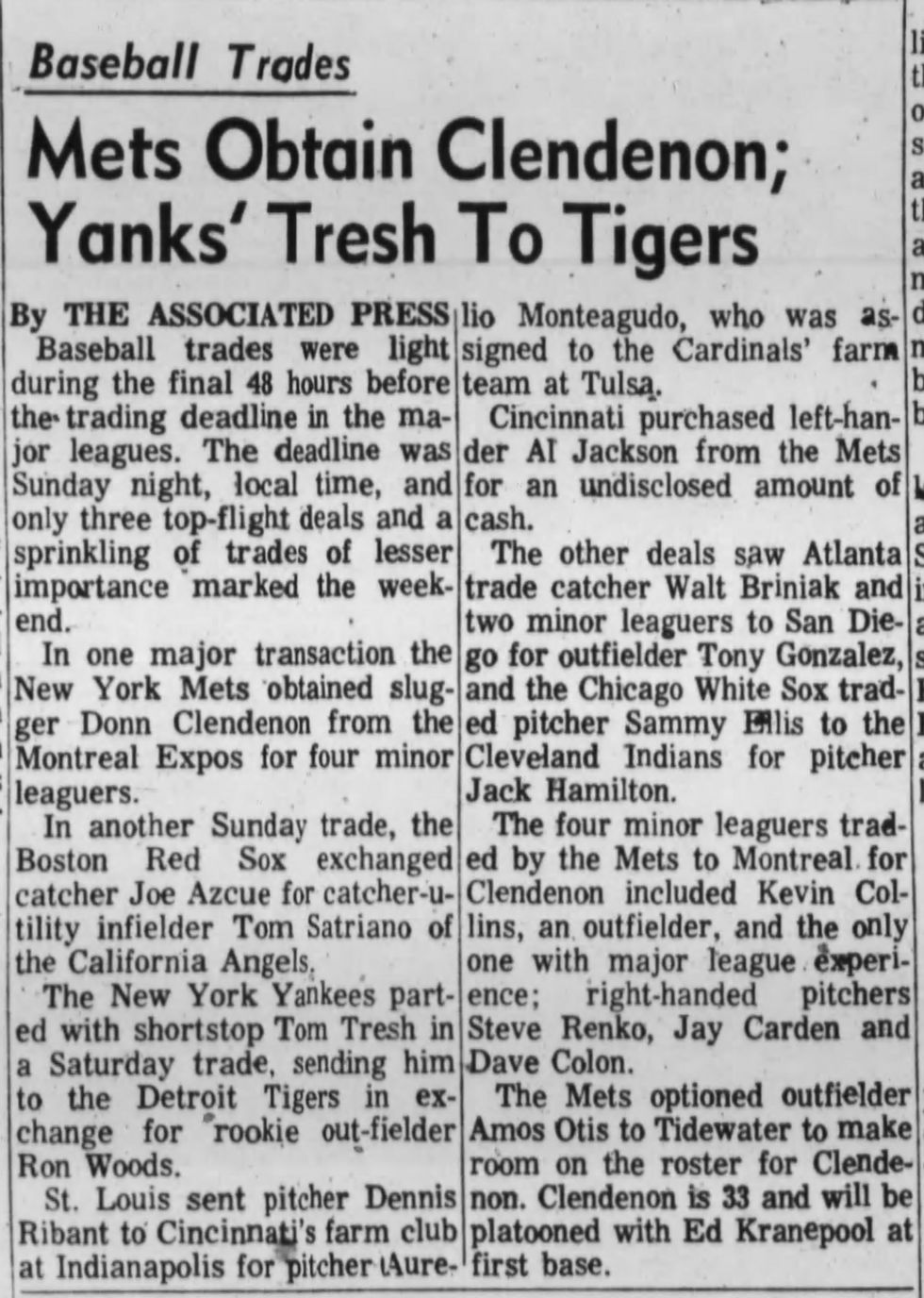
The Mets get their MVP of the 1969 World Series. However, it almost didn't happen. The roots of this trade go back to 1968. Then-Houston Astros Bob Aspromonte and Rusty Staub (Yes, that Rusty Staub) requested to sit out a game following the assassination of Robert F. Kennedy. The request was denied and the players were fined. Houston later decided to trade the popular Ginger. In January of 1969, Houston traded Staub to the Expos for Clendenon and future Met Jesus Alou. Clendenon refused to report to Houston because he had previously played for Astros manager Harry Walker in Pittsburgh and did not like his experiences. Clendenon retired! Staub then made it known he would not return to Houston because of how he was treated.
Brand-new Commisioner Bowie Kuhn stepped in and let Staub move on to Montreal, with the Expos receiving future Big Red Machine stalwart Jack Billingham instead. Clendenon, nicknamed Clink because that's how his name looked shortened in a boxscore, was later traded to the Mets.
Clendenon was the power bat the Mets desparately needed, even though his home run totals in his first seven full seasons were between 12 and 17, with a 28 homer season in 1966. Interestingly, because he platooned with Ed Kranepool, Clink did not appear in the 69 NLCS at all. He hit .357 with 3 home runs in the World Series. Speaking of uniform numbers earlier, the only two Mets World Series MVPs both wore 22, Clink and Ray Knight. Juan Soto, you're on the clock!
Clendenon was an extremely vocal player who helped keep the team loose and he later became a lawyer.
Steve Renko pitched for 15 years in the majors, starting 365 games and winning 134.
TEACHER SAYS A++. Clendenon was gone by 1972, but when you get a World Series MVP, that's a winning trade!
April 5, 1972. Mets get OF Rusty Staub for SS Tim Foli, 1B Mike Jorgensen, and OF Ken Singleton.

This trade was finalized 2 days after the death of Gil Hodges. The Mets, again, get their man to take them to the post-season. The popular Staub never made an All-Star team as a Met, but later set the team RBi record with 105 in 1975, which he held until Darryl Strawberry broke it in 1990. Staub was injured in 1972 and only played in 66 games. But he played in at least 151 in each of the next three years. Staub famously crashed into the rightfield wall during the 1973 playoffs and couldn't throw at all afterwards. Infielders would charge out to short right field to get the underhand tosses Rusty would lob at them. He returned to star in the World Series, in which the Mets would lose to Oakland in 7 games. Rusty did not start the first game of the World Series due to the injury. You must watch the Mets being introduced at the start of Game 1. Staub is upset he isn't starting and angrily waves at the camera when his name is called. Who started in right for the Mets? Previously mentioned Don Hahn. Staub is called on to pinch hit for Tug McGraw with one out in the ninth of an eventual 2-1 loss, but manager Yogi Berra lifts his injured star for right handed hitting Jim Beauchamp when Oakland brings in lefty Darold Knowles. Knowles, to appear in all seven games of the series, easily retires Beauchamp and Wayne Garrett for the save. Staub hits an incredible .423 in the Series.

Staub later becomes a chef and owner of Rusty's Ribs in NYC before returning as the club's pinch hitter deluxe in the early 1980's.
Singleton became a long time slugger for Montreal and Baltimore, gaining MVP consideration in seven different seasons. The New York native attained over 2,000 hits and a 1983 World Championship with the Orioles. Foli, who returned as a Met in 1978, later was traded to the Pittsburgh Pirates, where he was a key member of the Willie Stargell Fam-a-lee of World Champions in 1979. Jorgensen, who also returned to the Mets in 1980, was a solid major leaguer for 17 years. He won a Gold Glove in Montreal in 1973.
TEACHER SAYS B. Who didn't love the Grande Orange? Staub was clutch and he even was second in baseball with 17 outfield assists in 1973. Who lead the majors with 20? That would be Ken Singleton. Staub was also second in 1974 with 19 (to Bobby Murcer) and second in 1975 with 15 to another former Met, Leroy Stanton! Obviously more on him when we get to the Angels.
The Mets almost won the Series with Staub, but the three they gave up all had productive long careers.
December 10, 1984. Mets get C Gary Carter for INF Hubie Brooks, C Mike Fitzgerald, RHP Floyd Youmans, and OF Herm Winningham.

How could the Mets have received this receiver? Carter had led the league in RBIs and was a regular All-Star. What upset the Expos, according to the 1985 Street and Smith Baseball Yearbook, was what was going on behind closed doors. "There had been talk of clubhouse intrigue, racial animosity, petty jealousy, and second-class citizen syndrome (double taxation from U.S. and Canada) for Expo players." Camera Carter was the one who appeared to be in the middle of it all. Carter was the games highest paid player at $2 million a season in 1982. (Juan Soto makes $51 million a year). Teammate and future Hall of Famer Andre Dawson was worried the Expos could not sign Carter long term and the team would lose the star for nothing. Carter eventually would sign an 8 year contract for $15 million, but it proved to be too much for Montreal. Carter was a Met.
He had only two complete seasons in a Mets uniform before injuries took its toll. Carter's 8 is still not retired by the Mets, but should it be? Only 11 players in Mets history have worn it, none since Desi Relaford 25 years ago! The Mets embarrassingly put the 24 of Willie Mays on ice forever (with a few exceptions) before finally putting it up in the rafters. Carter is in the Hall of Fame and won the World Series as a Met. Are two good seasons enough? I say no to retirement. Tell me why you disagree?

Mike Fitzgerald (1983) was one of five Mets to hit a home run in his first Major League at bat. The others were Benny Ayala (1974), Kaz Matsui (2004), Mike Jacobs (2005) and active Met Brett Baty in 2022.
TEACHER SAYS A. Hall of Fame? Check. World Series? Check.
Other Mets - Expos trade names from the past: David Segui, Tim Burke, Ron Darling, Joel Youngblood, Tom Gorman, Jim Dwyer, Wayne Garrett, Pepe Mangual, Del Unser, and Jim Gosger.


He hung a curveball! Fun memories. I want to breakout my Expos jersey and go to Jarry Park and get blinded with sun glare on a perfect summer day.