
Topps Tuesdays: 1966 Topps Mets — Tug Gets His Own Card


The games are over. The hot stove hasn't lit yet. This is the part of the year when a Mets fan's mind wanders — to the shoebox in the closet.
Last week we opened 1965, the farewell summer of Casey Stengel, Yogi Berra and Warren Spahn. This week it's 1966 — the first year of the rest of the franchise's life. Casey is gone. Wes Westrum is running the club. And if you read the checklist the way you'd read a box score, you can see 1969 starting to assemble itself, one solo card at a time.
Every Tuesday we open one year of Topps Mets cards, look at the full team set and what it carries today, and then you vote one card into the Mets Baseball Card Hall of Fame. Here's 1966.
The 1966 Topps Set
Topps stayed at 598 cards in 1966, again across seven series, and gave the set a design so clean it almost disappears: a big color photograph, the team name riding a diagonal stripe across the upper-left corner, and the player's name in big bold letters — with his position beside it — in a color bar across the bottom. The bars are color-coded by team, and the Mets drew the loudest combination in the set: yellow print on purple. You can spot a '66 Met across a card-show aisle.
The backs go pink, with the biography, the season-by-season stats and the cartoon. The packs carried a new insert to chase — Topps Rub-Offs, 120 temporary tattoos. Two things are missing that collectors noticed: there is no World Series subset this year (it comes back in 1967), and there are no Mets error cards — the set's eleven variations are trade-statement corrections and a checklist that first listed Warren Spahn where Bill Henry belonged, none of them ours. There are also two partial parallels out in the world: a Venezuelan printing of cards #1–370 and a Canadian O-Pee-Chee printing of #1–196.
The star power is heavyweight: Willie Mays leads the set at #1, Mickey Mantle is #50, and Sandy Koufax's #100 is his final Topps card — he retired after the season. The rookie class belongs to the pitchers: Jim Palmer (#126) gets a solo card, and Fergie Jenkins (#254) and Don Sutton (#288) arrive on multi-player Rookie Stars cards. And then there is the seventh series. The 1966 high numbers (#507–598) are among the toughest of the whole decade — 43 of them short-printed — and the Mets have five cards living up there.
The Mets Checklist
The full team set runs 31 cards — 27 individual players and manager Wes Westrum, the team card, and three two-player Rookie Stars cards.
The checklist:
#17 Johnny Stephenson · #35 Ron Swoboda · #51 Gordon Richardson · #67 Mets Rookies (Cleon Jones/Dick Selma) · #87 Dan Napoleon · #108 Bobby Klaus · #124 Tug McGraw · #154 Chuck Hiller · #172 Mets Team · #188 Al Luplow · #191 Darrell Sutherland · #212 Ed Kranepool · #241 Dennis Ribant · #262 Jack Hamilton · #282 Johnny Lewis · #302 Ernie Bowman · #316 Jack Fisher · #328 Jerry Grote · #341 Wes Westrum · #360 Ron Hunt · #385 Ken Boyer · #402 Jim Hickman · #421 Roy McMillan · #443 Bill Wakefield · #464 Larry Bearnarth · #480 Dick Stuart · #516 Eddie Bressoud · #534 Mets Rookies (Eilers/Gardner) · #561 Choo Choo Coleman · #574 Mets Rookies (Hepler/Murphy) · #589 Lou Klimchock
Five Mets live in the high numbers — Eddie Bressoud (#516), the Eilers/Gardner rookie (#534), Choo Choo Coleman (#561), the Hepler/Murphy rookie (#574) and Lou Klimchock (#589) — and Coleman is the team set's only short print, which is why a backup catcher who hit .142 is one of the harder pulls in the binder.
The ghosts tell the winter's story. Gil Hodges (#386) is still Washington's manager. And the two men the Mets paid for Ken Boyer are wearing Cardinal red in this set — Al Jackson (#206) and Charley Smith (#358), traded to St. Louis on October 20, 1965. Jackson, by the way, went out and posted a 2.51 ERA for the Cardinals in 1966. The winter giveth to Boyer, and the winter taketh away.
On the field, the 1966 Mets went 66–95 — and finished ninth. Read that again. For the first time in franchise history, somebody else was last (the Cubs, 59–103). The team card still brands them "10TH PLACE," because team cards carried the previous season's finish, but the cellar door had finally closed behind someone else. There was even a pitching first: Dennis Ribant (#241) went 11–9, the first Mets pitcher ever to finish a season with a winning record.

What It's Worth Today
The full 598-card set in high grade is serious property — one national dealer currently lists a near-mint complete set at $32,300, with a break-up value near $39,890 — because those short-printed high numbers punish anybody trying to build it card by card.
The Mets, as ever, sit at the friendly end, and this might be the most affordable year of the whole run so far: there is no Berra or Spahn tax here. The team card (#172) in PSA 9 has sold in the $107–$127 range on eBay in 2025, with PSA 8s changing hands around $30–$60. The stars of the team set — McGraw, Swoboda, Boyer — are common-card money raw and stay modest even graded, and the one card that will cost you more than it should is the short print: Choo Choo Coleman (#561), priced by scarcity rather than by anything he did at the plate.
The Money Cards
#561 Choo Choo Coleman — the team set's only short-printed high number, and his final Topps card. Scarcity beats batting average: this is the toughest Mets card in the set to find nice.
#124 Tug McGraw — Tug's first solo Topps card. Solo firsts of franchise icons never stay cheap forever, and this one is still gettable.
#35 Ron Swoboda — Swoboda's first solo card, wearing the Topps All-Star Rookie trophy for his 19-homer debut season.
#172 Mets Team — the strongest graded seller in the team set (PSA 9s at $107–$127 in recent eBay sales), the whole club in rows on a red background.
#385 Ken Boyer — a former MVP's first card in a new uniform, for common-plus money. Cards that two fan bases need tend to hold their value.
Five Cards to Sit With
#124 Tug McGraw. A year ago Tug was the bottom-right face on a four-man rookie card, sharing cardboard with three other hopes. Now look: a full card, his name in the purple bar, nobody else in the picture. He was 21 years old, a left-hander with a screwball and more personality than the franchise had ever contained, and Topps — without knowing it — had just printed the first solo card of the man who would close out the 1969 World Series parade route and give the 1973 Mets their "Ya Gotta Believe." Every great Met has a first card that is truly his. This is Tug's.

#35 Ron Swoboda. The gold trophy in the corner says it: Topps All-Star Rookie, earned with those 19 home runs as a 20-year-old in 1965, a Mets rookie record that stood until Darryl Strawberry came along. This is Rocky's first solo card, bat on his shoulder, Shea behind him, looking very much like the slugger the Mets thought they were building around. The catch in Game 4 of the '69 Series was still four years and a lot of fly balls away. Sit with the confidence in this photograph.

#385 Ken Boyer. The imported star of this set — the 1964 National League MVP and the captain of the champion Cardinals, traded to the Mets that October for Al Jackson and Charley Smith. Boyer was 35 and his knees were going, and he still led the 1966 Mets in RBIs (61) and doubles (28). But the card's value to a Mets fan is simpler: for one summer, a genuine, no-argument star third baseman — seven All-Star teams, five Gold Gloves — wore this uniform and hit in the middle of this lineup, and this is his first card saying so. The line of Mets third basemen starts being respectable right here.

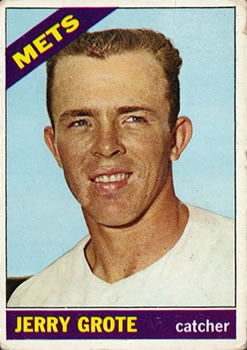
#328 Jerry Grote. The most consequential common card in the set. Grote's 1965 Topps card showed him as a Houston Astro; this is his first as a Met, acquired in October 1965 for a player to be named later who turned out to be Tom Parsons — the very pitcher who had shared Cleon Jones's rookie card a year earlier. Grote hit .237 in 1966, and nobody cared, because the arm and the temper and the game-calling were the point. He would catch every inning of the 1969 and 1973 World Series. Franchise catchers have to arrive from somewhere; this plain, unsmiling portrait is where this one arrived.
#67 Mets Rookies — Cleon Jones / Dick Selma. Jones is doing something almost nobody did in the Topps of this era: appearing on a Rookie Stars card two years in a row, after the 1965 card he shared with Tom Parsons. Topps kept betting on him in cardboard before the Mets fully bet on him in left field, and the bet paid off — by 1969 he was the club's best hitter and the man who squeezed the last out of the World Series. Selma, the right-hander beside him, took a longer road to 1969 — he spent that summer with the Cubs, the team the Mets ran down. Two panels, two different Octobers.

A few more worth a pause: Wes Westrum (#341) gets the most honest manager photo of the era — hands cupped around his mouth, hollering instructions at a 66-win team. Dick Stuart (#480), "Dr. Strangeglove" himself, smiles like a man who has never once worried about a ground ball. Ed Kranepool (#212) is a fixture now, a solo low-number card for the third straight year. And Lou Klimchock (#589) closes the team set in the high numbers, photographed in a fielder's crouch with a mitt the size of a pizza pan.
The Mets Baseball Card Hall of Fame
Three finalists this week. One vote. One plaque.
#124 Tug McGraw — His first solo Topps card. The screwball, the smile that isn't quite there yet, and the whole future of the Mets bullpen standing alone in the frame for the first time.
#35 Ron Swoboda — His first solo card, All-Star Rookie trophy and all. The 19-homer rookie season, certified in gold, four years before the catch.
#385 Ken Boyer — The 1964 MVP in a Mets uniform for the first time. The biggest name in the team set, and the first real star the Mets ever traded for.
[★ WINNER SLOT — HALL OF FAME INDUCTION TO BE ADDED AFTER THE VOTE ★] The winning card's induction will be announced in this space once the vote is counted.
The vote is yours. McGraw, Swoboda, or Boyer — cast it in the Topps Tuesdays group.
Full team set below — all 31 cards. Next Tuesday: 1967.
Join the conversation. The Topps Tuesdays group is where the weekly Hall of Fame poll lives — come vote, argue your pick, and show off your own '66s. And while you're there, poke around the rest of Talkin' Mets on the Korner: the Game Day Thread, Mets History & Memories, Hot Stove, Down on the Farm, and the Venting Booth for when the bullpen ruins your evening. Nine thousand Mets fans are waiting. Come talk baseball.
🔔 Get the Korner in Your Inbox
The Rumor Roundup, the Chronicles, Sunday School and everything from the Korner — delivered free every Sunday morning, plus a breaking-edition alert when the Mets make a move. Just drop your email in the form below and you're in.


Comments