
Trade Tracker Thursday: Multi-Team Trades. Jonathan Trumpbour Matlack, Hammer Milner, and Hot Dog Montanez

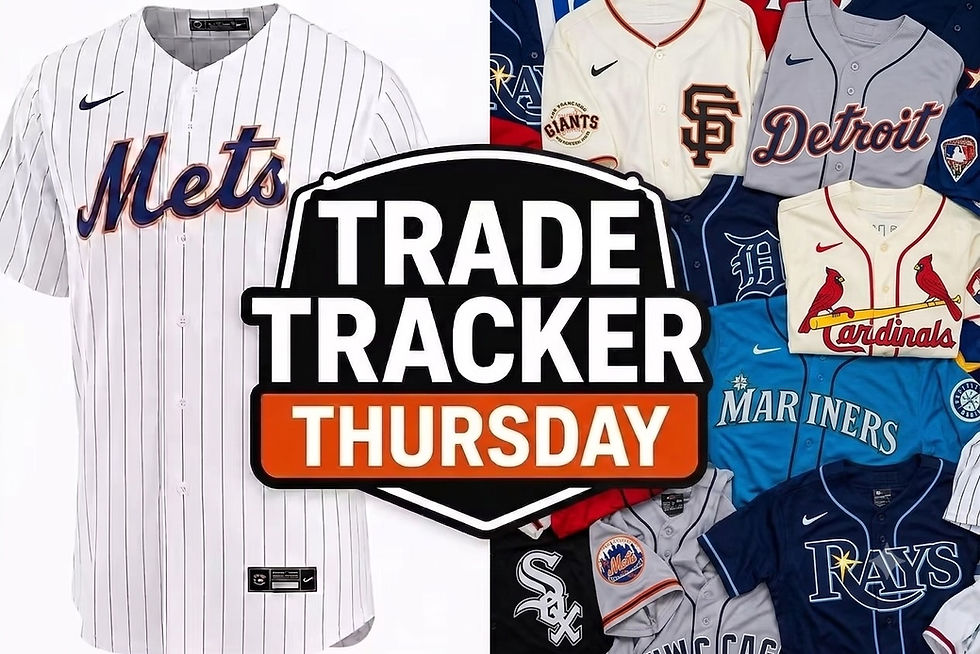
If you think modern baseball trades are complicated, try untangling the 11-player, four team matrix that the Mets executed on December 8, 1977.
The Mets were still reeling from the Midnight Massacre on June 15, 1977, with the unceremonious dumping of The Franchise Tom Seaver and All-Star moonshot behemoth Dave Kingman.
Almost all trades made today are looking to raid the other team's farm system. GMs are looking for cheap talent that may prove quite valuable one day. Think of the Cub jackpot as they fleeced the Mets of Gold Glove All-Star Pete Crow Armstrong. Pete just had a June for the history books. PCA
reached numerous stats in a month that hadn't been done since the likes of mythical heroes Ruth and Gehrig.
Now imagine an 11-player trade made up entirely of Major Leaguers! Included were numerous All-Star caliber players and one Hall of Famer! (Bert Blyleven, although let's debate that Al Oliver belongs, too). This is the first and only 4-team trade in history.
The Mets continued to clean house of any 1969 or 1973 post season heroes, by trading Jon Matlack and John Milner.
Here is the trade: The Braves sent 1B Willie Montanez to the Mets. The Mets sent LHP Matlack to Texas and 1B/OF Milner to Pittsburgh. The Pirates sent SS Nelson Norman and 1B/OF Al Oliver to Texas. Texas sent RHP Bert Blyleven to Pittsburgh. Texas sent OFs Ken Henderson and Tom Grieve to the Mets. Texas sent pitchers Tommy Boggs and Adrian Devine and OF Eddie Miller to Atlanta.
Let's try and see which team won this trade.
Braves get Boggs, Devine, and Miller for Montanez.
Boggs wound up starting 94 major league games, including going 12-9 with a 3.42 ERA in 1980. Devine was coming off a strong year in the bullpen for Texas, winning 11 games and saving 15. He pitched in 56 games, throwing 105 innings with a 3.58 ERA. Throwing about two innings a game! What would Devine's salary be today? Doesn't sound like he was on a pitch count! (Well, maybe he should have been. 5.92 ERA in Atlanta).
Miller wound up with 17 homers over a 7 year career.
Guillermo Montanez Naranjo finished second in the 1971 Rookie of the Year voting as a Phillie. Hot Dog Montanez was as flashy as they came. He would swipe at pop-ups. Think how Rickey would do it. Now amp it up 100 degrees. That was Willie. He would take little stutter steps right before touching each base on homers, before stopping cold ten feet from the plate and walking slowly the rest of the way.

Willie drove in 96 runs in 1978 for the Mets. It doesn't sound like earth shattering news, but it was the third highest total in Mets history behind Rusty Staub's 105 (1975) and Donn Clendenon's 97 (1970). Presently, Hot Dog Montanez is in 40th place in Mets history for RBI in a season. Quick...who leads? (Pete Alonso with 131 in 2022. But we'd rather have Polanco and Vientos, right?)
Montanez played on 9 teams in his 14 years, never more than two except for the beginning of his career in Philly. Sounds like a sign that teams don't want a pain in the butt! (Phone call for a Mr. Cespedes on line 2).
Willie was in a slew of interesting trades other than this one. He was in the original Curt Flood trade in 1970, when Flood refused to report to his new team. It directly led to free agency and the end of the reserve clause.
Montanez was traded by the Phillies for CF Garry Maddox, which helped the Phillies to their division crowns in the mid 70's.
He was traded to the Braves for Darrell Evans, an underrated player who hit 414 homers.
The Mets got Ed Lynch and Mike Jorgensen for him . (Profiled in the Rangers Trade Tracker).
He was also traded for Hall of Famer Gaylord Perry ; then for leadoff man extraordinaire Tony Phillips. Finally, in 1981, he was traded for John Milner again! That trade involved Pittsburgh and Montreal.
TEACHER SAYS D. Braves got very little for the RBI bat of Montanez. But there was a method to their madness. They wanted to open first base for hot prospect Dale Murphy! Failed catcher Murphy was moved to first for two years before finally taking to centerfield and becoming a two-time MVP.
Mets get Montanez, Henderson, and Grieve for Matlack and Milner.
Henderson previously spent 8 years in San Francisco, highlighted by an 88 RBI, 104 runs scored season in 1970. He was a starter on the 1971 division winners, going 5-16 (.313) in the NLCS, which the Giants lost in 4 games. He was involved in three big-name trades before the 1977 blockbuster. First he was traded to the White Sox with future Cy Young winner Steve Stone; then he moved to Atlanta with successful starting pitcher Dick Ruthven for batting champ Ralph Garr; then he was on the way to Texas for former MVP Jeff Burroughs! Henderson's Mets career lasted 7 games before moving on to the Reds for bullpen headache Dale Murray. He pitched over 100 innings out of the pen in 8 of his 12 seasons.
Tom Grieve reached highs of 20 homers and 81 RBI with the 1976 Rangers. His Mets career lasted 54 games. He was elected to the Texas Ranger Hall of Fame in 2010. That election was as a General Manager. He was their GM for 10 years, highlighted by acquiring Rafael Palmeiro and Jamie Moyer from the Cubs for Mitch (no relation) Williams. He also traded for future batting champ Julio Franco (is he still playing?). Young stars that he traded away too soon include Sammy Sosa and Robb Nen. Well, Grieve did get questionable Hall of Famer Harold Baines in the Sosa deal.
Grieve and his son Ben were the first father-son duo to be drafted in the first round. Ben was the AL Rookie of the Year for Oakland in 1998.
The Mets traded Grieve and pitcher Kim Seaman (yep, Seaman) to the Cardinals for Pete Falcone. Falcone won 26 games over 4 years for the Mets.
Mets Hall of Famer Matlack was the team's second Rookie of the Year in 1972, winning 15 games to a 2.32 ERA. He won 82 games during his 7 Mets years. The three-time Mets All-Star was the only Mets All-Star MVP, sharing the award with like-named Bill Madlock in 1975. He pitched two innings, striking out 4 batters. He struck out Bucky F. Dent, Graig Nettles, Fred Lynn, and the impossible to strike out Rod Carew. I was at Jon's one hitter on June 29, 1974. The only hit he gave up was a third inning single to an .065 hitter, pitcher John Curtis!

Matlack was a dominant force in the 1973 post season. He pitched a two-hit shutout in Game 2 of the NLCS vs Cincinnati. He started three games vs Oakland in the World Series. He lost two games while winning one, although he had a 2.16 ERA.
He finished his career as a Ranger, winning 43 games over 6 years. His best Texas year was in 1978. He won 15 with a 2.27 ERA. He threw 270 innings because that's what starting pitchers did.
John "The Hammer Milner" started his career as a lefty platoon with Cleon Jones in leftfield in 1972. On September 8th, he became the first Mets rookie to record a five-hit game. (Carson Benge was the last to do it as a rookie.) Milner was also the youngest Met to have a five hit game, just beating out Jose Reyes and Benge.
Milner finished third in Rookie of the Year voting, behind teammate Matlack and Giants catcher Dave Rader. Milner led the NL Champion Mets in homers and RBI with modest totals of 23 and 72.

He was a solid bat for the 1979 Fam-a-lee Pittsburgh Pirates World Championship team. He hit 16 homers with 60 RBI as a backup to Hall of Famer Willie Stargell at first and future 1986 Mets World Champion first base/hitting coach Bill Robinson.
Milner walked more than he struck out in his career (504-473). Milner was named as a witness in the Pittsburgh drug trials of the 1980's. Milner said he received amphetamines from both Stargell and Willie Mays!
TEACHER SAYS F. Montanez had a good year, but Milner and Matlack were home grown talents who had many years left.
Rangers get Matlack and 1B Al Oliver for RHP Bert Blyleven.
Blockbusters like this don't happen anymore.
You know about Matlack, but Oliver had a career .303 average with 2,743 hits. He was a member of the Pirates 1971 World Championship team, made 7 All-Star appearances, and won the Silver Slugger three times. As a Montreal Expo in 1982, he led the league in average (.331), hits (204), and RBI (109).
Oliver was the first player to wear 0 on his uniform, wearing the digit in 1980 with Texas. Oliver had 11 seasons where he hit .300 or better, which is greater than a great many Hall of Famers. Many players who played with "Scoop" feel Al belongs in Cooperstown. A questionable attitude at times and finishing his career with 4 teams over two years didn't help his cause. I feel he belongs! I'd like to hear your opinions on Al.

Bert Blyleven is a Hall of Famer, although some call him the dreaded "compiler." He is 5th all time in strikeouts, 9th in shutouts, 11th in games started, 14th in innings pitched, and 27th in wins with 287. Those are mighty impressive numbers.
He compiled a WAR of 94.5, among the top ten in modern history. Since 1945, his combined WAR and ERA+ places him among Tom Seaver, Greg Maddux, and Randy Johnson. That's good company.
He pitched 22 years with only one 20-game victory season, in 1973. Blyleven also finished with the 10th most losses in history with 250. If you look only post-war, he has the fifth most losses, only behind Nolan Ryan, Phil Niekro, Gaylord Perry, and Don Sutton.
For Pittsburgh, he went 14-10 in 1978, and 12-5 with 20 no-decisions in the World Championship 1979 season. He went a combined 2-0 in that post season, pitching 19 innings only giving up 3 earned runs.
TEACHER SAYS B +. Texas got a few good years from Matlack and four very good years from Oliver. That's not bad value for anyone, including a Cooperstown resident.

Pittsburgh gets RHP Blyleven and Milner for Oliver and SS Nelson Norman.
Norman played parts of 4 seasons with Texas, only being a regular in 1979, hitting .222.
Pittsburgh gets two key players and they win the World Series.
TEACHER SAYS A. I said they won the World Series and they got a Hall of Famer! So that makes Pittsburgh the winners of this blockbuster.
The only team to get an F was our Mets. Wouldn't you know it?
NEXT WEEK: More multi-team trades in Mets history. Who are you calling a (J.J.) Putz?


That is why we still love our effin' Mets. I am sure there will be more amazing trade coming up as we get closer to the trade dealing. Another nice job on dissecting tis trade for us!