
Baseball, Buster Keaton, Joe E. Brown, and My Joyfully Out-of-Control 8-Hour SABR Rabbit Hole Deep Dive Into Everything

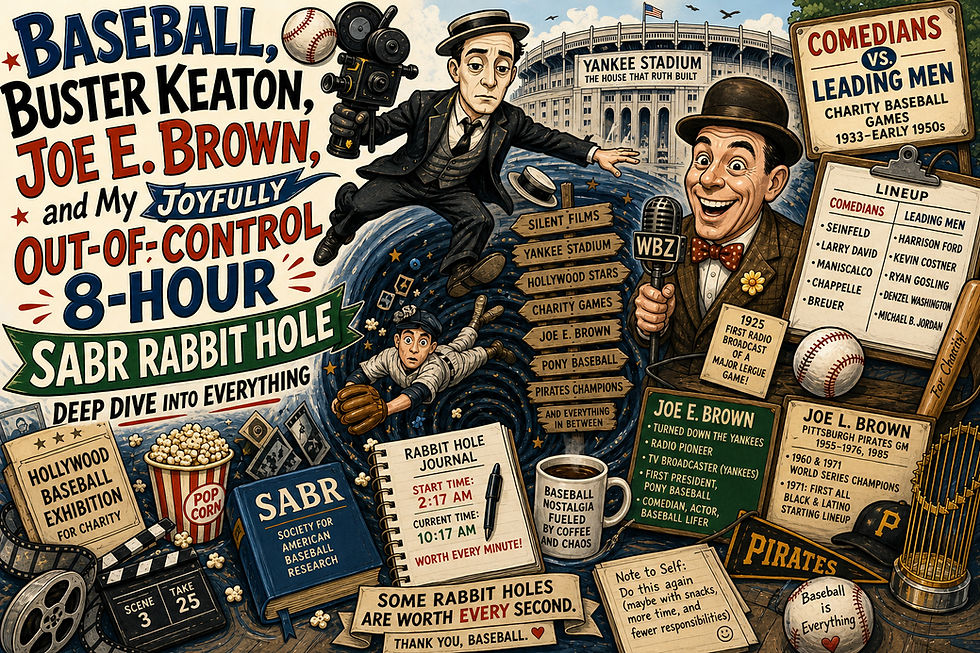
Every now and then, you set out to do something productive and wind up in a place where productivity goes to die—somewhere between YouTube, baseball nostalgia, and “how did I get here and why is it 2:17 in the morning?”
For me, it started innocently enough.
As I’ve been working to build the Long Island chapter of the Society for American Baseball Research (SABR, for those of us who enjoy explaining acronyms almost as much as we enjoy box scores), shameless plug: if you’re a Long Island baseball fan and want in, reach out and join us. No scouting report required, just a pulse and an appreciation for a good box score.
I wanted to add a little culture to the chapter. You know—expand horizons, stimulate minds, justify eating popcorn for dinner. So I came up with the idea of monthly baseball movie nights.
Simple, right?
Which is how I found myself rewatching old baseball scenes and eventually landing on a clip from The Cameraman—a silent film starring the great Buster Keaton.
Now, for those who haven’t seen it, The Cameraman follows Keaton as a well-meaning but hopelessly overmatched newsreel cameraman trying to impress the girl he loves. Think of it as every Mets fan’s emotional journey, but with fewer rain delays.
About midway through the film, there’s a sequence shot at Yankee Stadium—the original House That Ruth Built—where Keaton finds himself on the field during a game.
And here’s where things got interesting. I actually went back and rewatched that clip about 25 times, just to take in every nook and cranny of old Yankee Stadium. Every railing, every shadow, every bit of that vanished ballpark texture that modern AI or virtual recreations still can’t quite capture. You can render pixels all day long, but you can’t fake that kind of lived-in history.
If Buster Keaton were alive today (he’d be 130), I have a feeling David Stearns might at least have his scouting department “do the due diligence”—age be damned—especially with that whole run prevention mantra in mind. Because Keaton didn’t just look like a guy pretending to play baseball… he looked like someone you could pencil into the lineup and trust to keep the other team from scoring on sheer defensive positioning alone.
The movements were fluid. The instincts were real. The swing? Let’s just say if you dropped him into a spring training game today, at least one scout would quietly put down his coffee and start paying attention.
And here’s the kicker: Keaton was about 32 years old when The Cameraman was released in 1928. Thirty-two! At that age, most of us are thrilled if we can still find our softball glove, let alone move like we belong on a big-league diamond. I was 32 once that was the year I pulled a hamstring opening a bag of pretzels.
Naturally, this sent me down a rabbit hole.
And not one of those shallow, “I’ll just look up one thing” rabbit holes. No, this was a full-blown Alice-in-Wonderland freefall into the strange and wonderful intersection of Hollywood and baseball.
Which is how I stumbled onto something I had never heard of before, but instantly wished I had:
The “Comedians vs. Leading Men” charity baseball games.

Yes, that’s exactly what it sounds like.
For roughly two decades—from 1933 through the early 1950s—Hollywood’s biggest stars took to the diamond in annual charity exhibitions that pitted comedians against dramatic leading men. It was part baseball game, part publicity stunt, part organized chaos—and 100 percent a window into a different era.
Think about that for a second.
An actual baseball game where the lineup card might include some of the biggest names in film—guys who spent their days making audiences laugh or swoon—now trying to turn a double play without tearing a tuxedo.
It’s the kind of thing that makes you wonder two things:
1. Wouldn't it be awesome if they could still do this?
2. And more importantly, how did I not know about this until now?
The answer to the second question is simple: history has a way of hiding its best stories in plain sight, usually somewhere between grainy film reels and “you’ve got to be kidding me” trivia.
The answer to the first question… well, that’s what we’re going to explore.
Because once you start digging into these games—the players, the purpose, the pure spectacle of it all—you realize this wasn’t just a quirky sideshow.
It was a phenomenon.
Somewhere in the early 1930s, in the middle of these “Comedians vs. Leading Men” charity games, one name keeps appearing with suspicious consistency:
Joe E. Brown.
And unlike most celebrity participants who treated baseball like a fun afternoon between film shoots and publicity obligations, Brown treated it like something closer to a life calling.
Which is ironic, because before he was one of the biggest comedy stars in America, he had already been something else entirely: a baseball player who turned down a chance to sign with the Yankees. Let that sit there for a moment. A man who looked at the New York Yankees and said, essentially, “No thank you, I have tumbling and vaudeville plans.”
And he wasn’t just a casual fan who wandered into the sport later in life. Brown was all-in from the jump. He even made a small piece of baseball history in 1925, when Boston’s WBZ radio station aired a Braves-Giants game—the first-ever broadcast of a Major League game in that market—with Joe E. Brown behind the microphone calling the action. Not bad for a guy who was supposedly just passing through sports on his way to comedy.
The connection never really left him. He resurfaced decades later in an even stranger role—returning to baseball broadcasting in 1953 as a New York Yankees television commentator on WPIX, taking over a pre- and postgame spot after Joe DiMaggio. Imagine that timeline: a man who once reportedly said “no thanks” to the Yankees, later showing up on their broadcast booth, talking baseball on TV like it was the most natural thing in the world.

Somewhere in there, he also helped shape youth baseball nationally as the first president of PONY Baseball and Softball, because apparently one baseball lifetime wasn’t enough.
And like most good rabbit holes in baseball history, it doesn’t really end—it just branches off into another story, because baseball didn’t stop with Joe E. Brown.
His son, Joe L. Brown, carried the families obsession straight into the front office, serving as general manager of the Pittsburgh Pirates from 1955 to 1976 and again briefly in 1985. Under his watch, the Pirates didn’t just win—they built champions, including the 1960 and 1971 World Series teams, with that ’71 club famously breaking ground with the first all Black and Latino starting lineup in baseball history.
So in a way, Joe E. Brown went from almost signing with the Yankees… to having a son who helped build a championship team that defeated the Yankees in 1960.
Not bad for a family that started with vaudeville plans and a fastball dream.
Oops—sorry about that, we appear to have fallen into a completely different rabbit hole without proper clearance. Happens more than I’d like to admit around here. Let’s pretend that detour never happened, close that side tunnel back up, and return to our regularly scheduled assignment: the Comedian vs. Leading Man rabbit hole, already in progress and only mildly under control.

By the early 1940s, the “Comedians vs. Leading Men” exhibitions—and the broader Hollywood baseball charity circuit they had become part of—were no longer just studio publicity stunts or novelty events. They had evolved into something larger and more urgent: wartime morale, war bond promotion, and Hollywood’s attempt to remain visible in a world where opening nights suddenly mattered a lot less than world events.
And like everything in Hollywood, it still needed names. Big ones. So the games leaned heavily on what you might call marquee gravity: Clark Gable, Gary Cooper, and Errol Flynn. These were not regulars, and they weren’t baseball players in any meaningful sense, but their presence reshaped everything around them. If Gable was involved, people showed up. If Cooper was rumored to be playing, newspapers made room for it. If Flynn was anywhere near a baseball diamond, the assumption was that the game might end with either a heroic slide or an accidental swashbuckling incident at second base.
On the other side of the field, however, there was no such stability. The Comedians’ roster in the 1940s was not really a roster at all, but a rotating collection of performers drawn from vaudeville, studio comedy contracts, radio personalities, and character actors who could either play baseball or convincingly survive pretending to. It was a fluid, evolving cast that shifted from event to event, anchored—almost permanently—by the aforementioned Joe E. Brown, but never defined beyond him.
Beyond Brown, the names appear in fragments rather than full lineups: Burns and Allen circulating through Hollywood charity exhibitions, members of the Ritz Brothers appearing in various comedic contingents, and a steady stream of studio-era comic performers like Abbot and Costello and the Three Stooges rotated in and out depending on availability, obligation, or sheer willingness to put on baseball pants in front of a crowd. It was never a fixed team in the modern sense. It was closer to a traveling idea—assembled whenever Hollywood decided baseball was the right way to sell goodwill, raise money, or remind people that laughter still had a place in a world at war.
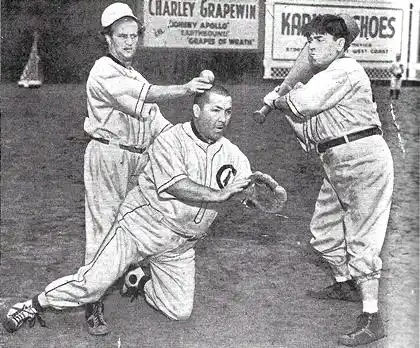
By the time the 1950s arrive, the whole thing starts to feel a little like a reel of film running out of sprockets.
The “Comedians vs. Leading Men” idea—and the broader Hollywood charity baseball circuit it helped inspire—doesn’t end with a single final inning or a neatly preserved box score. It just… fades. Quietly. The way most things do when they stop being essential and become instead something people remember they used to do.
The war is over. The urgency that once pulled together stadiums full of stars for bond drives and morale events is gone. Hollywood itself has changed too—less studio-driven communal spectacle, more controlled appearances, television beginning to siphon off attention one living room at a time. And slowly, the idea of corralling a dozen major film stars into baseball uniforms for a charity game starts to feel less like tradition and more like nostalgia that hasn’t quite admitted it yet.
The marquee gravity that once made names like Clark Gable or Gary Cooper or Errol Flynn turn a ballgame into an event still exists, but it’s no longer being harnessed in quite the same way. Appearances become sporadic, not seasonal. Charity events shift formats. And the once-fluid Comedians’ side—never really a fixed roster to begin with—drifts further into memory, its rotating cast now more legend than lineup.
Even the presence of Joe E. Brown, who had once functioned as the sport’s unlikely stabilizing force, begins to recede into a different kind of career phase—more stage work, more character roles, fewer baseball-adjacent exhibitions anchoring the story.
What remains in the 1950s is not so much a continuation as a residue: the occasional celebrity softball game, the lingering idea that Hollywood *used to* do this kind of thing together, and newspaper clippings that read more like postcards from another era than coverage of anything ongoing.
By the time the decade settles in, the “Comedians vs. Leading Men” games aren’t really part of a schedule anymore. They’re part of folklore—something that once filled stadiums, raised money, and blurred the line between performance and pastime, now remembered in fragments, like a game where nobody can quite agree on the final score, but everyone insists they were there.
And maybe that’s the real reason this story doesn’t feel finished in the 1950s—it feels paused. Because if you squint hard enough at the modern sports-and-entertainment landscape, you can almost see the outline of it coming back. Picture it: a “Comedians vs. Leading Men” revival game played for charity, somewhere between nostalgia and chaos, with a Comedians roster that somehow ends up featuring Jerry Seinfeld chirping at shortstop, Larry David refusing to acknowledge the existence of the strike zone, Sebastian Maniscalco chirping at everyone within earshot, Dave Chappelle turning a press conference into a philosophical debate, and Jim Breuer treating warmups like a full stage set.
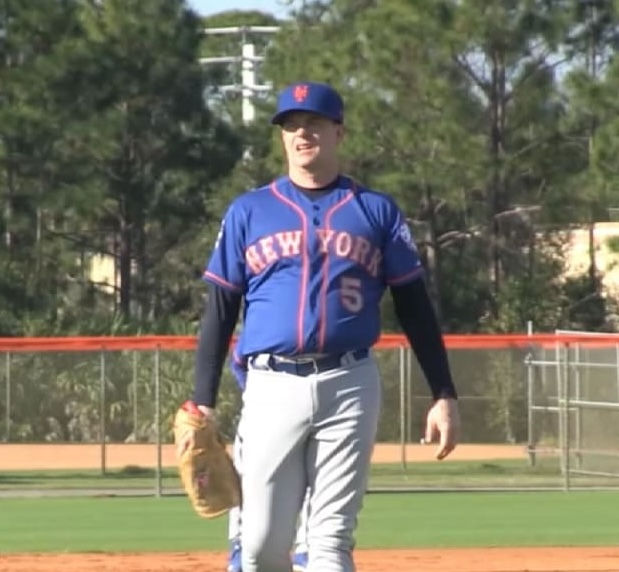
On the other side, the Leading Men lineup would look like a box office All-Star team that somehow also believes it can turn a double play: Harrison Ford playing first base like he’s flying a plane at low altitude, Kevin Costner insisting—politely but firmly—that he has been preparing for this his entire life, Ryan Gosling making every throw look like a scene that will be edited later, Denzel Washington turning center field into a masterclass in controlled intensity, and Michael B. Jordan somehow turning a charity game into a training montage.

And the funny thing is, I’d watch that game in a heartbeat.
So here’s where I’ll throw it out to you: who would you want in a game like this, past or present? Drop your picks in the comments, and keep the conversation going over on our Facebook page—because half the fun of this rabbit hole is seeing who else you can get to join you..


Comments