
Best Mets First Basemen of the 1960s: From Hodges to Clendenon

As we wait to see who'll be starting at 1st base in 2026, the editors and writers here at the Korner thought it would be interesting to turn back the clock and see all the great (and not-so-great) 1st basemen in Mets history.
We'll break the list down by decade. For example, we know undoubtedly that Pete Alonso is the best 1st baseman to play for the Mets in the 2020s; that's going to be easy to write once we get to the present. However, when you turn back the clock to the 1960s, can you say who the hands-down "best" 1st baseman of that decade was?
Let's start with the Mets' first 1st baseman in the team's history.

Gil Hodges isn't exactly known for being the team's 1st first baseman. He didn't even play the most games (47) at 1st base in 1962. Hodges was just the best option at the position while the team figured out a more solid and younger option.
Hodges' Hall of Fame career stats include a career 370 HR and 1,274 RBI. He's an 8-time all-star with three Gold Gloves and was a central member of two World Series teams. Only 37 of his 1,921 hits came while playing for the Mets in 1962 and 1963. He'll always be a legend in New York City for his playing days on the Brooklyn Dodgers and for coming back and managing the Mets from 1968-1971, including the legendary 1969 World Series team. He even had his number "14" retired by the team. But for the sake of this list, he's a mediocre afterthought, who acted as a placeholder for the eventual everyday 1st baseman for the team's inaugural season, "Marvelous" Marv Throneberry.
Throneberry joined the Mets in May of 1962, just a month after opening day. The 29-year-old was acquired by the Mets in a trade with the Baltimore Orioles for catcher Hobie Landrith, who was the team's first pick in the 1961 expansion draft.
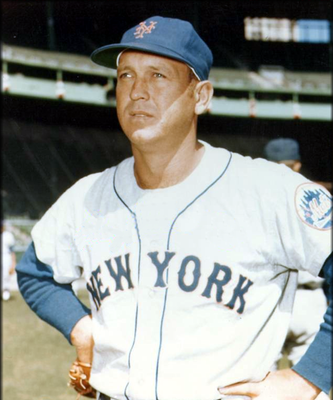
Throneberry became a fan-favorite for the hapless Mets. He wasn't popular for his spectacular play at 1st base; instead, it was for his spectacular mistakes at just the right moment. He made so many errors for a team with so many losses that the fans just named him "Marvelous Marv" sarcastically. He actually led the National League in errors at the position in 1962 with 17 total.
In review, if this list were "Best of the Worst 1st basemen for the 1960's" Hodges and Throneberry would be at the top of the list.
There was a player on the 1962 team who sat and waited for years for his opportunity at 1B, Ed Kranepool. The 17-year-old only played 3 games at 1B for the Mets in 1962. Then he played a mere 20 games at the position in 1963, backing up Tim Harkness.

Kranepool would then play more than 100 games at 1B for the rest of the 1960s for the Mets. The lefty would amass more than 1,400 career hits and was a solid option at 1B for the bulk of the decade. His career .261 batting average won't turn many heads, but his consistency and loyalty to the team will always be remembered.
He played his entire 18-year career with the Mets, and he's considered one of the most beloved players to ever wear the orange and blue, even though his number was never retired by the club. He played a total of 1,302 games at 1B.
So the Mets' 1960s "best" 1B is obviously Kranepool. He played the most games, had the most hits, won the World Series, and is remembered by most fans as the club's main first baseman of the '60s. But what if I were to tell you that the Mets needed some extra help at 1B in the 1969 World Series, and if they didn't get that help, they probably wouldn't have won the series?
Enter, Donn Clendenon.
Clendenon only played 72 games with the Mets in 1969, but those games were full of clutch moments and big plays. He was traded to the Mets from the Montreal Expos for five players, including pitcher Steve Renko, infielder Kevin Collins, and three other minor leaguers, Bill Carden, Dave Colon, and Terry Dailey.

The trade was to add some extra right-handed pop in the lineup, and the plan worked almost flawlessly.
Clendenon hit 12 HR, drove in 37 runs, and had one of the most memorable World Series in the team's history. He'll always be remembered as the '69 "Miracle Mets" World Series MVP, taking home the honors for his .357 batting average and three home runs in the Series against the Orioles.
As we close the chapter on the Mets’ 1960s first basemen, it’s clear that while Hodges and Throneberry gave fans plenty of laughs (and groans), it was Kranepool’s steady presence and Clendenon’s timely heroics that truly defined the position for the decade. Next week, we’ll turn the page to the 1970s, a decade that saw its own mix of memorable moments, under-the-radar contributors, and perhaps a few surprises at first base. Stay tuned as we see who left their mark and who, well, didn’t quite measure up.


Comments