
Mets Spring Training Day 3 Observations: Technology, Pitching Depth and Clubhouse Insight


Day three in Port St. Lucie and by now you start noticing the things you miss when you first arrive — the small details, the subtle changes, the little hints that baseball continues to evolve even if the smell of sunscreen and pine tar still feels exactly the same. I’ve reached the midpoint of my six days here covering camp, and what stood out most today wasn’t a home run or a diving catch. It was intent. There’s a little more purpose to everything, from the way players stretch in the morning to the technology woven quietly into the routine.
Morning conditioning looked less like loose calisthenics and more like a coordinated effort to squeeze every ounce of performance from the human body without actually replacing it with robotics — though we may not be far off. Players cycled through drills using the 1080 Sprint 2 system, which in assisted mode can overspeed athletes up to 14 meters per second, letting them experience velocities they wouldn’t normally reach on their own. In resisted mode it extends the acceleration phase, building force application against a programmed load. It was fascinating to watch, part science experiment, part track meet, and all baseball. If you had told the 1969 version of me sitting at Shea Stadium that someday ballplayers would be tethered to machines designed to make them run faster than nature intended, I would have assumed you were describing a rejected plot from The Jetsons.
On the field, the work continued to look crisp. Bo Bichette keeps grinding through his transition to third base with the kind of focus that suggests he understands exactly what’s expected. The sheer number of live arms in games remains eye-opening, and while it’s still spring training, the at-bats seem sharper than they felt at this time last year. Clay Holmes looked in midseason form during live BP, commanding the zone with confidence, while Freddy Peralta showed plenty of life but not quite the same precision just yet. Mets hitters challenged a handful of strike calls and — in a development that will surprise no umpire anywhere — were wrong most of the time.
I caught up with Carlos Beltrán while watching batting practice and asked him about Luis Robert Jr. Beltrán believes the Mets might unlock something new there, suggesting the tools and athleticism point to a level we haven’t seen yet. He also raved about what he expects defensively, noting that the infield athleticism has the potential to make this group special.

One of my own observations coming into camp was the body language of Juan Soto. Last year he struck me as respectful and a bit guarded, not eager to disrupt an established core. This spring I thought I noticed a more relaxed, visible presence. Manager Carlos Mendoza didn’t quite share my interpretation. “No, I see the same guy that we saw last year, to be honest with you,” Mendoza said. “We saw a lot of smiles, and how much fun they were having in the dugout… I see the same guy that we saw, like I said, the whole last year. He knows a lot of the new faces already. So far, it’s been two days, but nothing out of the ordinary.”
Mendoza confirmed some early pitching plans as well, saying, “Waddell, he’s going to start … But Waddell will start the first game,” before turning to roster management and health progression. When discussing Luis Robert Jr., he emphasized patience and preparation. “The tools are there. Elite power, the defense, the speed… When he’s healthy, we saw it in 2023 what he can do. We’ve got to keep him healthy… He’s going through full workouts, he’s getting live at bats, but as far as putting him in game settings… we’re not going to out of the gate.” Mendoza clarified the reasoning was precautionary rather than reactive. “No, no, no… he physically is 100 percent as far as health goes. We’re just trying to avoid, early in spring training, he has to beat out an infield single and we don’t want to take any chances there.” He added optimistically, “As far as the ceiling and the potential… he’s got a chance to do something special here.”

The cautious approach extends to others. “Albie’s going to be on a progression as well… Jorge Polanco, same way,” Mendoza said, and regarding Brett Baty he noted, “He felt something on the right hamstring… he’s in a good spot now, but we are going to slow play.” On managing workloads overall he struck a tone of realism over bravado. “The mindset and the goal is for 162, but how good of a player are you going to be for 162? I would rather play you for 150 or 155 and get the best version of yourself.”
Following the media session I headed into the clubhouse, where conversations with Nolan McLean, Jonah Tong, and Sean Manaea offered insight into the mindset shaping this camp.
McLean spoke about building on last season and sharpening execution. “My biggest focus this offseason was to develop those pitches a little bit more and be able to throw any pitch in any count for a strike.” He praised the organization’s individualized approach, noting, “Our organization does a tremendous job… not having cookie cutter things for every single guy, but doing what works for each player.” On his competitive outlook he summed it up with admirable clarity. “Every time I go out there, I believe I’m the best player… it’s not cockiness, it’s just the mental state I have to get to in order to compete.”
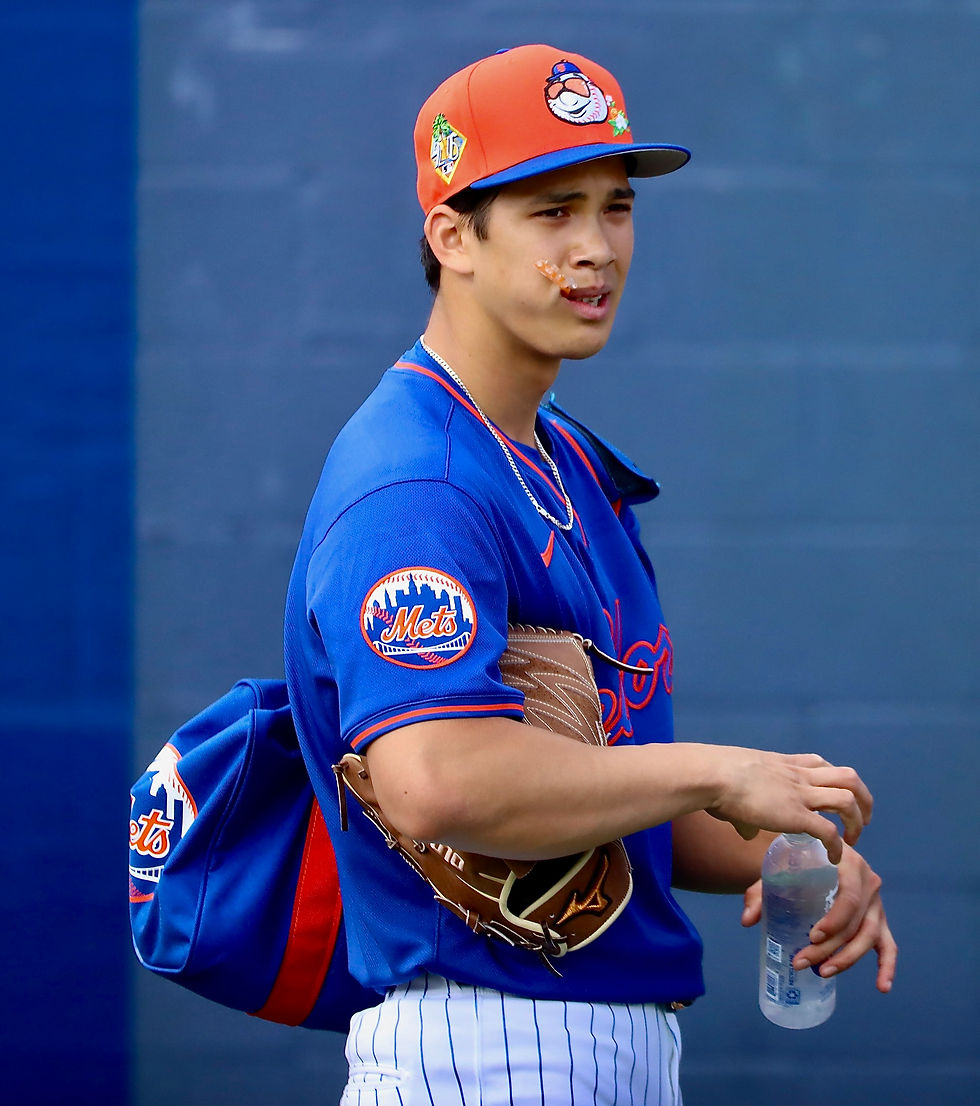
Tong, perpetually smiling, emphasized perspective over pressure. “My biggest thing… is just be myself… spring training is a great opportunity to work on things.” He added a sentiment that probably should be posted above every clubhouse doorway: “Leaving every day with a smile… this game is so much fun… we’re doing everything we want. This is a kid’s game.” When discussing technology and development, he saw it as a tool for reflection as much as correction. “It’s a really cool part… to fix things now but also address things in the future… seeing what you did when it was working.”
Manaea, healthy and upbeat, spoke about preparation and competition. “It feels great… I feel like I put a lot of work into this offseason and I feel good.” On the influx of experience and perspective around him he said, “They come from winning organizations… it’s great for us to mesh and use all this information toward the ultimate goal.” Asked what this staff could accomplish, he didn’t hedge. “Unbelievable things… I don’t think there’s any reason why we shouldn’t believe otherwise.”
By the time I stepped away from the clubhouse, day three had delivered its own narrative — not dramatic, not headline-screaming, but meaningful. There’s a seriousness here about preparation, an embrace of technology without losing the game’s heartbeat, and a clubhouse blending youth, experience, and optimism. If the first half of this trip has taught me anything, it’s that spring training isn’t about results — it’s about hints. And the hints, so far, suggest a team trying to maximize every inch, every rep, and every opportunity.
And tomorrow, of course, we’ll do it all again — with sunscreen, curiosity, and hopefully fewer arguments with imaginary strike zones.


Comments