
Mets Spring Training Day 5: Chess Matches, 115 Off the Bat, and a Clubhouse That Feels Different


Spring Training has a rhythm to it. The crack of the bat. The thud of a fastball into leather. The hum of golf carts. And apparently… the gentle click of chess pieces.
Day 5 began in the clubhouse, and what jumped out immediately had nothing to do with radar guns or exit velocity. It was Sean Manaea holding court with Jonah Tong, teaching him chess as if he were channeling Bobby Fischer rather than former Mets pitcher Jack Fisher.
Manaea wasn’t just explaining moves. He was explaining patience. Strategy. Consequence. He leaned over the board the way a veteran pitcher studies a scouting report, calmly outlining options, seeing three steps ahead. Tong listened like a rookie being handed the keys to a Ferrari.
At the end of the match, Tong had two possible moves. Either one would have ended in checkmate. Instead of calculating it out, he flipped a coin. Made his move. Lost.
Manaea smiled and calmly explained that either choice would have led to the same outcome.
His point wasn’t about winning the game.
It was about training the mind.
The lesson was simple and profound. Work the brain like you work your arm. Because pitching, at its essence, is a chess match. Every at bat is a series of moves and countermoves. You elevate here. You expand there. You show something soft to set up something hard. The hitter adjusts. You adjust again. Check. Counter. Checkmate.
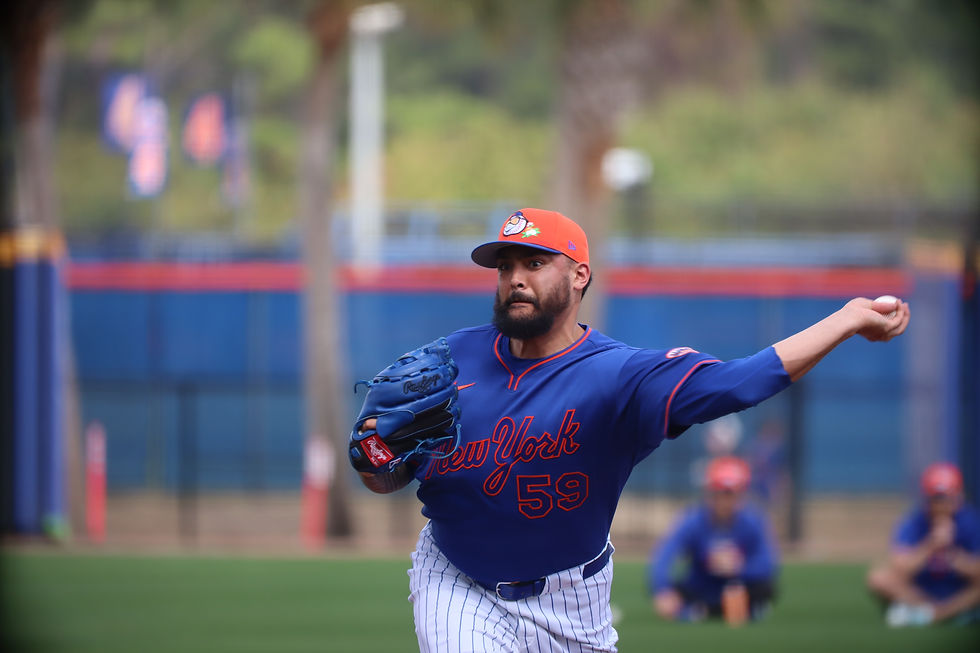
Out on the main field later, Manaea looked sharp throwing cross-body — the slot the Mets believe gives him his best version, the one that resembled his 2023 success. But before the bullpen session, there was the chessboard. And honestly, that told me just as much.
Then there was the arrival of Michael Tauchman.
The Mets signed Tauchman to a minor league deal on February 16, and if you’re building a roster in today’s game — where versatility is currency — his résumé reads like a frequent flyer card. He’s logged big league time with Colorado, the Yankees, San Francisco, the Cubs, and the White Sox, and even spent a year in Korea. He debuted in 2017, was a 10th round pick out of Bradley University, and once hit .425 as a senior, leading all of Division I.
But what struck me wasn’t the stat sheet. It was the perspective.
When I asked him about coming into camp with opportunity in the air, he didn’t blink.
“I mean, I think my focus is, like, getting ready for the season. And if there’s really anything I’ve learned in all the years of doing this is that 162 is a really long, really, really long time.”

That’s a man who has seen the marathon.
“I feel like I’ve never had a season where my expectations, really, or the expectations that have been given to me have stayed that the whole time. So my focus is just kind of on getting myself ready, obviously trying to make the club and being ready for opening day.”
When I brought up that magical .425 college season, he smiled like someone remembering a favorite song.
“I was a senior and I’d been a three-year starter going into that season. That’s kind of the cool thing about being in a program. You have years to develop. You’re developing your physical skills but at the same time you’re developing your mental skills because you start to pick stuff up. If they bring certain guys in in certain situations, you kind of know this is what they’re coming in to do. That year I was just kind of able to slow the game down.”
Slow the game down.
There’s that chess theme again.
Tauchman has played in big markets and playoff races. He’s learned from veterans like Charlie Blackmon and Brett Gardner. He understands reputation matters.
“Baseball feels like this massive thing, but at the end of the day it’s a pretty small community. Even sitting in the meeting yesterday, I know a dozen people here. I’ve tried to compose myself a certain way throughout my career and hopefully have a reputation as somebody who loves the game, wants to win. Your reputation does kind of precede you when you go places. That’s why it’s so important to make a good impression everywhere you go.”
When I asked about mentoring someone who might technically be competing with him for a job, he didn’t take the bait.
“I think competition overall is a good thing. I don’t really necessarily view it as competition, more like just a couple of guys trying to get ready for a season. When you step into a clubhouse and everybody’s in there, everybody in there is your teammate.”
That’s the tone of a pro.
Out on the fields, there was plenty to digest. Keith Hernandez arrived in camp and, selfishly, I bent his ear about my Strat O Matic draft this week. Baseball conversations with Keith tend to wander beautifully into the mid 60s Giants and A’s. He spoke glowingly about Blue Moon Odom like the man had just thrown a bullpen.
At third base, Bo Bichette looks more comfortable by the day. In the outfield, Juan Soto continues refining his routes and reads. And then there’s Luis Robert Jr..
If you hear a different sound off the bat, it’s probably him.
One of his balls today left at 115 mph off Sean Manaea. Not a typo. One fifteen. It wasn’t just loud, it was that kind of crack that makes you stop mid sentence and just stare for a second in awe. He moves gracefully for a big man and can absolutely go get it in the field. No matter what field in the complex he’s on, he just stands out.
On the back fields, Syracuse manager Dicky Scott oversaw live BP with Ryan Lambert lighting up the gun at 98 to 100. Hitters walked back to the dugout shaking their heads like a young Daniel LaRusso trying to catch a fly with chopsticks. Jared Young was the lone batter to square him up with any real authority.

I spent a few minutes talking with Scott about the possibility that arms like Jonah Tong and Christian Scott could begin the season with him in Syracuse, and he just smiled at the thought of it. He mentioned how strong the pitching staff could be if things fall that way, and added that the position player group is shaping up to be deep as well. Then he laughed and said he just hopes the manager doesn’t screw things up.
Later, Young and I chatted hockey, because when Canada beats Czechia in overtime on a Mitch Marner goal, you check in with the Canadian.
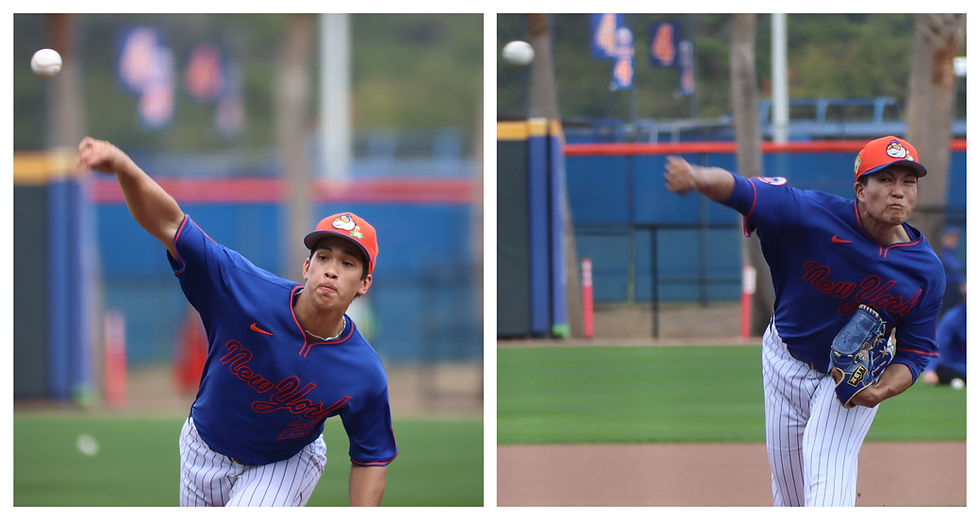
Back on the main mound, Kodai Senga drew positive reviews from hitters and impressed with his velocity. Carlos Mendoza later said he “got good feedback from the hitters on Senga’s stuff” and was pleased with Manaea’s work, noting that last year “at one point they felt he dropped his arm slot down too much and they got him back to where he had the most success.” Carlos Mendoza was also impressed with Tong’s fastball, especially considering the quality of hitters he was facing. Mendoza feels last year’s major league experience was important for him. He specifically pointed to Tong’s third big league start on September 12 against Jacob deGrom — no small assignment — a night that unraveled quickly. Two thirds of an inning. Six runs. Forty pitches.
But Mendoza’s takeaway wasn’t the line score. It was the response. Tong was able to push that start out of his mind and come back sharper the next time out.
Mendoza also confirmed Tauchman is very much in the mix.
“When healthy he can play all three outfield positions well. He controls the strike zone and can hit to the opposite field. He’s definitely in the competition for a roster spot.”
And yes, when Luis Robert Jr.’s name came up — again — Mendoza was clear the priority is keeping him healthy because the talent screams superstar.
The ABS challenge system will be a spring experiment too.
“We’re going to let the guys be aggressive with it,” Mendoza said, essentially using March to determine who has a feel for when to challenge and who might need to be reined in once the games count.
Back in the clubhouse, I caught up with David Peterson, who reflected on his All Star season and the workload that followed.

“I think once I got kind of past the workload from the season prior, I started to feel a little more,” he admitted. “That’s one thing for me this offseason, looking back to that experience. How did I feel? How can I learn from that experience and get used to the workload?”
On the All Star validation, he was candid.
“It’s a huge honor and an amazing experience. Being able to share it with my family was amazing. But it was nice to see, okay, I know exactly what level I’m capable of pitching at.”
There’s confidence there now. Earned confidence.
And then Clay Holmes, who spoke about the rotation’s upside.
“The top end has been there for all of us. It’s just a matter of how close can we get to our potential and how many of us can be there. It’s a very driven group. There’s a lot of guys that are hungry in here.”
On the addition of Freddy Peralta, Holmes said, “He’s a guy who’s done it for quite a few years now. Just his consistency and how good his work has been is putting us all in a better place.”
Holmes also lit up discussing pitch design.
“I love the pitch design process. I love that part of the game. For me to be able to throw more types of pitches and really add the changeup in and work on it was a lot of fun for me.”
Fun.
You hear that word a lot this spring.
Five days in, the vibe feels different. There’s talent. There’s depth. There’s 115 off the bat. There’s 100 on the gun. There’s chess in the clubhouse.
And there’s a team trying to train both the body and the mind for a very long season.
To watch the full interviews with Michael Tauchman, David Peterson and Clay Holmes, click here.


Comments