
Saturday Seasons, 2022: Buck Stops Here

The 2022 Mets were not as much about what was, but about what could, or should, have been. About a front office and roster overhaul that took the Mets to the playoffs, but not beyond.
So was the glass half empty or half full?
We’ll let you decide.
The overhaul began in November, shortly after the 2021 season ended, when owner Steve Cohen and head of baseball operations Sandy Alderson hired Billy Eppler to replace the fired Zack Scott as general manager. It was considered a relatively safe hire, unlike the reaches from the previous ownership that handed the reins to unproven hires such as agent Brodie Van Wagenen. Eppler had five years’ experience as the Angels general manager and spent 11 years in various roles with the New York Yankees.
As one unnamed baseball executive noted in a David Lennon Newsday column, “It could take some time, but I think he [Cohen] and Billy could be a great combo. I think Billy knows what he is doing and Cohen has the cash.”
“It’s a relief that I really feel good about [the Eppler hire], and just based on our conversations, I think … he is going to be an easy person to work with,” Cohen said in a statement announcing the hiring. “I really look forward to the whole team getting going here and filling our needs.”
Eppler’s first task? Hiring a manager to replace the fired Luis Rojas, who was thrust into the manager’s chair two years previously after Carlos Beltran resigned, without managing a game, after his role in the Houston Astros’ sign stealing scandal was revealed. Rojas, despite some early optimism tied to his baseball experience and pedigree (a son of longtime baseball player and manager Felipe Alou), never seemed to grow into the job. Pressure was on Eppler to find an experienced manager who would not require on-the-job training.
Eppler did consider some candidates with coaching but no managerial experience on their resume – Matt Quartraro, who would later be hired to helm the Kansas City Royals, and Joe Espada, who a few years later would get the Astros job – before turning to the most traveled candidate in field: former Yankees, Diamondbacks, Rangers and Orioles skipper Buck Showalter.

“In picking Showalter, Cohen isn’t guaranteeing success for the 2022 Mets,” Lennon wrote. “No one person, or any amount of money, is capable of that. But what Showalter does do is eliminate as much of the unnecessary risk as possible, and what’s more appealing to a hedge fund titan than that?”
Lennon added, “The Mets couldn’t afford to invest in any more growth opportunities with a rookie manager.”
Eppler also dug deeply into Cohen’s checkbook to remake the roster. He committed $78 million over four years for outfielder Starling Marte, $130 million over four for future Hall of Fame pitcher Max Scherzer, $26 million over two years for outfielder Mark Canha and $20 million over two years for infielder Eduardo Escobar. He traded for Oakland starter Chris Bassitt.
With a returning roster that included Pete Alonso, Francisco Lindor, Brandon Nimmo, Edwin Diaz, Jacob deGrom, Carlos Carrasco and Taijuan Walker, the Mets seemed poised to make a playoff run.
If there actually would be a season.
On December 1, 2021, as the collective bargaining agreement expired, baseball’s team owners locked the players out. Negotiations dragged well into 2022: the first screen-to-screen (it was conducted on Zoom) session did not occur until January 13. With no settlement in sight, the owners on February 18 canceled spring training and all spring training games through March 4 and told the players' union on February 20 that the last day to come to an agreement and have the season start on time would be February 28.
As February dragged into March, one of the issues in the negotiations appeared to be aimed directly at Cohen and the Mets – a new luxury tax tier, reportedly in response to Cohen’s willingness to spend on free agents. It was reported at the time that Cohen was okay with the surcharge if "MLB thought it was for the greater good."
The two sides did not reach agreement until March 10 – a pact that brought the designated hitter to the National League and expanded the number of playoff teams to 12 (from 10). Spring training camps opened the next day, with the season opener scheduled for April 7.
For the Mets, spring training began with a bang – literally: a Tampa car crash with a driver t-boning Pete Alonso’s truck as he was starting out to drive to Port St. Lucie. The truck flipped three times, but Alonso escaped unhurt. “One moment I was coming here to work, coming to spring training, and the next thing I know I’m kicking my windshield in trying to get out of a flipped-over car.
"Just really blessed to be here. Thankfully, nothing is wrong,” Alonso said.

This being the Mets, they did not get through the abbreviated preseason unscathed. deGrom was shelved with a “stress reaction” in his right shoulder and Scherzer suffered a tight hamstring; neither was available to start on opening day, so Tylor Megill got the nod.
Of course, the best pitcher to appear in the first week of the season was not on the mound, but, rather, outside Citi Field. Just before the home opener, the Mets unveiled a 10-foot high, 13 ½-foot long, 33,600-pound statue of “The Franchise,” Tom Seaver, in his characteristic drop-and-drive delivery.
“Hello, Tom,” an emotional Nancy Seaver said about her late husband, choking back tears. “It’s so nice to have you here where you belong.”
Added Hall of Famer Mike Piazza, who also spoke during the ceremony, “Tom Seaver is our royalty.”

(Later in the season, the Mets would honor two other legends, retiring Keith Hernandez’ number 17 and Willie Mays’ 24, even though Mays’ best New York years were in a Giants uniform)
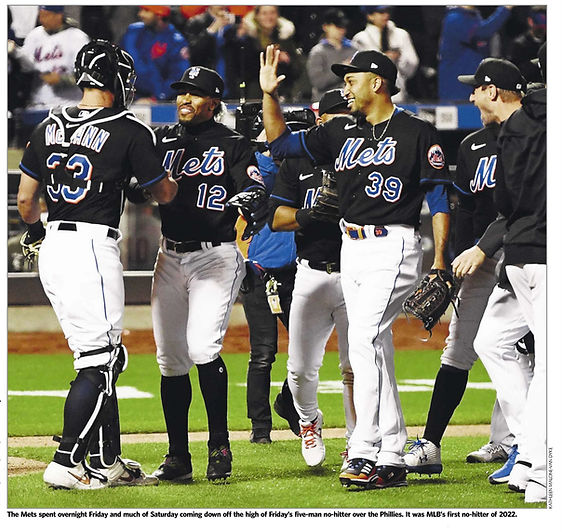
Under Showalter’s guidance, the team got off to a fast start in April, capping a 15-7 month with the oddity of oddities – a group no-hitter on April 29. Five pitchers contributed to hold the Phillies hitless in what was only the team’s second no-no and the first not aided by a helpful umpire’s call. Megill started, Drew Smith, Joely Rodriguez and Seth Lugo followed. By the time Edwin Diaz blew away Bryce Harper, Nick Castellanos and J.T. Realmuto, Mets hurlers had issued six walks but fanned 13 in what was then the 17th combined no-hitter in MLB history.
“The high of a lifetime,” Megill said.
“It was like seeing a buffalo on a unicorn,” Alonso added.

A week later, it was the hitters’ turn to set a record, also against the Phils. Trailing 7-1 going into the ninth, they rallied for seven runs to take the lead – sparked by a Lindor home run and capped by a Marte RBI single – before handing the ball to Diaz to notch the save. It was the team’s biggest ninth inning comeback in 25 years.
The writers were jumping on the Mets bandwagon, noting team camaraderie and the manager’s steady hand. “In an era where some managers can disappear behind calls from the analytics department and front office, Showalter is notable in that it feels as if he is actually making big decisions out there,” Laura Albanese wrote in Newsday.
This was a fun team to watch. The hitters were patient and worked counts in a way that has disappeared since the inception of the pitch clock. Pitchers stared down opposing batters. And Diaz? His appearance to the strains of Blasterjaxx’ Narco became must-see TV, especially the night Timmy Trumpet appeared live at Citi Field.
Lurking in the back of everyone’s minds, of course, was the previous season, when the Mets held first place for 103 days but ended the year with a losing record and watching the playoffs from their living rooms after an epic collapse. Could it happen again? Would it?
As the bats cooled off toward the end of July, Eppler imported one from the Pirates: Daniel Vogelbach, essentially a pure designated hitter who worked counts so aggressively he supplanted Steve Trachsel as the holder of the nickname “Human Rain Delay.”
Moves were necessary because while the Mets remained winning, the Braves were hotter and a lead that was 10 games at one point was down to 1 ½.
“Eppler looks primed like a man who’s one hand of poker away from winning back the family farm,” Albanese wrote. In trades, Eppler acquired outfielders Tyler Naquin and Darrin Ruf, the former for prospects that never made it and the latter for J.D. Davis and no-name prospects. Eppler gets an ‘A” for effort, but neither of those two moves worked out, and the Mets would end up missing Davis’ bat both in 2022 and 2023.
The moves were uninspiring, but Eppler said he did not want to mortgage the future by giving up top prospects (maybe he read up on the Pete Crow-Armstrong for Javier Baez deal his predecessor made the year before)
The rotation got a boost not from a trade, but from the IL. Out of action for more than a year, deGrom made his first appearance on August 2, allowing one run while striking out six in five innings. The Mets would lose that game after deGrom left, snapping a seven-game win streak, but the outlook for the rest of the season looked rosier.
It would be unfair to say the Mets collapsed from there – they went 36-23 to finish the season at 101-62 and clinched a playoff spot on September 19. But win the division? That was another story. The Braves were hot, too, and the division came down to who would win a three-game series in Atlanta September 29-October 1, which the Mets entered leading the Braves by one game. They left Atlanta two games out of first after dropping all three to the Braves, thanks to unlikely bad pitching performances from all three starters, deGrom, Scherzer and Bassitt, and some very cold bats.
Still, they entered the Wild Card round as favorites against the Padres, a team that finished 14 games behind them during the regular season, with Scherzer, Bassitt and deGrom lined up to avenge the lost weekend in Georgia. To provide an additional spark, Starling Marte, shelved since fracturing a finger when hit by a pitch in early September, returned to the lineup for game 1.
Placed in a crucial situation, Scherzer did his best to channel Tom Glavine, allowing seven runs in a little over four innings while the Mets could only manage one: a 7-1 loss. Facing elimination, Showalter rejiggered his rotation and sent deGrom to the mound. Led by Brandon Nimmo’s three hits and homers by Lindor and Alonso, Mets bats woke up and their beat the Padres, 7-3, forcing a win-or-go-home game three, with Bassitt on the mound.
After a solid first inning, Bassitt unraveled in the second, allowing two runs after two were out, thanks to two walks, and three runs overall in four innings. Not that it mattered. Padres starter Joe Musgrove pitched as if he were Cy Young, holding the Mets to a single hit – an Alonso single. Final score: Padres 6, Mets 0.
All of which dredged up the major blemish on Showalter’s resume: While he had made every team he took over better, they didn’t get to the World Series until after he left.
He’d get one more shot – but only one – with the Mets to erase that curse.


Comments