
Saturday Seasons: For 2023, Another Bizarre Injury, A Sticky Situation and A Fire Sale


The New York Mets hoped to build on their 101-win 2022 season by adding high-salaried free agents who would propel them past the wild card round in 2023. Instead, they ended up a major disappointment, a 26-win swing in the wrong direction as they were beset by injuries (real and phantom), underperforming veterans and, and, at least in this writer’s analysis, a failure to recognize the impact of new rules changes that should have prompted a different overhaul of the roster.
The 75-87 record – only the fourth time an MLB team would post a losing record after a 100+ win campaign – would feature a trade deadline fire sale that raised questions not only about the remainder of the 2023 season but the prospects for 2024 and would end up costing manager Buck Showalter his job. General manager Billy Eppler would lose his, too, amid accusations that he had played fast and loose with the Injured List to add roster flexibility.
As the 2022 season ended, Eppler did have a formidable task in replenishing a starting rotation depleted by 40 per cent when Jacob deGrom and Taijuan Walker left in free agency. Eppler responded by signing two veteran pitchers: future Hall of Famer Justin Verlander (reuniting him with his former Tigers teammate, Max Scherzer) and Jose Quintana. Both contracts were short-term, two years, which seemed prudent given their advancing age. He lured Japanese pitching star Kodai Senga and his ghost fork, with a five-year deal. To bolster the bullpen, Eppler traded for Brooks Raley and signed David Robertson one-year deals, providing what seemed like solid setup men for closer Edwin Diaz, whom Eppler re-signed.
With a lineup headlined by Francisco Lindor, Pete Alonso (signed to a one-year deal to avoid arbitration) and reigning National League batting champ Jeff McNeill, the Mets once again on paper looked like solid contenders to surpass (rather than tie) the Atlanta Braves for the Eastern Division championship.
But no sooner had spring training started than the injuries started piling up, including one that ranks right up there in the pantheon of bizarre Mets injuries.
Let’s start with the “normal” one first: In early March, just before he was to leave to pitch for his native Colombia in the World Baseball classic, Quintana – who had a reputation as a reliable innings eater – suffered a stress fracture in one of his ribs. He wouldn’t make his first appearance in a regular season game until late July, after undergoing bone graft surgery to repair the rib and a lesion that was discovered during imaging for the rib fracture. By then, the season was lost.
The bizarre injury: the season-ending one Diaz suffered two weeks later, tearing the patellar tendon in his right knee not while in the heat of competition but while celebrating Puerto Rico’s World Baseball Classic championship.

How exactly did it happen? “Who cares?” Showalter was quoted as saying. “I don’t really care. You’ve got people that are trying to figure out who…Nobody’s at fault….Could have happened 20 times last year in some of the celebrations we had.”
Suddenly, Robertson was bumped up from his setup role to the closer; some of the lead would also be shouldered by another former Yankee, Adam Ottavino.
The next pitcher to go down was Verlander, who, just before Scherzer was about to throw the Mets’ first regular-season pitch, ended up on the IL with a low-grade muscle strain in his right side; he would miss a month. “It feels like crap,” Verlander said of missing the beginning of the season. “Not the way I wanted my Mets tenure to start, that’s for sure.”
A couple of weeks later, Scherzer got the Mets into a sticky situation – literally—when he was ejected from a game against the Dodgers and suspended for 10 more when home plate umpire Phil Cuzzi accused Scherzer of applying a foreign substance to a baseball. Scherzer protested mightily and said the sticky substance was rosin that became clumpy because of sweat on his hand. Scherzer noted that the inning before he was ejected, Cuzzi ordered him to change his glove and wash his hands with alcohol – while an MLB official watched.
“I knew I was going to get checked in the fourth,” Scherzer said. “I’d have to be an absolute idiot to try to do anything when I am coming back out for the fourth. I am in front of the MLB official that is underneath [near the dugout]. I wash my hand with alcohol in front of the official. I then apply rosin and I then grabbed sweat. I then go back out there and Phil Cuzzi says my hand is too sticky.”
But plate umpire Dan Bellino stuck to the crew’s contention that Scherzer’s hand contained more than sweat. “As far as stickiness, this was the stickiest that it has been since I have been inspecting hands, which goes back three seasons,” Bellino said. “Compared to the first inning, the level of stickiness, it was so sticky that when we touched his hand, our fingers were sticking to his hand. Whatever was on there remained on our fingers for a few innings afterwards [so] that you could still feel the fingers were sticking together…It was far more than we have ever seen before on a pitcher in live action and we understand the repercussions of removing a pitcher from the game, we take that very seriously and with the training we have been given by Major League Baseball to check … this is clearly something that went too far, it went over the line.”
Other rules had subtler, but still important effects on the 2023 Mets: the implementation of the pitch clock and the banning of the shift.
Part of what made the 2022 Mets so effective is the way their batters worked counts, largely by stepping out of the box after each pitch and disrupting the opposing pitcher’s rhythm. The two best examples were Mark Canha and Daniel Voglbach, who would spend so much time between pitches during an at-bat that that they were the hitting version of Steve Trachsel, the former Mets pitcher nicknamed The Human Rain Delay. But the pitch clock also applied to batters, who needed to return to the box within eight seconds after a pitch, a rule that robbed Canha, Vogelbach and some other Mets of a key weapon against opposing pitchers. Their effectiveness diminished.
So did Jeff McNeill’s, the reigning NL batting champ who used to hit against the shift and drop balls where fielders weren’t. But with the shift banned, there were now fielders where open spaces used to be, and McNeill’s average dropped 56 points, from .326 to .270.
At its best, the team was inconsistent: 15-12 to open the season, 14-15 in May and then a June swoon that seemed to take them out of any serious playoff contention. Then a June swoon: 7-19, followed by a hotter streak to raise their record to 42-48 at the All Star Break. And Eppler and owner Steve Cohen were faced with the crucial decision on whether to be buyers or sellers at the trade deadline.
They decided to sell, starting with Robertson, whom they traded to the Marlins for two low-level prospects (one has made it to Binghamton this year; the other is still at Brooklyn). Then they had a heart-to-heart meeting with Scherzer, who agreed to waive his no-trade clause and be traded to the Texas Rangers for Luisangel Acuna.
Most troubling about that conversation, apparently, was the Mets’ assessment that not only would they not contend in 2023, but that 2024 would be a washout, too. "When you do hear that they're going to pull the plug on '23, yeah, that's disappointing," Scherzer said. "A common viewpoint among all of us players, was that, 'OK, let's go for it in 2024 and we got the talent here to do it.' I think obviously that wasn't the direction."
At the time of the Scherzer trade, the Mets were 50-55 and 6 ½ games out of the final NL Wild Card spot. Despite rumors that a toxic environment led to the Mets' struggles, Scherzer said it was "a great clubhouse" and the team still believed they could get back into the playoff race.
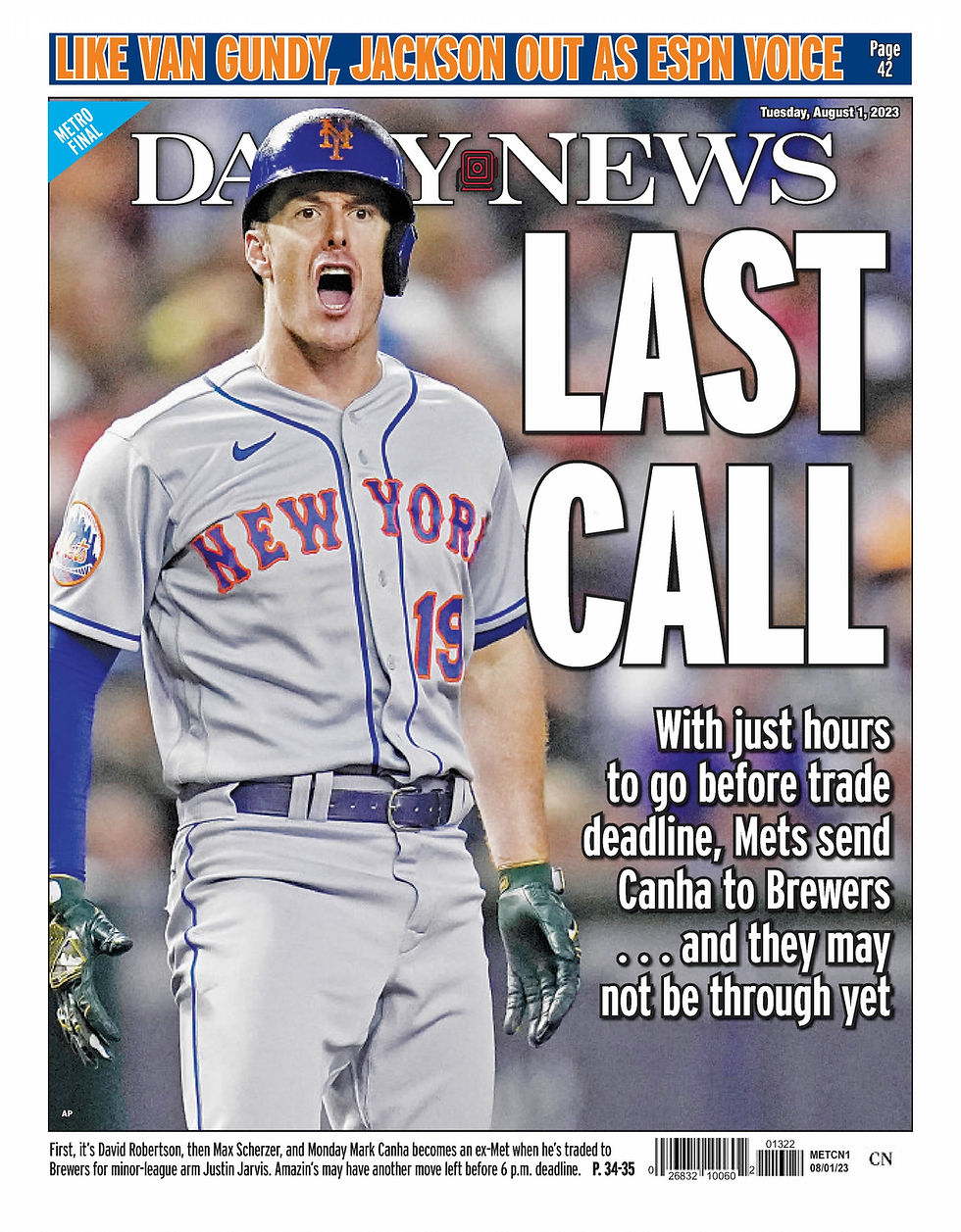
But management had already thrown in the towel. In quick succession, they traded Canha to the Brewers for a pitching prospect, Justin Jarvis (now playing in the Mexican League). Verlander went to the Astros for Drew Gilbert (traded in 2025 as part of the Tyler Rogers deal and now with the Giants) and Ryan Clifford (currently hitting .216 at Syracuse, but with eight home runs).
Tommy Pham went to the Diamondbacks, but not before some parting comments in the Athletic: “Out of all the teams I played on, this is the least-hardest working group of position players I’ve ever played with,” Pham was quoted as saying, although he did except Lindor and a few of the other stars.
With the white flag flying, it should be no surprise that the Mets sank even further after that – an August swoon (11-18) followed by a so-so September and a fourth-place finish.
The end of the season did bring some cause for optimism from owner Cohen, who for more than a year had eyed the Brewers’ David Stearns to become the Mets’ head of baseball operations once his Brewers contract had expired. In expectation of Stearns coming on board, Cohen fired Showalter, saying that Stearns should have the power to hire his own manager.
Eppler was supposed to stay on as general manager, reporting to Stearns, but that plan quickly evaporated when it was revealed that MLB was investigating Eppler for playing fast and loose with the Injured List, fabricating injuries for healthy players to increase roster flexibility. While the numbers didn’t raise any suspicions – the Mets were tied for 16th in the number of times the Mets placed players on the IL, an anonymous letter cited seven specific cases.
Eppler resigned and was eventually suspended from baseball until the end of the 2024 World Series. MLB’s investigation concluded that Eppler had acted alone, without involvement of Mets ownership. And so the streak of Mets GMs leaving under a cloud reached three.
A fitting end to a thoroughly disappointing season.


Comments