
Sunday School: Forgotten Faces of Flushing #61: Lou Niss and the Mets Hall of Fame Case Nobody Talks About


Welcome back to Sunday School: Forgotten Faces of Flushing, our weekly stroll through the Mets attic where the yearbooks are a little worn, the bubble gum cards stick together, and every once in a while you come across a name that makes you stop and say, “Wait a second… how did we forget that guy?”
Last week we talked about the time the Mets brought in Hall of Fame pitcher Bob Gibson to serve as what manager Joe Torre jokingly called the team’s attitude coach. Because if your pitchers need a little edge, why not bring in the man who once glared at hitters like he already had their obituary written.
This week’s lesson stays in that same neighborhood of Mets lore. The overlooked. The under appreciated. The people who were there for everything but somehow slipped between the pages of history.
Which brings us to today’s Sunday School trivia question.
Who is the only person to appear in every official New York Mets team photograph from 1962 through 1980?
And no, the answer is not Ed Kranepool.
We will get to the answer in a moment.
But first a quick observation from the back of the classroom.
The Mets have a franchise Hall of Fame that honors the players, broadcasters and figures who helped shape the club’s story. Yet from time to time, someone essential seems to get overlooked. A perfect example was longtime Shea Stadium organist Jane Jarvis, whose music was part of the soundtrack of Mets baseball for years before she was finally recognized. If you missed that story, we covered her in Chapter 49 of this Sunday School series.
Today’s subject belongs in that same conversation.
His name was Lou Niss.
And if you ever owned a Mets yearbook in the 1960s or 1970s, you have seen him whether you realized it or not.
Flip through those old team photos from the Polo Grounds and the early Shea Stadium years. Players in uniform. Coaches in jackets. And somewhere in the group there is always a smaller gentleman wearing glasses and a suit.
That was Lou Niss.
He was not a player.
He was not a coach.
He was not even a manager.
He was the Mets traveling secretary from the birth of the franchise in 1962 until early 1980.
In fact, Niss holds a piece of Mets trivia that almost sounds impossible.
He was the first person the Mets ever hired for their front office.
Before the team even had a season under its belt, Lou Niss was already helping build the organization.

What makes the story even more interesting is that baseball was not his first career.
Lou Niss began as a newspaperman.
Born Louis Nisonoff in 1903 near Minsk in what was then part of the Russian Empire, he immigrated to the United States as a child with his family. They eventually settled in New York, and for a time he even attended Flushing High School, not far from where Shea Stadium would stand decades later.
By the early 1920s he was already writing sports for local newspapers. One job led to another until he found himself in Brooklyn covering sports for several papers, eventually rising to become sports editor of the Brooklyn Eagle.
That meant he covered the old Brooklyn Dodgers long before the Mets existed. It also meant he became part of sports history in ways that rarely get mentioned. His assignments were not limited to baseball either. During his career he covered major boxing events as well, including the heavyweight bout between Joe Louis and Buddy Baer, proof that long before the Mets ever took the field he was already ringside for some of the biggest moments in American sports.

During the 1940s Niss developed a close working relationship with legendary executive Branch Rickey. Rickey, of course, was the man who signed Jackie Robinson and shattered Major League Baseball’s color barrier.

While Rickey receives the rightful credit for the vision, Niss worked quietly behind the scenes helping prepare the ground for Robinson’s arrival. He spent countless hours speaking with community leaders, journalists and people within baseball to help make sure the transition would succeed.
It was the kind of work that rarely ends up in headlines but helped shape one of the most important moments in sports history.
When the Brooklyn Eagle folded during a strike in 1955, Niss moved into public relations work and eventually joined another project connected to Rickey. The proposed Continental League, an ambitious attempt to create a third major league.
The Continental League never played a single game.
But it accomplished something else.
It pushed Major League Baseball to expand.
And one of those new teams was the New York Mets.
Because of his work with the Continental League and his deep connections in baseball, Niss joined the Mets organization in its earliest days. At first he worked in public relations before moving into the role that would define his Mets career.
Traveling secretary.
If you want a job in baseball that requires patience, diplomacy and the occasional miracle, that is the one.
The traveling secretary handles the logistical circus of a baseball team on the road. Flights, buses, hotels, schedules, tickets, equipment shipments, itineraries and a hundred other details fans never see. When something goes wrong, the traveling secretary is usually the first person to hear about it.
And sometimes the loudest.
1969 Mets outfielder Art Shamsky once summed up the job perfectly. He said the ideal traveling secretary is someone who can absorb complaints, handle pressure and be just a little hard of hearing.
According to Shamsky, Lou Niss fit the description perfectly.
Niss was there for everything in the early Mets years. He saw Casey Stengel try to steer the original expansion roster through those chaotic early seasons. He later watched the team rise to respectability under Gil Hodges.
And when the Mets shocked the baseball world in 1969, Lou Niss received a World Series ring alongside the players.
He wore it proudly.
Because in his way he had been part of the journey since the very beginning.
Niss finally retired after the 1979 season, closing out nearly two decades of service to the franchise. He remained a familiar presence at Shea Stadium and lived long enough to see the Mets win another championship in 1986.
Lou Niss passed away in 1987 at the age of 83 after more than fifty years around the game he loved.
Most fans never knew his name.
But if you owned a Mets yearbook between 1962 and 1980, you absolutely saw his face.
Which brings us back to the trivia question.
Who is the only person to appear in every New York Mets team photograph from 1962 through 1980?
Not Ed Kranepool.
The answer is Lou Niss.
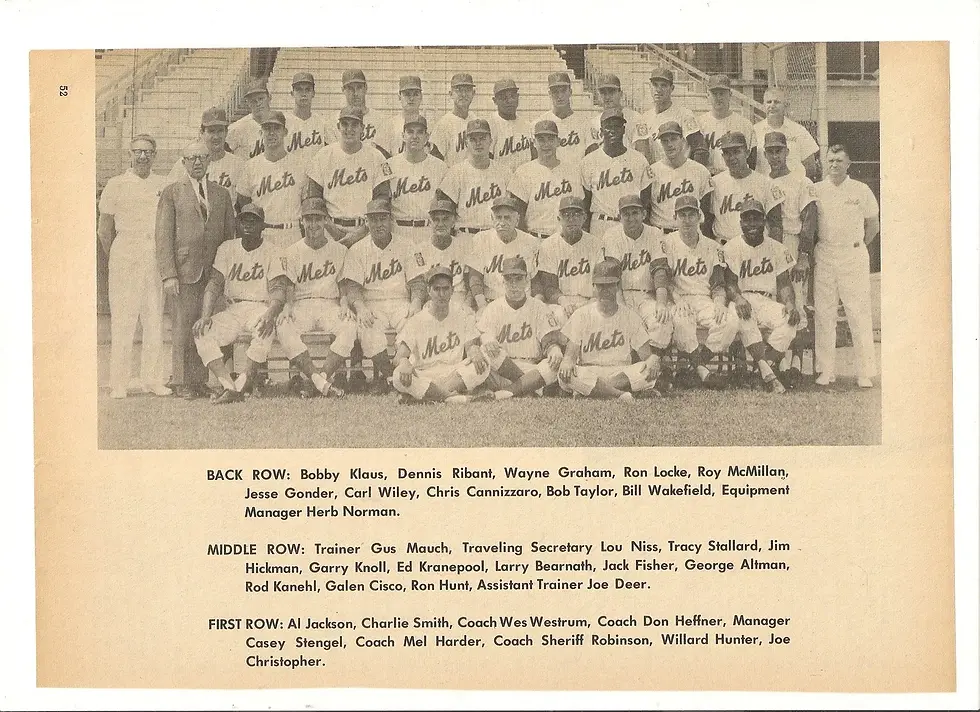
And maybe someday the Mets Hall of Fame will recognize the man who quietly appeared in every snapshot of the franchise’s first two decades.
Before you close the yearbook and head out of class, come join the conversation in our Facebook group. Sunday School works best when Mets fans start digging through the attic together remembering the players, the characters and the names that make you say “I can’t believe I forgot about him.” Bring your memories, your trivia and the forgotten faces you think deserve their own lesson. Around here class participation is always encouraged.


Comments