
Sunday School: Forgotten Faces of Flushing #49 : Jane Jarvis: The Jazz Genius Who Gave Shea Stadium Its Soundtrack

Welcome back to Sunday School: Forgotten Faces of Flushing, our weekly rummage through the Mets’ attic, where we brush the dust off the bubble-gum cards, rummage through the old yearbooks, and rediscover the players who made you pause mid–potato knish and mutter, “Hold on… he was a Met, right?”
Last week, we dove into the rarest of Mets species, the two-sport unicorn himself, DJ Dozier, NFL running back, major-leaguer, and a man who collected job titles the way the rest of us collect old scorecards.
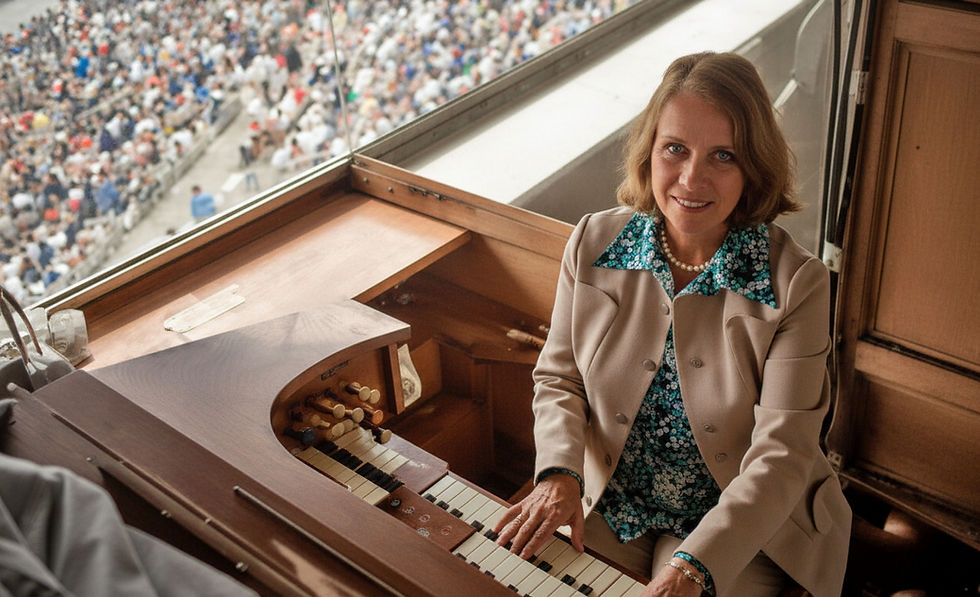
This week, though, we are flipping the turnstile in a completely different direction. No gridiron grit. No dual-sport mystique. Instead, class, we are going from DJ to the DJ, the woman whose music literally soundtracked Shea Stadium. Dust off your organ-lesson memories and tune those ears, because next up is the legendary Jane Jarvis, the First Lady of Flushing’s keyboards.
If Shea had a soundtrack, she wrote it. If Mets fans had goosebumps, she caused them. And if the umpire had just blown a call, she had a tune for that too.
Jane’s story is bigger than baseball and louder than the Shea PA system and far more interesting than most of the Mets teams she performed for.
Born in Indiana, she was the kind of child prodigy who could play anything you threw at her, from hymns to jazz standards to department store jingles, probably “Meet the Mets” before it even existed. By the time she was barely tall enough to see over a keyboard, she had a radio gig accompanying major entertainers. Real entertainers, the kind you did not have to wait through a rain delay to see.
Her life reads like a jazz chart, brilliant highs, rough breaks, improvisation at every turn. She lost her parents young, poured herself into music, and became so good she essentially collected conservatories like baseball cards. Eventually, Milwaukee discovered her, plopped her into a glorified submarine of an organ booth at County Stadium, and told her to play something cheerful while the windchill tried to kill her.

She did that for years, long enough to soundtrack a World Series, before New York called. And in 1964, when Shea Stadium opened and the Mets were still trying to figure out which direction to run the bases, Jane Jarvis took her seat at the organ and instantly became the most polished thing in the ballpark.
If Jane Jarvis’ life were a jazz chart, her Mets years would be the bridge, an unexpected key change, surprising harmony, and somehow the most joyful part of the tune.

By the time she arrived in Queens, she had already lived three or four musical lives, from child prodigy to radio staff pianist at age twelve to Chicago Conservatory standout to big-band wanderer to television musician to Milwaukee Braves organist who learned baseball on the fly. Literally. “I had never been to a baseball game. I couldn’t even get a passing grade in gym. And my eyes cross if you throw a ball at me,” she said in her September 3, 1995 interview with Mark Rowe for the Jazz Archive at Hamilton College.
That was Jane, self-deprecating, brilliant, funny in a bone-dry Midwestern way that Mets fans immediately recognized as a spiritual cousin to Ralph Kiner.
Her unlikely baseball detour began with a call from the Milwaukee Braves, and her reaction was priceless. “I took music so seriously and that seemed so frivolous, you know,” she told Rowe in the 1995 interview. But she took the gig, learned the rhythms of the ballpark, and found herself in a job she never planned for but turned into high art.
When the Braves prepared to move to Atlanta, team president John McHale called her again, this time offering relocation. Jane’s answer changed Mets history. “He wanted to know if I’d like to move to Atlanta. And I decided no. As long as I was going to make a move it was going to be a complete one, and where else but New York for jazz,” she said in the Hamilton College interview.
So she came to New York, a single mother, a working musician, a jazz improviser with perfect pitch and impossible drive, and took on the ballclub that needed her next.
“I went to the new club owners of the New York Mets and they hired me because I had experience,” she explained in the 1995 interview.
Just like that, Shea Stadium got a new sound.
Within 24 hours of landing in New York, she was already on a gig with Milt Hinton and Osie Johnson. “And I thought, oh, I’ve got it made,” she laughed in the Hamilton College interview. Reality hit soon after, the dry spells, the hustle, the grind. But the Mets gave her something different: stability, visibility, and an audience of 40,000 every night.
She was not just background music; she was atmosphere. Shea Stadium felt different when she played. Her jazz sensibility shaped everything she touched, refusing the corny organ clichés and even refusing to play the now ubiquitous “charge” fanfare. “I never did play that,” she said flatly in her 1995 interview. And bless her for it.
Her Mets repertoire was not shtick; it was musical storytelling. She played standards and snippets and moods. She played baseball, not just organ.
And somehow, improbably, Mets fans understood her. They did not just hear her, they listened.
What makes Jane’s Shea tenure so magical is that it was never supposed to happen. Not according to baseball tradition. Not according to jazz circles. Not according to the career expectations for a woman musician in the mid twentieth century.
But Jane never followed a map. She improvised her entire life.
She could go from writing symphonic music, which she abandoned because “I’m constitutionally unable to play anything the same way,” to arranging for the greats to producing over 300 recordings for Muzak. She could sit down at Shea Stadium and turn a baseball game into a jazz gig simply by being herself.
Her musicianship seeped into everything. Even in conversation, she described life as sound. “Everything in life is a sound to me,” she explained in the 1995 interview. “Your speaking voice has a series of sounds… I can almost tell you what your range is.” Imagine having that kind of ear while playing 81 games a year outdoors with jet engines taking off over your head.
She gave players theme songs. She gave fans energy. She gave Shea a soul.
And when chaos broke loose, whether during a blackout or whenever Pete Rose tried to become a human bowling ball, she steadied the crowd with a few well placed notes. If Ralph Kiner was the voice of the Mets, Jane Jarvis was the heartbeat.
Still, after 15 seasons in Queens, she walked away to follow her first love, jazz. And she was good. Really good. The kind of good that makes critics reach for words like “encyclopedic” and “top notch” while Mets fans mumble, “Why doesn’t Citi Field sound like that anymore?”
Here is the wild part. Jane Jarvis has not played a note at Shea since 1979, and yet modern Mets fans still know her name.
Think about that. Mets fans can barely remember who played shortstop last year, but they remember the organist from the 1960s and 70s.
Her name pops up on broadcasts. On social media. In fan forums. In those “Only True Mets Fans Know…” quizzes that circulate every spring. YouTube compilations of her organ work exist. Reddit threads debate which of her runs was the coolest. Younger fans discover her online and instantly ask, “Why don’t we have this anymore?”
She became a symbol.
Not just of Mets history, but of Shea history.
A reminder of the analog era, when music was not loaded from a laptop but played by a human being who could read the vibe of 40,000 people like a conductor reads a symphony. When ballparks had personality and quirks and flavor instead of corporate soundscapes designed to sell you an energy drink.
Jane Jarvis’s name still echoes because she represents an age when Shea Stadium wasn’t merely where the Mets played, it was where fans lived their summers. And she was the soundtrack playing underneath every memory.


Comments