
Sunday School: Forgotten Faces of Flushing #80 — Frank Howard: The Washington Monument Who Tried to Build a Mets Foundation

Last week in Sunday School, we continued our month-long look at one of baseball’s strangest job descriptions…
Interim Manager.
The man with the clipboard but no guarantee.
The guy asked to steer the ship after someone else has already hit the iceberg.
We first met Salty Parker, the original Mets emergency captain, who briefly grabbed the wheel during the franchise’s inaugural season.
Then came Roy McMillan, the former “Mr. Shortstop” who went from Yogi Berra’s trusted coach to the man suddenly responsible for finishing a sinking 1975 season.
McMillan wasn’t hired to change history.
He was hired to survive it.
And that is often the forgotten job of an interim manager.
This week, we meet the third man to temporarily inherit the Mets dugout.
A man who was impossible to miss.
Literally.
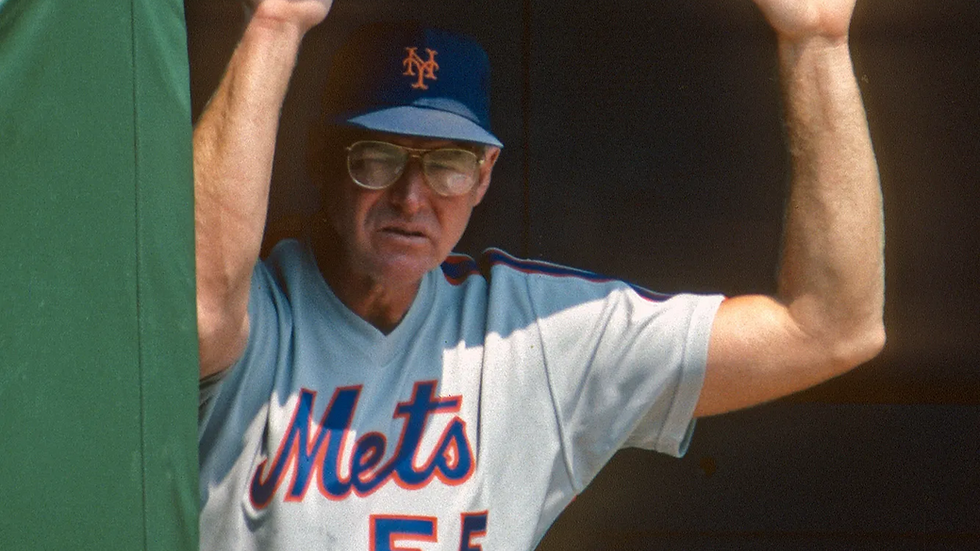
Frank Howard.
Before he ever wore a Mets uniform as a manager, “Hondo” was one of the most physically intimidating hitters baseball had ever seen.
At 6-foot-7 and nearly 300 pounds, Howard didn’t walk to the plate.
He arrived like a moving company delivering a piano.
Pitchers looked in and thought the same thing everyone else did:
“Wait…that’s the guy I have to throw to?”

Howard earned his reputation with the Los Angeles Dodgers before becoming the face of the Washington Senators franchise. He was a Rookie of the Year, a four-time All-Star, and one of the most feared power hitters of his era.
During his years in Washington, he became known as “The Capital Punisher.”
And the nickname fit.
Frank Howard didn’t hit baseballs.
He sent them into witness protection.

But by the time he arrived in New York, the home run totals were behind him. Like many great players, he discovered the second chapter of a baseball life:
Teaching.
Helping.
Passing along the lessons learned from decades inside the game.
And that eventually brought him to the Mets.
Howard joined the Mets organization as a coach in 1982, serving as first base coach under manager George Bamberger. The Mets were still searching for an identity, still several years away from becoming the powerhouse of the mid-1980s.
They were a team under construction.
Unfortunately, the construction crew had misplaced the instructions.
The 1983 season began with optimism, but by June, the cracks were showing. The Mets stumbled out of the gate, and on June 3, Bamberger resigned as manager.
The Mets needed someone to finish the job.
They looked down the dugout.
And there stood Frank Howard.
The giant former slugger.
The respected baseball man.
The guy who had spent years watching, learning, and absorbing every detail of the game.
Congratulations, Frank.
You’re the boss.
No pressure.
Just manage a young team that finished last place the year before.
No problem.

Howard inherited a Mets club that was still finding its way. The roster featured young players like Darryl Strawberry and Ron Darling, veterans trying to hang on, and a franchise that was still searching for the magic that would arrive just two years later.
Under Howard, the Mets played respectable baseball but continued to struggle. In 116 games at the helm, New York went 52-64, finishing sixth in the National League East.
The record wasn’t spectacular.
But managing the Mets in 1983 was never just about wins and losses.
Howard’s job was to help develop a young team and provide stability during another transition period.
And that is the funny thing about interim managers.
They often arrive during the storm.
They rarely get credit when the clouds finally disappear.
After the season, the Mets moved in another direction, hiring Davey Johnson as manager.

Howard returned to his role as a coach, continuing a baseball career that would eventually include stops with the Brewers, Yankees, Mets again, and Devil Rays.
He remained one of those baseball lifers who never really left the game.
Because some people retire from baseball.
Frank Howard never did.
He simply changed seats.
From the batter’s box…
to the dugout…
to the coach’s box.
The man who once terrified pitchers became the man trying to teach the next generation how to survive them.
Interim managers rarely get statues.
They rarely get parades.
They are the bridge between what was…
and what comes next.
Frank Howard managed the Mets for 116 games.
A small footnote in a remarkable baseball life.
But for one summer in Queens, the man known as the Washington Monument stood tall in the Mets dugout.
And that’s why he deserves his place among the Forgotten Faces of Flushing.
Next Sunday: We continue our journey through the men who briefly held the Mets’ top job, another interim manager who stepped into the dugout.
Class will once again be in session.


Comments