
Sunday School: Forgotten Faces of Flushing #85: Gene Clines — The World Champion Who Became a Met


Last week, we took a trip back to 1975 and remembered Randy Tate, the young Mets pitcher who came within five outs of throwing a no-hitter at Shea Stadium.
Instead, he lost the game.
The next day, Yogi Berra lost his job.
Because, well...Mets history.
This week, we're sticking with the 1970s, but we're going in a slightly different direction.
Our forgotten face is a player who arrived in New York with something Randy Tate never got to experience as a Met: a World Series ring.
His name was Gene Clines and he was the Mets starting left fielder on opening day in 1975.
And if you're wondering how a World Series champion somehow ended up becoming a Forgotten Face of Flushing, welcome to the Mets.
Clines was born in San Pablo, California, and was selected by the Pittsburgh Pirates in the sixth round of the 1966 draft.
He was fast.
Really fast.
He could play all three outfield positions, had a good glove and brought the kind of speed that could turn an ordinary single into a double before the opposing defense had finished discussing what just happened.
He reached the majors with Pittsburgh in 1970 and quickly established himself as a useful part of a very good Pirates club.
Then came 1971.
The Pirates won the National League East, beat the Giants in the NLCS and defeated the Baltimore Orioles in a memorable seven-game World Series.
Clines had a World Series championship ring.
And he wasn't just a spectator.
He was part of a Pirates team that was making history in another way, too.
On September 1, 1971, Clines was in the lineup when Pittsburgh became the first major-league team to field an all-minority starting lineup.

So by the time the Mets acquired him, Gene Clines had already been part of a World Series championship and a significant moment in baseball history.
Not exactly your typical Forgotten Face.
On October 22, 1974, the Mets acquired Clines from Pittsburgh in exchange for catcher Duffy Dyer.
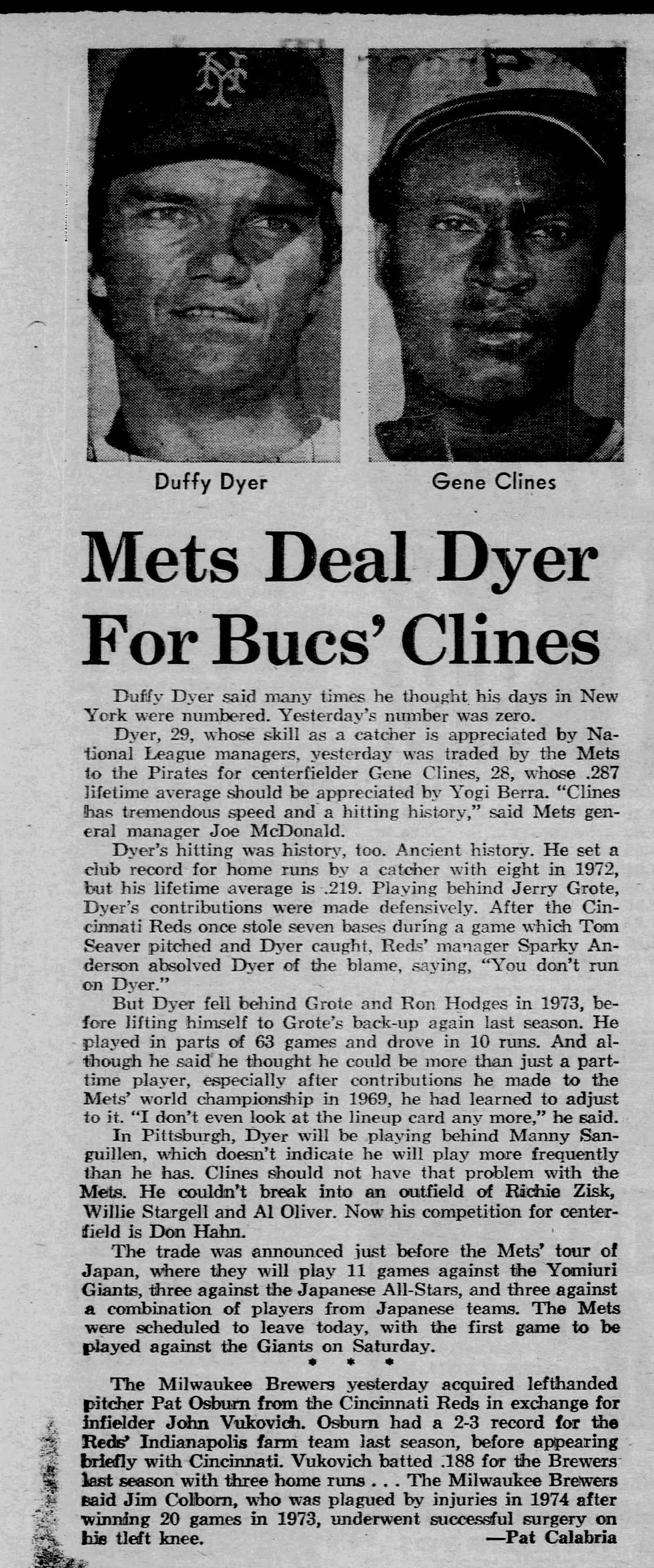
The Mets were hoping to add some speed, defense and versatility to their outfield.
Clines arrived in Queens having hit .334 in 1972, the best batting average of his career.
The problem was that the Mets weren't exactly acquiring him at the peak of his career.
By 1975, his production had slipped.
He played in 102 games for New York and hit .247.
There were flashes of the player Pittsburgh had enjoyed, but the Mets were entering one of those periods where a lot of things seemed to be happening at once—and very few of them were particularly good.
Remember, this was the same 1975 club that employed Randy Tate, watched Yogi Berra get fired and finished the season 82-80.
In other words, Gene Clines arrived just in time for the Mets' version of musical chairs.
Clines spent only one season in Flushing.
Following the 1975 campaign, the Mets traded him to Texas for Joe Lovitto.

And just like that, Gene Clines became another name on the ever-growing list of players who wore a Mets uniform long enough for the equipment manager to learn their shoe size, but not long enough for fans to completely figure out what they were supposed to remember about them.
His Mets career: 102 games. ,247 batting average. One season. And then he was gone. But Clines wasn't finished with baseball. Not even close.
After his playing career ended in 1979, Clines discovered that he might have been even better at teaching baseball than playing it.
He became a coach.
And this is where his story gets really interesting.
Clines spent years moving through major-league organizations, working as a hitting instructor, outfield coach, base-running instructor and minor-league coordinator.
He coached with the Cubs. The Astros.The Mariners. The Brewers.The Giants.And eventually, the Cubs again.
He worked under Dusty Baker in Chicago and later joined the Dodgers organization, where he eventually became a senior advisor for player development.

Think about that for a second.
The guy who spent one forgettable season playing left field for the Mets eventually spent decades helping develop other major-league players.
That's a pretty good second act.
Gene Clines played ten seasons in the major leagues, finishing with a .277 career batting average.
He wasn't a superstar.
He wasn't a Hall of Famer.
But he was the kind of player every good baseball team needs—the versatile guy who could run, defend, hit a little, contribute in a variety of ways and, apparently, later teach everybody else how to do it.
And that's why his career is so much more interesting than his one season in Flushing would suggest.
The Mets got Gene Clines for one season.

Baseball got him for much longer.
He became a coach, instructor and mentor for generations of players long after his playing days were finished.
Sadly, Clines died in January 2022 at the age of 75.
Gene Clines came to the Mets as a World Series champion.
He left after one season as another name in the Mets' historical filing cabinet—the one located somewhere between *"Oh yeah, I remember him" and "Wait...he played for the Mets?"
But before and after New York, Clines built a pretty remarkable baseball life.
He won a World Series.
He was part of a historic lineup.
He played ten seasons in the majors.
Then he spent decades teaching the game to others.
That's more than enough to earn a place here.
Because Forgotten Faces of Flushing isn't about the greatest Mets.
It's about the players whose names have slowly faded from our baseball memory.
And Gene Clines is one of those names.
And, yes for one season in 1975...a face in Flushing as a Met.


Comments