
Sunday School: Forgotten Faces of Flushing #94: The Other Glavine

Last week on Sunday School, Forgotten Faces of Flushing, we did not meet just one forgotten face. We met an entire baseball family.
An Alomar Hat Trick brought together Sandy Alomar Sr., Roberto Alomar and Sandy Alomar Jr. — a father and two sons, three different eras, and three very different Mets stories.
This week, the family theme remains.
But the spotlight gets much smaller.
Last week was about three Alomars.
This week is about the Glavine almost everybody forgot.
When baseball fans hear the name Glavine, they think of Tom.
Three hundred five victories.
Two Cy Young Awards.
Ten All-Star selections.
A World Series Most Valuable Player Award.
And a plaque in Cooperstown.
But for two weeks in September 2003, there was another Glavine in the Mets clubhouse at Shea Stadium.
His name was Mike.
His entire major-league career lasted six games.
He came to the plate seven times.
He collected exactly one hit.
That would be an awfully short story if the hit were all there was to tell.
It is not.
Mike Glavine spent a decade chasing the major leagues before he got there. When his playing career finally ended, he built another one so successful that the little brother who once lived in Tom Glavine's shadow became the face of a college baseball program.
This is not really Tom Glavine's story.
This is Mike's.
The Little Brother Who Tagged Along
Michael Patrick Glavine was born on January 24, 1973, in Concord, Massachusetts, and raised in Billerica. He was seven years younger than Tom, close enough to worship his older brother and far enough behind to spend his childhood trying to keep up.
Mike was the bat boy for Tom's high school baseball team and the stick boy for his hockey team. If there was a Wiffle Ball game or a street hockey game and the older boys needed one more player, Mike was the kid allowed to fill in.
He later explained that the age difference made Tom his idol.
Plenty of younger brothers say that. Fewer get to turn the admiration into a baseball career of their own.
Mike became a star at Northeastern University, where he played for coach Neil McPhee from 1992 through 1995. As a freshman, he hit .307 and set a school record with nine triples. By the time he graduated, he had hit 28 home runs, driven in 110 runs and walked 120 times.
Those were not the numbers of a young man surviving on his brother's name. They were the numbers of one of the best hitters in Northeastern history.
Northeastern agreed. Mike Glavine was elected to the school's Athletics Hall of Fame in 2006.
And then there was the summer of 1994.
Playing for the Hyannis Mets of the Cape Cod Baseball League, Glavine led the league with 13 home runs and was named an All-Star.
Yes, the Hyannis Mets.
Nine years before Mike Glavine finally reached Flushing, he had already been a Met — just not the New York kind.
A Decade of Almost
The Cleveland Indians selected Glavine in the 22nd round of the 1995 draft.
Tom had been a second-round pick. Mike was chosen in the 22nd round. That difference tells you nearly everything about the roads the two brothers would travel.

Tom became a star almost immediately and stayed one for more than two decades.
Mike rode the buses.
He spent 10 seasons in professional baseball, most of them moving between Double-A and Triple-A. By the time the Mets finally called him up, he had played 854 minor-league games, collected 673 hits, hit 133 home runs and driven in 460 runs.
That is not a cameo career. That is a baseball life.

Glavine also knew the independent leagues. He played for the Somerset Patriots in 2001 and 2002, batting .273 with 21 home runs and 66 RBIs in 2002. After that season, he represented Team USA in a 14-nation tournament that served as a qualifier for the 2003 Pan American Games.
By 2003, he was 30 years old and playing first base for the Norfolk Tides, the Mets' Triple-A club. He hit .266 with five home runs and 17 RBIs in 169 at-bats.
He was close enough to see the major leagues.
He had been close enough for years.
All he needed was somebody to open the door.
In September 2003, the Mets finally did.
Six Games Beside Tom
The Mets purchased Mike Glavine's contract from Norfolk on September 12, 2003.
Over the final two weeks of the season, he would appear in six games, mostly as a pinch-hitter and at first base.
Suddenly, the bat boy was on the same major-league roster as his brother.
Mike and Tom Glavine became the first set of brothers ever to play for the Mets. More than two decades later, they remain the only brothers to do it.
Mike made his major-league debut on September 14, 2003, against the Montreal Expos at Olympic Stadium.
His first plate appearance could not have been scripted any better — or any more cruelly.
In the top of the sixth inning, he pinch-hit for Tom.

The little brother who had spent his childhood tagging along behind the future Hall of Famer now walked to the plate in his place. Mike grounded out, and the Mets went on to lose, 7–3.
There was no dramatic hit. No storybook moment. Just a major-league debut that had taken 10 years to arrive.
Years later, when Howie Karpin and I were collecting firsts for our book You Never Forget Your First: A Collection of New York Mets Firsts, I asked Tom what that afternoon felt like from the other side of it. The entry in the book is his, and it remains the best account of the day:
“It’s hard to explain. I mean, it was tremendous. My brother had worked really hard. I was excited for him for the opportunity. I knew from my mom and dad what a thrill it was for them to see both of us on the same field and a big league ballgame at the same time. Same for my sister and my brother, so there was a ton of pride for the family, really. More than anything else, I was excited for him.”
Eleven days later, on September 25, the brothers did it properly — in the same starting lineup at Shea Stadium. Mike played first base and batted eighth; Tom pitched and batted ninth, in a 3–1 loss to the Pittsburgh Pirates. It nearly ended before it had really started:
“I remember in that game, I want to say the first at-bat, Jason Bay hit a line drive off my knee cap and I thought, Oh, my God, I’m gonna have a chance to play with my brother and I’m going to get knocked out of the game with a line drive. I just remember, it hurt like hell and I remember walking around on the mound going, there’s no way in hell I come out of this game right now with my brother standing over there at first base, so I didn’t. I’ll be damned if he didn’t get me again later in the game. So it was a little crazy in that regard, but it’s just so much pride really for our family but, for me, I was just really happy for my brother.”
Then came September 28, 2003.
It was the final game of the season, the final game of Mike Glavine's brief major-league career, and, as it turned out, his final major-league plate appearance.
Pinch-hitting against Florida Marlins closer Braden Looper, Glavine lined a single up the middle.
One hit.
One beautiful, permanent, nobody-can-ever-take-it-away-from-him major-league hit.
He finished with a .143 batting average — one hit in seven at-bats.
Mike has since joked that he did not really get the traditional cup of coffee in the major leagues. He got a sip.
But one was better than none.
And after 10 years of buses, batting cages, roster moves and near misses, one was enough to make the journey real.
Glavine retired after one more season in 2004.
The record books closed on his playing career with a single line.
The man did not.
The Forgotten Face Became the Face of a Program
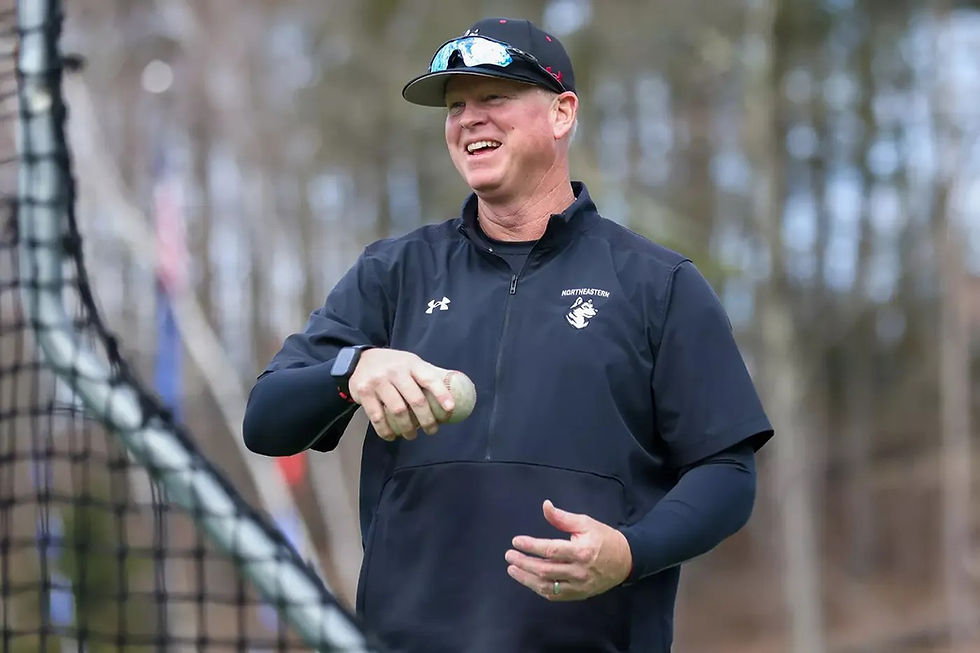
In 2007, Glavine returned to Northeastern as an assistant coach, working under McPhee, the same man who had coached him there.
He was named McPhee's successor in 2013 and took over the program after the 2014 season.
That is when the other Glavine stopped being a footnote.
Northeastern has made five NCAA tournament appearances under Glavine. He has been named the conference Coach of the Year five times. His 2025 Huskies won a school-record 49 games, finished 49-11, swept the conference tournament and earned the program's first NCAA regional victory since the 1970s.
In 2026, Northeastern won the conference tournament again — this time by winning four straight elimination games after losing its opener.
Glavine now ranks second in Northeastern history in coaching victories, behind only McPhee, the mentor he replaced. His teams have sent a steady stream of players into professional baseball through the MLB draft.
Remember that word people used to use for Mike Glavine: underrated.
In a 2020 Baseball America poll, college coaches from around the country placed him among the nation's most underrated head coaches.
By then, the description was becoming difficult to defend.
A man cannot keep winning conference titles, reaching NCAA tournaments and developing professional players while remaining overlooked forever.
Mike Glavine simply did what he had always done.
He kept showing up.
He kept working.
And eventually, people had to notice.
But Forgotten Faces of Flushing was never only about the size of the numbers. It is about the stories hiding behind them.
Tom's story is about greatness sustained over 22 seasons.
Mike's story is about persistence — about spending a decade in the minor leagues for an opportunity that lasted two weeks, and then spending the next two decades proving that the two weeks were never the measure of the man.
In Flushing, Mike Glavine will always be introduced as Tom Glavine's younger brother.
At Northeastern, no introduction is necessary.
He is simply Coach Glavine.
And on September 28, 2003, with one swing against Braden Looper, the other Glavine made certain he would have a place in Mets history, too.
Not as a Hall of Famer.
Not as a star.
But as one half of the only pair of brothers ever to wear the Mets uniform — and as a forgotten face worth remembering.


Comments