
Sunday School: Forgotten Faces of Flushing #96: The Third Alou


Last week on Sunday School, Forgotten Faces of Flushing, we met Mike Maddux — the only member of his family who ever wore a Mets uniform, while the famous brother never did. This week the family theme remains, but the arithmetic gets crowded. This week’s forgotten face comes from a family that produced three major-league brothers and a second generation after that. Felipe Alou played seventeen seasons and managed against the Mets for a decade. Matty Alou won a batting title. And one of the brothers actually wore a Mets uniform.
It wasn’t either of those two. It was the youngest. It was Jesús.
Say the name Alou to a baseball fan and the roll call starts at the top. Felipe — the patriarch, 2,101 hits, the first Dominican star of the modern game, later the Expos manager who spent the nineties tormenting us from the other dugout. Matty — the little contact machine who hit .342 for Pittsburgh in 1966 and took the National League batting crown. And then, if the fan is good, a pause. “Oh, right. There was a third one.”
There was. Jesús María Rojas Alou played fifteen seasons in the major leagues, won two World Series rings, collected 1,216 hits — and did it all as the third name in his own family’s sentence. Somebody has to be the other brother. In the Alou family, being the other brother still meant a decade and a half in the big leagues.
The All-Alou Outfield
Jesús broke in with the San Francisco Giants on September 10, 1963, at the Polo Grounds — against the Mets, because of course it was against the Mets. That day, all three Alou brothers batted in the same inning. They were retired in order. Felipe, Matty, Jesús — one, two, three. Even their history-making had a box score, and the box score was unkind.
Five days later in Pittsburgh, manager Alvin Dark did the thing nobody had ever done: he put all three brothers in the same outfield at the same time, the last two innings of a 13–5 win over the Pirates. Left to right, take your pick — everywhere you looked, an Alou. They shared an outfield three times that September. Then the Giants traded Felipe to Milwaukee that winter, and it never happened again. Three brothers, one outfield, one month. Baseball has been around for a century and a half and it has produced exactly one Alou outfield.
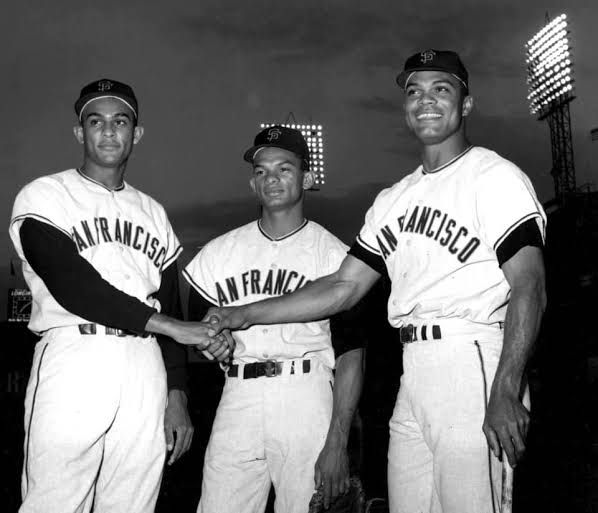
Jesús was a regular soon enough — a hundred games or more every year from 1964 through 1971, first for the Giants, then for Houston. He was a particular kind of hitter, the kind that has nearly gone extinct: no power to speak of, and almost impossible to strike out. Thirty-two home runs in fifteen years. Two hundred sixty-seven strikeouts in 4,345 at-bats. Pitchers could get him out. They just couldn’t make him swing at air. He hit .280 for his career, the quietest .280 you ever saw, because the brother in front of him hit .286 with a batting title and the brother in front of him hit everything and then managed for fifteen years.
The Enemy in October
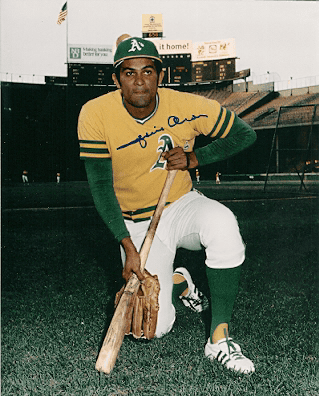
Mets fans of a certain vintage met Jesús Alou the hard way — in the 1973 World Series, wearing Oakland green and gold. Houston had sold his contract to the A’s in the middle of that season, and when Oakland’s center fielder Bill North went down hurt late in the year, the third Alou brother found himself starting five of the seven games against us. In Game Two in Oakland — the twelve-inning marathon the A’s won 10–7 — Jesús had three hits and drove in two runs. He won a ring that October, and another one the next year. The forgotten brother has two World Series championships. Felipe and Matty, between them, have none. Read that sentence again. The third Alou is the only Alou with a ring, and he has two.
One Summer in Flushing
Oakland released him in the spring of 1975, and on April 10 the Mets signed him — making Jesús Alou the first man who had ever faced the Mets in a World Series to later wear their uniform. He joined the club on April 16 in St. Louis, and he had one job: be the right-handed half of the best pinch-hitting platoon in baseball. Ed Kranepool hit .400 off the bench from the left side that year. Jesús hit .350 in forty pinch-hit at-bats from the right. The ’75 Mets weren’t going anywhere — they finished 82–80 — but for one summer, the last man on the bench from each side was money.
The overall line is humble, and we’ll print it because this series always prints the line: 62 games, a .265 average, 11 RBIs, no home runs. Then the Mets released him the following spring, and just like that the Alou era ended — 1976 was the first season with no Alou in the major leagues since 1957. Jesús wasn’t done, though. He resurfaced with Houston in 1978 and 1979, because third brothers are hard to get rid of. Sometime during that 1975 summer, by the way, the three brothers’ combined career games played passed five thousand. Five thousand games. One family.

Nailed at the Plate?
And now we have to deal with the legend, because if you grew up listening to Mets baseball, you have heard this story. Sometime, somewhere — Shea Stadium, a Giants or Astros uniform, a throw coming home — Jesús Alou tried to score, and Bob Murphy, painting his word picture as only Murph could, delivered the most dangerous sentence a broadcaster could ever aim at a man named Jesús:
“And Jesús is nailed at the plate!”
Did he say it? Here’s the honest answer, and this series deals in honest answers: nobody knows. No tape of it has ever surfaced. No newspaper printed it. It lives where the best baseball stories live — in the retelling, passed from father to son like a foul ball. What we can say is that the ingredients were all real. Murphy called hundreds of games with Jesús Alou in them — at Shea as a visiting Giant, Astro and Athletic, and in 1975 as a Met, when a broadcaster had to say the name carefully, “hay-SOOS,” every single night. A hundred afternoons, a hundred chances for a throw to come home at exactly the wrong moment. The line survives because it sounds like something that must have happened — and because every Mets fan who repeats it gets to do the Murphy voice.

Urban myth? Almost certainly. But it’s Jesús Alou’s urban myth, and a man could do worse than to be remembered at Shea Stadium forever for a play he may never have made, in a call that may never have happened, from the booth of a Hall of Fame broadcaster.
And since we're trading in Alou lore, here's the bar-trivia version. Ask any fan how many Alou brothers there were and he'll tell you three — Felipe, Matty and Jesús. Wrong. There were four. The fourth one changed his name, because he didn't want to go through life being called Boog Alou.

Boog Powell — the fourth 'Alou brother,' who wisely went into the record books as John Wesley Powell instead. The 1970 American League MVP hit 339 home runs, every one of them under his own name. Photo: public domain, via Wikimedia Commons.
The Family Business
The Alous weren’t finished with us, either. A generation later, Felipe’s son Moisés Alou spent 2007 and 2008 patrolling the outfield at Shea — the second generation of the family in a Mets uniform, even if his uncle’s summer had been forgotten by then. The family that gave the Mets one quiet summer in 1975 gave them a star thirty years later. Baseball families are patient that way.
Jesús Alou died on March 10, 2023, two weeks short of his 81st birthday. Felipe got the managing career and the patriarch’s chair. Matty got the batting title. Jesús got two rings, five thousand family games, one summer as half of the finest pinch-hitting combination in the league — and a legend at the plate that Bob Murphy probably never called and every Mets fan of a certain age will swear he did.
Third brother. First in rings. Not bad for the forgotten face bringing up the rear of the most famous outfield a family ever fielded.
He was just bringing up the rear of a very fast family.


Comments