
The Context Missing From Eric Chavez's Criticism of David Stearns


There is an old saying in baseball.
There are three sides to every story.
Your side.
My side.
And somewhere in the middle, the truth is probably taking batting practice.
Former Mets hitting coach Eric Chavez recently released what he called an "emergency" episode of his EC3 Podcast, and if you listened to it without knowing the backstory, you'd think David Stearns personally canceled baseball, brought back the Mercury Mets jerseys and traded for Cedric Mullins in a deadline deal that sent three pitching prospects to Baltimore—oh wait, he did last one.
Chavez unloaded on virtually every aspect of the Mets organization. He questioned David Stearns' hiring. He criticized the club's philosophy. He accused the Mets of mishandling Juan Soto. He even suggested Steve Cohen should have stayed with Billy Eppler.
Strong stuff.
Some of it is fascinating.
Some of it unquestionably fair.
And some of it, like most things in baseball, depends entirely on where you're standing when you’re watching it.
Before going any further, I should add something that matters here.
My interactions with Eric Chavez over the years have been consistently positive. He has been generous with his time, thoughtful in interviews, and in the past I have advocated for him as a potential future Mets manager once Buck Showalter was let go.

That doesn’t mean I agree with everything he said in this podcast.
But it does mean I’m not interested in turning him into a villain for the sake of a column or clicks.
What I am interested in is context — especially when a former coach speaks with authority about a clubhouse he was inside.
And that context cuts both ways.
One of the more overlooked parts of Chavez’s public persona is that he is not, nor has he ever been, purely “old school.”
In fact, during his time as Mets bench coach under Buck Showalter, Chavez repeatedly emphasized something very different from the tone of his recent podcast appearance.
When I asked about analytics versus traditional decision-making, Chavez said:
“Analytics are great… you can’t be too heavy one way or the other. It’s balance.”
He went further:
“You try to gather as much information and come up with the best decision during the game.”
And perhaps most importantly, when discussing modern player development, he noted:
“There’s plenty of information… sometimes too much information. But the game is still played between the lines.”
That doesn’t sound like someone rejecting modern baseball.
That sounds like someone trying to reconcile both worlds — analytics and instinct — which is exactly the philosophy David Stearns has built his front office around.
Chavez also praised Buck Showalter’s bullpen management, preparation, and in-game structure, repeatedly emphasizing learning, adaptation, and balance.
In other words, the Chavez who once sat in a Mets dugout sounds significantly more aligned with organizational evolution than the Chavez speaking on a podcast nearly a year later.
That doesn’t invalidate his current criticism.
But it does raise a question:
Did the philosophy change… or did the perspective?
One part of Chavez's podcast that also deserves context was his glowing praise of Billy Eppler.
Chavez argued that Steve Cohen already had the right baseball executive in place and questioned why the organization ever felt the need to hire David Stearns.

That’s a defensible baseball opinion, and one I don’t fully disagree with either.
But it’s also impossible to ignore Chavez’s personal history.
Billy Eppler wasn’t just another general manager.
He was the executive who helped launch Chavez’s post-playing career. Their relationship dates back to the Angels, where Eppler brought Chavez into a baseball operations role. Later, Eppler brought him to the Mets.
When Eppler became Mets GM, Chavez followed.
So when Chavez praises Eppler and questions Stearns, it’s fair — not dismissive — to note that both executives represent very different chapters of his career.
One helped build it.
The other first cut his salary and then fired him.
That matters in any industry, not just baseball.
The comments that generated the most attention centered around Juan Soto.
Chavez claimed Soto frequently spent innings sitting on a couch in the batting cage instead of remaining in the dugout with teammates, suggesting a lack of engagement.
That’s a serious observation.
But it also deserves perspective.
From my own vantage point covering the Mets — often from the photo well adjacent to the dugout — what I consistently observed during the 2025 season was not isolation, but interaction.
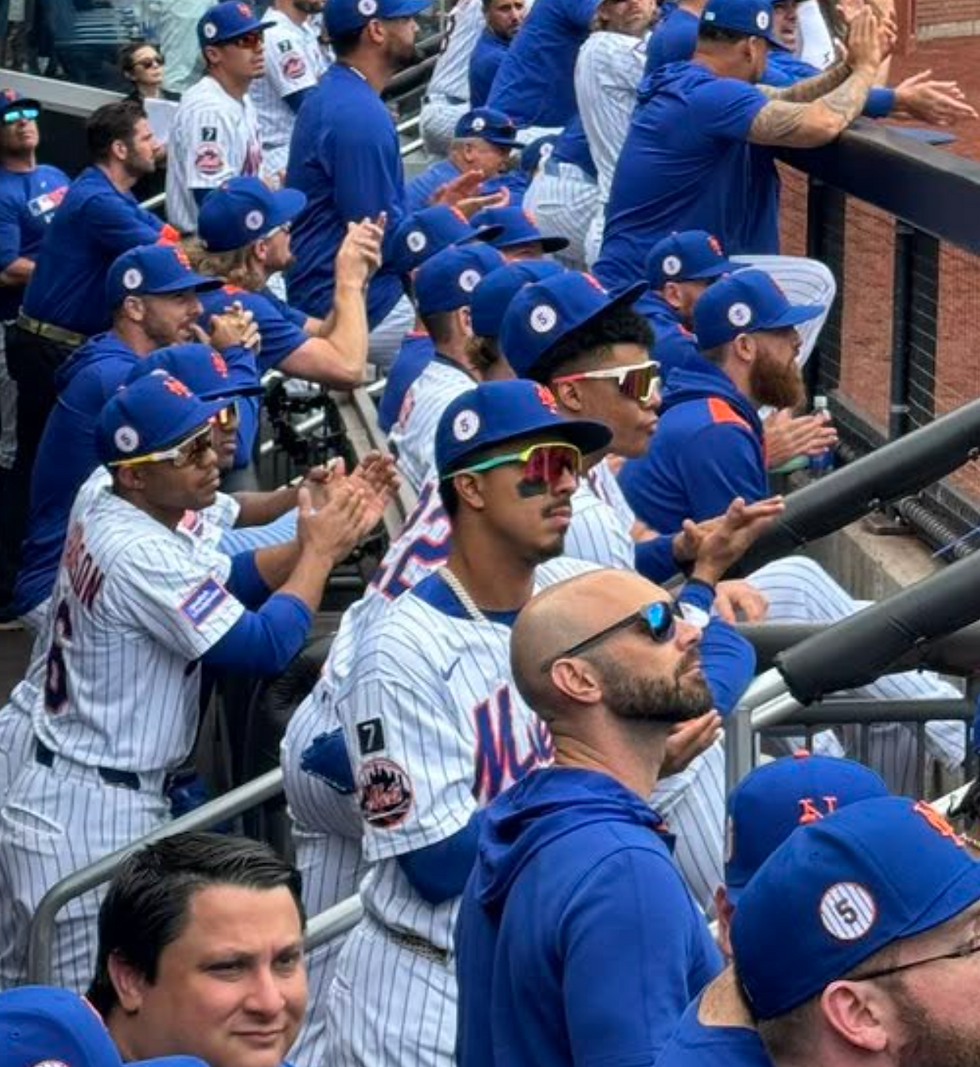
Soto routinely chatted with teammates like Jose Siri and Starling Marte. There was laughter, conversation, and constant engagement between innings.
Yes, Soto also went into the batting cage during games.
So do most elite hitters in baseball.
This is where another layer of context becomes important.
During spring training, I asked Carlos Mendoza a question that indirectly touched on this entire discussion.
I pointed out that Soto had spent his career entering clubhouses where leadership already existed — from Manny Machado in San Diego, to Aaron Judge in New York, to Francisco Lindor and Pete Alonso in Queens.
So I asked whether he had noticed Soto becoming more of a vocal leader now that he was more established and the core leadership other than Lindor was now gone.
Mendoza’s answer was simple, and notable:
“No, I see the same guy that we saw last year, to be honest with you,” Mendoza said. “We saw a lot of smiles, and how much fun they were having in the dugout… I see the same guy that we saw, like I said, the whole last year. He knows a lot of the new faces already. So far, it’s been two days, but nothing out of the ordinary.”
Could that be organizational messaging? Of course.
But it also complicates the idea that Soto required correction or intervention in the way Chavez described.
Perhaps what makes this entire discussion more complicated is that Chavez himself has described Soto in very different terms before.
In June 2025, when Soto was emerging from his early struggles, Chavez downplayed mechanical concerns and said:
“Nothing. He’s just comfortable.”
He also said:
“He knows what a long season is.”
And later added:
“He’s just feeling more comfortable in his uniform.”
That is not a critique of behavior or engagement.
That is an endorsement of process, patience, and mental approach.
Which raises the fair question:
Is this a change in observation?
Or a change in interpretation after the fact?
Here’s the part that often gets lost in these debates:
Baseball is not a laboratory.
It’s a workplace filled with personalities, routines, habits, frustrations, and routines that outsiders only partially see.
And even insiders — coaches, players, executives and reporters — see different versions of the same reality depending on role, timing, and outcome.
Chavez also praised Jeremy Barnes, Carlos Mendoza, and at times even David Stearns himself in prior settings. He has lived in both the analytical and traditional worlds of modern baseball, often advocating for balance between the two.
That’s why his current comments don’t feel like a clean ideological break — they feel like a reaction shaped by experience, outcome, and perspective.
Which brings me to the most important point:
I have reached out to Eric Chavez in hopes of better understanding the full context behind his recent comments and whether his perspective reflects a broader philosophical shift, specific experiences, or something in between. Hopefully, he’ll respond, and we can dig a little deeper into what’s driving his view.
Because in baseball, as in life, the most interesting answers usually aren’t found in the extremes.
They’re found somewhere between the dugout and the truth.
And that’s still taking batting practice.


Comments