
Andy Green Isn't Here to Win the Job. He likes Broadway Plays too Much.


There are press conferences where you walk away with a notebook full of clichés.
Then there are press conferences where you walk away thinking, "I'd run through a brick wall for this guy."
Andy Green's introduction as the Mets' interim manager fell squarely into the second category.
Whether he's ultimately successful over the next 81 games is anyone's guess. Baseball has humbled far better men than Andy Green. His first opportunity managing the Padres produced a 274-366 (.428) record over four seasons, and there isn't a marketing department on earth putting that on a billboard.
But here's the thing.

Those San Diego clubs weren't exactly stocked with All-Stars. They were rebuilding. They were developing. They were learning to crawl before they could walk. Sometimes a manager gets judged on the steak when all he was handed was the menu.
More importantly, this isn't 2016 anymore.
The Andy Green sitting behind the Citi Field podium Friday didn't sound like the 37-year-old manager eager to prove he belonged. He sounded like someone who had already taken baseball's biggest punches, gotten back up, dusted himself off and realized there are more important things than protecting your résumé.
"I genuinely believe that given my life experience, I was best positioned to help over the next three months and see what we can get done as a group," Green said.
Notice what he didn't say.
He didn't say this was his chance to become the permanent manager.
He didn't lobby for the job.
He didn't hint that if things go well maybe David Stearns would reconsider.
In fact, we already know that's not happening. Green will return to his role overseeing player development after the season while the Mets conduct a full managerial search.
Honestly, that may be the best thing that could happen for both Green and the Mets.
Think about it.
How often does an interim manager get to operate without worrying about tomorrow?
No political maneuvering.
No campaigning.
No trying to impress ownership.
Just baseball.
That's incredibly liberating.
Maybe—just maybe—that also means when the analytics binder says one thing but his baseball instincts tell him another, he'll have the freedom to lean on those instincts once in a while. Not because he's anti-analytics. He clearly isn't. But because he doesn't have to spend every waking moment wondering if one unpopular decision costs him the permanent job.
That's a luxury very few modern managers ever enjoy.
What struck me even more than his freedom was his humanity.
His first comments weren't about lineups, defensive alignments or fixing a struggling offense.
They were about Carlos Mendoza.
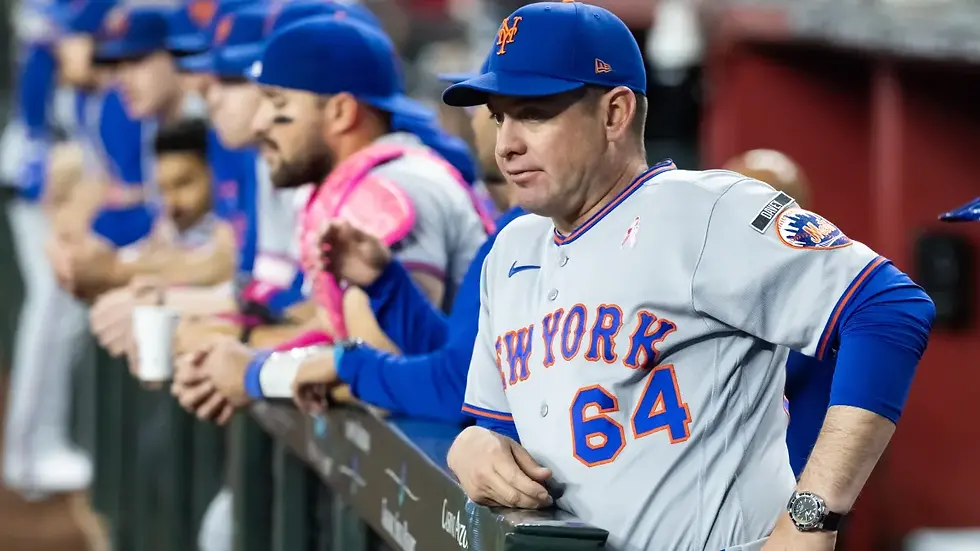
"I don't think anybody dreams of sitting in this seat this way," Green said.
Then he delivered perhaps the greatest compliment one baseball man can give another.
"I hope people say about me when it's all said and done that you're a good man who cares about people, who put the organization first."
He described Mendoza as "someone who walks out of here with a lot of respect," adding that after being informed of the decision, Mendoza immediately texted him to thank him.
That tells you as much about Mendoza as it does Green.
There wasn't an ounce of celebration in his voice.
Only empathy.
Green knows exactly what it feels like.
"I understand probably better than anybody what it feels like to be let go in season," he admitted. "I've been there before."
That experience echoed throughout the afternoon.
This wasn't someone pretending to have all the answers.
"I'm not naive enough to think that my words, no matter how persuasive, can change people and the way they perform," he said.
Instead, he kept returning to one central theme.
Freedom.
Over and over again.
"Guys play their best when they play with joy."
"Guys play their best when they realize this isn't about strategy, it's about freedom."
"The best thing we can do is recognize what keeps most people from performing is the burden they carry."
If you were playing Andy Green Press Conference Bingo, "freedom" would've filled your card by the fourth inning.
His belief is simple.
The Mets aren't failing because they forgot how to play baseball.
They're failing because they're trying too hard.
They're carrying yesterday's strikeout into today's at-bat.
They're worrying about September while standing in June's batter's box.
Green wants all of that baggage left outside the clubhouse.
"This is not a fundamental problem," he said. "This is a freedom opportunity."
Whether that's enough to rescue a team sitting 13 games under .500 remains to be seen.
But you couldn't help but be energized listening to him.
Imagine Phil Jackson's Zen philosophy after downing a five-hour energy drink while John Madden diagrammed blocking schemes with a turkey leg in one hand.
That was Andy Green.
Calm.
Passionate.
Thoughtful.
Relentlessly positive.
One minute he's talking about reducing anxiety. The next he's dropping lines like, "It's freaking fun," while discussing watching prospects climb through the system.
The enthusiasm wasn't manufactured.
It was contagious.
When asked why he accepted the job after repeatedly turning down managerial opportunities elsewhere, his answer had nothing to do with ambition.
He talked openly about what accepting the job would cost him personally. Green admitted he loved his role overseeing player development, but it also allowed him to be present for his family in ways managing simply doesn't. "I work like crazy in the PD job, but I went home for Father's Day weekend. Like, I can take my daughter to a Broadway show every now and again. Those things don't exist when you assume this responsibility." With three daughters and a wife waiting at home, Green wasn't chasing a title. He was accepting a sacrifice because he believed the organization needed hims.
He admitted he loved the player development job.
He acknowledged the personal cost.
Yet he still said yes.
That's not career advancement.
That's organizational commitment.
Maybe my favorite quote of the afternoon came when Green described what success actually looks like.
"We're a team that is rightly doubted at this present moment."
No excuses.
No sugarcoating.
No blaming injuries, bad luck or Mercury being in retrograde.
Then he followed it with one of the better baseball metaphors you'll hear.
"The players... they're the ones with the pen in their hands and get to author the story. I don't get to."
Exactly.
Managers don't hit.
Managers don't pitch.
Managers don't field.
But they can create an environment where players remember how to do all three.
Will Andy Green succeed?
Nobody knows.
History says managing isn't easy, and his first opportunity certainly wasn't decorated with champagne celebrations.
But history also says second chances often produce better managers because they're no longer trying to prove they belong.
They're simply trying to help.
The Mets don't need a miracle worker over the next 81 games.
They need someone who can get a talented roster to exhale.
If Andy Green can accomplish that, this season may still have a pulse.
And if not?
He'll quietly head back upstairs after the season, return to building the organization's future, and let someone else inherit the permanent job.
There's something refreshingly selfless about that.
Whether it leads to October baseball remains uncertain.
But after one press conference, one thing felt crystal clear.
The Mets didn't hire an interim manager desperate to keep the chair.
They found one completely comfortable giving everything he has while knowing he'll eventually give the chair back.
Sometimes that's exactly the person you want leading the room.


Comments