
The Mets' All-Time Rotation of Disappointment: Is Freddy Peralta the Ace?


For 64 seasons, the Mets have chased pitching.
Sometimes they developed it. Tom Seaver. Dwight Gooden. Jacob deGrom.
More often, they went shopping for it.
The shopping list has produced Hall of Famers, Cy Young Award winners, World Series heroes and established aces. On paper, many of those acquisitions looked like the missing piece. Some arrived with baseball cards that belonged in Cooperstown.
Unfortunately, by the time several of those pitchers unpacked their bags in Queens, their best seasons were already behind them.
Warren Spahn arrived with 363 victories, but he was 44 years old.
Mickey Lolich had won three 20-game seasons and pitched Detroit to a World Series championship, but he had already logged more than 3,600 major league innings.
Randy Jones was a Cy Young Award winner, yet shoulder injuries had stolen the devastating sinker that made him one of baseball's premier left-handers.
Frank Tanana had once thrown a fastball that rivaled Nolan Ryan's, but by the time he reached the Mets he had reinvented himself as a finesse pitcher simply to survive.
Every one of those acquisitions disappointed Mets fans.
Every one of them also came with an explanation.
Freddy Peralta doesn't.
That's what makes his 2026 season feel different.
When the Mets acquired Peralta from Milwaukee, they weren't buying a memory. They weren't hoping to squeeze one more season out of a fading star. They were trading for a pitcher who appeared to be entering the very best years of his career.
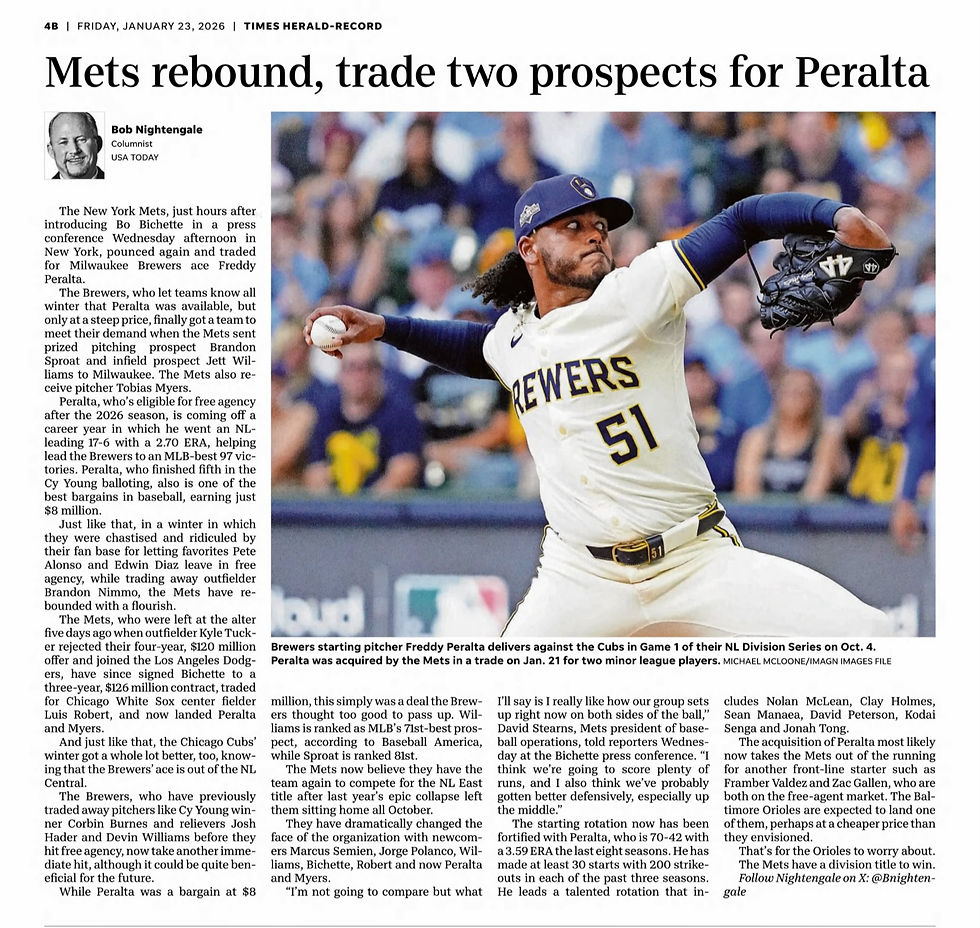
Peralta was 29 years old. He had just finished one of the finest seasons of his career, emerging as one of the National League's premier strikeout pitchers and the type of frontline starter every contender covets. He was healthy, durable, under no obvious physical limitations, and headed toward free agency with the chance to cash in on a massive contract.
Instead of becoming the ace the Mets envisioned, Peralta has struggled through the most disappointing season of his career. His ERA has ballooned, his command has deserted him, and perhaps most damaging of all, his value has plummeted at precisely the time the Mets could have maximized it.
That's what sent me down a rabbit hole.
Has there ever been a more disappointing pitching acquisition in Mets history?
The answer isn't as simple as looking at who pitched the worst.
Disappointment is measured by expectations.
And when you compare Freddy Peralta to the most famous pitching acquisitions in franchise history, one thing becomes strikingly clear.
Every pitcher on this list had an excuse.
Freddy Peralta may be the first who doesn't.
Warren Spahn: The Hall of Famer on His Farewell Tour

When the Mets signed Warren Spahn before the 1965 season, they weren't acquiring just another pitcher. They were acquiring one of the greatest left-handers in baseball history.
Spahn entered New York with 363 career victories, a Cy Young Award, 17 All-Star selections and a résumé that all but guaranteed him a plaque in Cooperstown. Between 1947 and 1963, he averaged nearly 21 victories per season, led the National League in wins eight times and completed an astonishing 382 games during his career.
Those numbers are almost impossible to comprehend today.
But by the time he became a Met, Spahn was also 44 years old.
The fastball had diminished. The workload of nearly two decades had taken its toll. His 1965 season reflected that reality, as he struggled to a 4-12 record and a 4.36 ERA before being released.
Was it disappointing?
Absolutely.
Was it surprising?
Not really.
Nobody expected the Mets to receive the same pitcher who had dominated the National League throughout the 1950s. They were hoping for one last vintage performance from a baseball legend whose greatest accomplishments were already behind him.
That's a far different expectation than the one attached to Freddy Peralta.
Mickey Lolich: The Workhorse Who Had Nothing Left

If Warren Spahn represented the Hall of Fame farewell tour, Mickey Lolich represented something equally dangerous in baseball—mileage.
The Mets acquired Lolich before the 1977 season in exchange for fan favorite Rusty Staub, hoping there was still one more chapter left in the arm of one of baseball's greatest workhorses. After all, this wasn't just any veteran pitcher. This was the man who won three complete games in the 1968 World Series, including the decisive Game 7, outdueling Bob Gibson to deliver Detroit a championship. Between 1971 and 1974, Lolich won 20, 25, 16 and 19 games while pitching an incredible 376 innings in a season. In an era when pitchers were expected to finish what they started, nobody finished more than Mickey Lolich. He led the American League in 1971 and eventually threw 195 of them during his career.
The problem was that every one of those innings leaves a fingerprint.
By the time the Mets acquired him, Lolich was 36 years old. He had already thrown more than 3,500 innings in the major leagues, plus another mountain of postseason baseball. The pitcher who once overpowered hitters with a lively fastball had become a craftsman trying to outthink younger hitters with older stuff.
The results reflected exactly where he was in his career. Lolich finished 8-13 with a 3.22 ERA for the 1976 Mets. Those numbers weren't embarrassing, but they weren't what Mets fans envisioned when they heard the name "Mickey Lolich."
To make matters worse for Mets fans, Staub immediately flourished in Detroit, batting .299 with 15 home runs and 96 RBIs that same season.
Still, there was an obvious explanation.
Age wins every argument.
Nobody expected the 1968 World Series hero to magically become 28 years old again.
Freddy Peralta doesn't have that luxury.
Randy Jones: The Cy Young Winner Whose Greatest Pitch Stayed in San Diego

Randy Jones wasn't just good.
For a brief period in the mid-1970s, he was one of the most dominant pitchers in baseball.
His 1976 season remains one of the finest ever produced by a left-hander. Jones went 22-14, posted a 2.74 ERA, completed 25 games, threw more than 315 innings and captured the National League Cy Young Award. This after winning 20 games the prior season in 1975 with a 2.24 era, becoming the ace of the Padres while baffling hitters with one of baseball's most devastating sinkers.
Then came the shoulder problems.
The injury robbed Jones of the movement that made his sinker special. He could still pitch, but he could no longer dominate. By the time the Mets traded for him before the 1981 season, the decline had already begun.
New York hoped Shea Stadium, a better defense and a fresh start might unlock one more productive run.
Instead, Jones went 1-8 with a 4.85 ERA in the strike-shortened 1981 season before going 7-10 posting a 4.60 ERA the following year. The pinpoint control remained, but the sinker no longer sank quite enough.
The Mets didn't acquire a broken pitcher.
They acquired a pitcher who had already been broken.
There is a difference.
Frank Tanana: When Reinvention Has Already Run Its Course

There was a time when Frank Tanana was mentioned in the same breath as Nolan Ryan.
During the mid-1970s with the Angels, Tanana routinely threw in the upper 90s, struck out 269 hitters in a season and formed perhaps baseball's most intimidating one-two punch alongside Ryan. In 1975, at just 21 years old, he went 16-9 with a 2.62 ERA and 269 strikeouts. Many believed his ceiling was Cooperstown.
Then injuries rewrote his career.
Instead of overpowering hitters, Tanana reinvented himself as a finesse pitcher, relying on pinpoint control, changing speeds and baseball intelligence rather than velocity. To his credit, the reinvention worked. He won 240 games during an outstanding 21-year career.
But by the time he reached the Mets in 1993, he was 39 years old.
The arm that once lit up radar guns had become one that relied almost entirely on experience.
His final season in Queens produced a 7-15 record and a 4.48 ERA.
Disappointing?
Certainly.
Unexpected?
Not in the least.
The Mets weren't acquiring the flamethrower who terrified hitters in Anaheim.
They were borrowing the final chapter of an exceptional career.
No "All-Disappointment Rotation" is complete without a few pitchers warming up in the bullpen. These three all had cases to crack the starting five, but each falls just short for a different reason.
Victor Zambrano (2004)

Victor Zambrano's numbers alone probably don't earn him a spot in the rotation. In parts of three seasons with the Mets, he went 39-35 with a 4.91 ERA, hardly the worst line in franchise history. What makes his name unforgettable is the price the Mets paid. Scott Kazmir developed into one of the premier left-handed pitchers in baseball, making three All-Star teams and winning 108 games. Every quality start Kazmir made for Tampa Bay became another reminder that this trade wasn't judged by what Zambrano did—it was judged by what the Mets gave away.
Rick Porcello (2020)

When the Mets signed Rick Porcello, they hoped the 2016 American League Cy Young Award winner had one more productive season left. Instead, he posted a 1-7 record with a 5.64 ERA during the pandemic-shortened 2020 season. It was unquestionably disappointing, but the unique circumstances of the 60-game COVID season make it difficult to compare directly with a full 162-game campaign. Porcello struggled, but so did plenty of established veterans during one of the strangest years baseball has ever experienced.
Justin Verlander (2023)

On paper, this one stings. The Mets signed the reigning American League Cy Young Award winner to anchor a rotation with Max Scherzer, only to watch injuries limit him and the team fall out of contention before he was traded back to Houston for Ryan Clifford and Drew Gilbert at the deadline. Yet Verlander is difficult to rank alongside Freddy Peralta because he was already 40 years old. He still pitched effectively when healthy, going 6-5 with a 3.15 ERA in 16 starts for New York before helping the Mets replenish their farm system by bringing back top prospects in the trade to Houston. The season was disappointing, but unlike Peralta, the Mets ultimately recovered much of the value they invested.
And that's why Freddy Peralta stands alone.
Zambrano is remembered because of Scott Kazmir.
Porcello because of a bizarre 60-game season.
Verlander because Father Time finally became a factor.
Warren Spahn, Mickey Lolich, Randy Jones and Frank Tanana all arrived in Queens after careers that had already reached their highest peaks.
Freddy Peralta is the only pitcher on this list whose best years were supposed to be unfolding in a Mets uniform.
Which brings us back to the question that started this journey.
Has any pitching acquisition in Mets history been more disappointing than Freddy Peralta?
Unlike Spahn, there is no age excuse.
Unlike Lolich, there aren't nearly 4,000 innings of accumulated wear and tear.
Unlike Randy Jones, there isn't a career-altering shoulder injury that changed the trajectory of his career.
Unlike Tanana, there isn't a fastball that disappeared a decade earlier.
Peralta was supposed to be the exception.
When David Stearns acquired him, he wasn't taking a sentimental chance on a fading legend. He was acquiring a pitcher who appeared to be entering the peak of his career. Peralta had established himself as one of the National League's premier strikeout pitchers, a durable starter capable of taking the ball every fifth day and missing bats at an elite rate. Better yet, he was entering a contract year, giving the Mets two potential paths to success.

If they contended, Peralta would headline a postseason rotation.
If they didn't, he would become one of the most attractive rental starters on the trade market, capable of bringing back the kind of prospect package that accelerates a franchise.
Instead, neither scenario materialized.
His struggles haven't simply hurt the Mets every fifth day.
They've cost the organization flexibility.
That's what separates Freddy Peralta from every other pitcher on this list.
The others were investments in yesterday.
Freddy Peralta was an investment in tomorrow.
And somehow, tomorrow never arrived.
Every franchise signs aging stars hoping to squeeze one last great season from a legendary arm.
Sometimes it works.
More often, it doesn't.
The Mets have lived through Warren Spahn's farewell, Mickey Lolich's final act, Randy Jones' post-Cy Young decline and Frank Tanana's closing chapter.
Those disappointments were understandable.
Father Time always collects.
Freddy Peralta is different because Father Time never knocked on his door.
That's what makes this conversation possible.
Not because he's the worst pitcher ever acquired by the Mets.
But because no pitcher in franchise history arrived in Queens with more reason to believe his best baseball was still ahead of him.
Sometimes the biggest disappointments aren't the oldest pitchers.
They're the ones who were never supposed to disappoint in the first place.
Of course, this is where every Mets fan gets to put on their general manager hat.
Because if there is one thing we know about Mets history, it's that everyone has an opinion—and everyone has a guy.
Now it's your turn.
Build your own Mets pitching staff of disappointment.
Give us your starting five in the comments.
And let us know where Freddy Peralta belongs.


Great points and painful memories. I hated the Kazmir trade. Guy stayed about close to 45 minutes after a Brooklyn Cyclones Game up here in Troy NY signing autographs and greeting fans shortly after he was signed. The next night he threw 7 scoreless touching mid-90's. And they dealt him for a guy with a bum elbow.