
Time Traveler Tuesdays: 80s Mets 1st basemen, Keith, and then everyone else

While the 70s featured some good 1st basemen for the New York Mets, it wasn't exactly a great decade for the team. The end of the decade was a very dark time for the team. The 80s, however, would provide great players at the position and some historic moments for the team.
The 80s started off with a fresh face at 1st. Lee Mazzilli, 25 years old at the time, started the 1980 season at 1st, after being moved from the outfield. Mazzilli was one of the few bright spots for the team in the late 70s. This home-grown talent could hit as well as any mid-upper-tier talent in the league. He was versatile and athletic. And he was better than most people on the team at the position, which wasn't saying much at the time. He played 92 games at 1st base in 1980, finishing the year with 16 HR and 76 RBI, with a respectable .280 batting average (162 hits).
Mazzilli rotated with lefty Mike Jorgensen that year, who played a good portion at 1st base as well, logging 72 games at the position. Jorgensen was a more natural fit at 1st base but not as great a hitter that year. He only batted .255 with only half the hits (82).

The next two and a half years were a rotating mess at 1st base for the team. Dave Kingman came back to the team, Mazzilli, and grizzled vet Rusty Staub, rotated at the position until mid-1983. Kingman would take the lion's share of games in those 2 1/2 seasons.
Kingman lit up the stat sheet in very polarizing ways. He actually led the National League in home runs in 1982 with 37. However, he only batted .204 that year, leading the league in strikeouts as well with a whopping 156.

Kingman could have been mistaken for a soccer player that year at 1st too, committing 18 errors at the position as well. It was always all or nothing for the star.
The story of the first few years of the 80s was good hitting and sloppy fielding at 1st base. In 1983, a trade would bring a generational talent to the position for the team that would change the course of the decade for the young franchise.
On June 15, 1983, the Mets traded away two pitchers to the St. Louis Cardinals for a former MVP, the best fielding 1st baseman ever (arguably), and a guy still affiliated with the team as a broadcaster. None other than the "Pretty Boy," Keith Hernandez.
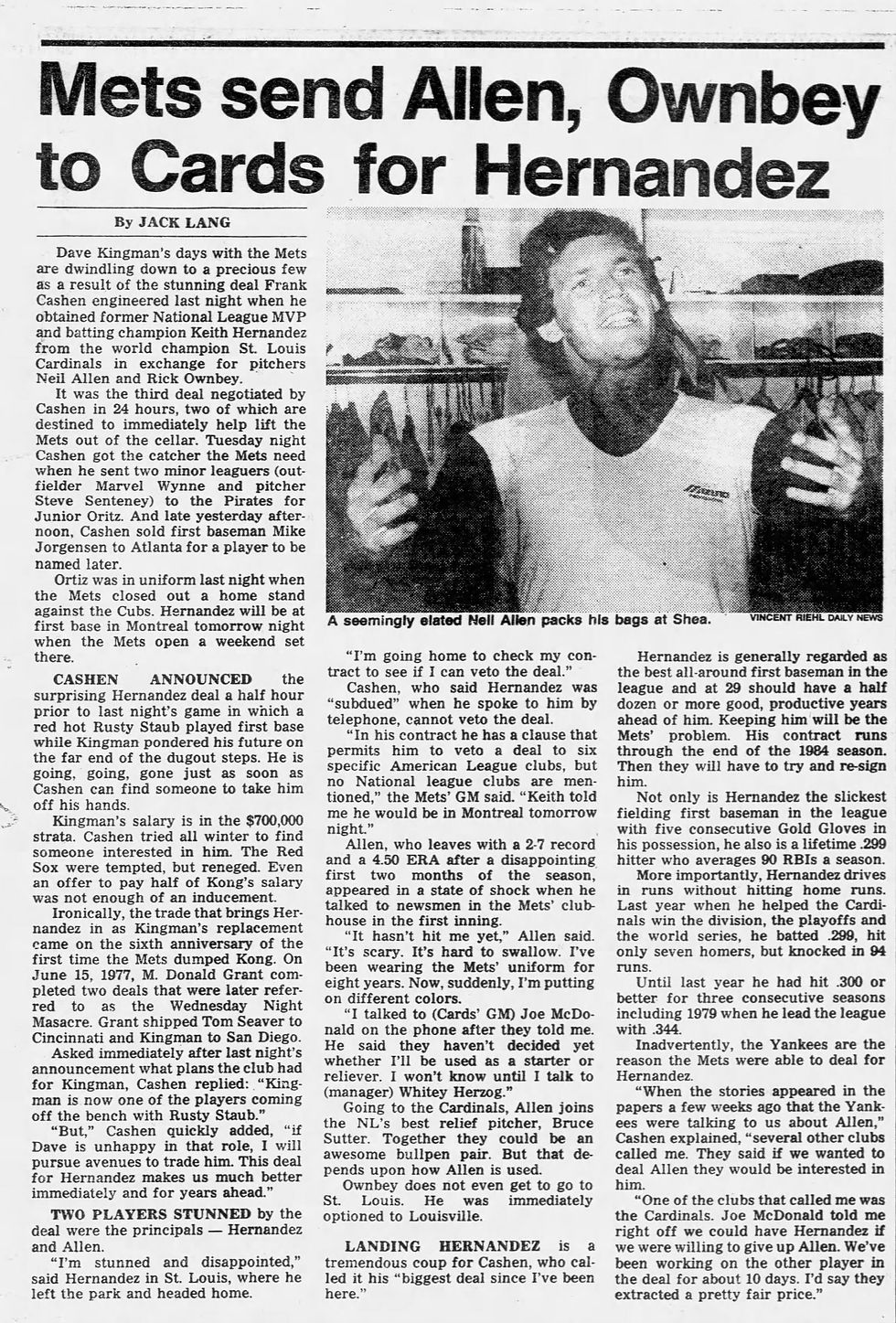
In what was known then as "the great heist," the Mets traded Neil Allen and Rick Ownbey (who?) to the Cards for the great Hernandez. The Cardinals needed pitching in a bad way, and after Hernandez kept flaring up in the dugout with Manager Whitey Herzog, they were worried he'd hit free agency in the offseason and they'd lose him for nothing. So, they decided to take what they could get for him, considering rumors of his drug use were swirling, and his reputation had taken a hit.
Hernandez was sturdy, consistent, and nothing short of excellent for the team, whose farm system was churning out some generational talents of its own.
The gamble to trade for Hernandez, get him signed to a long-term deal, and make him the pillar of the team, while all that young talent was coming up, paid off big-time.
As soon as Hernandez came to the Mets, there was a different energy. He added some flash to 1st, and he also had a great eye, leading to his high average and great on-base percentage. He batted .306 in 1983, with a .424 OBP and an .858 OPS.
For the next five seasons, Hernandez went on a tear for the team and was arguably the best first baseman in baseball in that span. From 1984 to 1988, Hernandez won the Gold Glove each of those seasons. He finished in the top 10 in MVP voting three of those years, made the All-Star team three times during that period, won a Silver Slugger, and became the team's first captain.
Let's not forget the most important season in those five years, the historic 1986 Mets. They won it all that year, finishing with 108 wins. Hernandez was a huge reason the Mets won it all. He led the team in hits, doubles, and walks (led the league), and he finished second on the team with a .859 OPS. In the playoffs and World Series, Hernandez didn't light up the stat sheet, but his clutch hits will forever be remembered as some of the most pivotal moments in team history. His hit in Game 7 of the World Series against the Red Sox doesn't get as much attention as Mookie Wilson's dribbler under Bill Buckner's legs, but it may be as important to winning that postseason.
The Mets were down 3-0 in the bottom of the 6th, with one out. His 2-run single to left-center opened the scoring for the Mets and led the team to an 8-5 win against the Red Sox to cement his name as one of the team's all-time greats.
As Hernandez began to age and his hitting abilities began to wane, a solid-hitting replacement, Dave Magadan, swooped in to take over most of the time at 1st base. In 1989, Magadan played 87 games at first, while Hernandez only played 58. Magadan batted .286 that year, with 4 HR, 22 doubles, and 41 RBIs. He was a solid fielder as well.

Magadan was not Hernandez, that's for sure. No one with half a brain would actually try to compare those two players. The magical run by those 1980s Mets ended, as Hernandez's career did at the end of the 80s. Setting the table for an uncertain decade for the team in the 1990s. First base was not as memorable starting off the decade. However, the position did feature some huge names. Come travel through time next week for another installment.


Comments