
Bo Bichette and Mets Position Themselves to Win.


If you were looking for subtlety at Citi Field on Monday afternoon, you were very much in the wrong building.
This was not a depth signing. This was not a hedge. This was the Mets standing at the podium and telling you exactly who they think they are right now. Bo Bichette is a New York Met, and from the opening remarks to the final breakout session, the message stayed remarkably consistent. This was about winning, work, and a willingness to embrace change in pursuit of something bigger.

David Stearns set the tone early. He talked about Bichette the way executives talk when they believe the scouting report and the person line up. One of the most complete right handed hitters in the game. Elite baseball aptitude. An intense desire to win. Stearns kept it clean and direct, returning again and again to the same idea. Position did not matter. Geography did not matter. What mattered was competing for championships, and on that front, he said, the Mets and Bichette were aligned from the start.
When Bichette took the microphone, the polish was there, but so was the conviction. He spoke about prayer, family conversations, and a decision that became obvious as the process unfolded. He did not say the Mets were one of several good options. He said he wanted to be a Met. He talked about Steve Cohen and Stearns building an organization designed to win every year, about the roster backing that up, about the city and the fans, and about how all of it matched something he had always wanted to be part of. It did not sound rehearsed. It sounded settled.

The questions quickly turned to the obvious talking point, his move to third base. Bichette did not flinch. He said he was open to anything if it felt like the right place, and New York felt like the right place. Winning, he reiterated, was the priority. Everything else came second.
During the main press conference, I asked Bichette about his relationship with Marcus Semien and how much that factored into his decision to sign with the Mets. Bichette was clear. The decision was not based on Semien, but it certainly did not hurt. Semien was the player who taught him how to be a professional, how to go about the work, how to prepare, and how to compete every day. The respect was obvious, and so was the excitement about being teammates again.
Carlos Mendoza then added the manager’s layer to the story, and it grounded the entire day in reality. When he referred to Bichette as his new third baseman, he smiled and called it a full circle moment. Mendoza talked about knowing Bichette since he was 13 or 14 years old, watching him grow up as a shortstop and now seeing him take on a new challenge at the major league level. He did not pretend the transition would be easy. Third base, he explained, is about angles, reactions, and decision making the instant the ball is put in play. Those are different reads than a shortstop makes. But he also emphasized Bichette’s athleticism, work ethic, and intelligence, the traits that give a player a chance to make that kind of transition successfully.
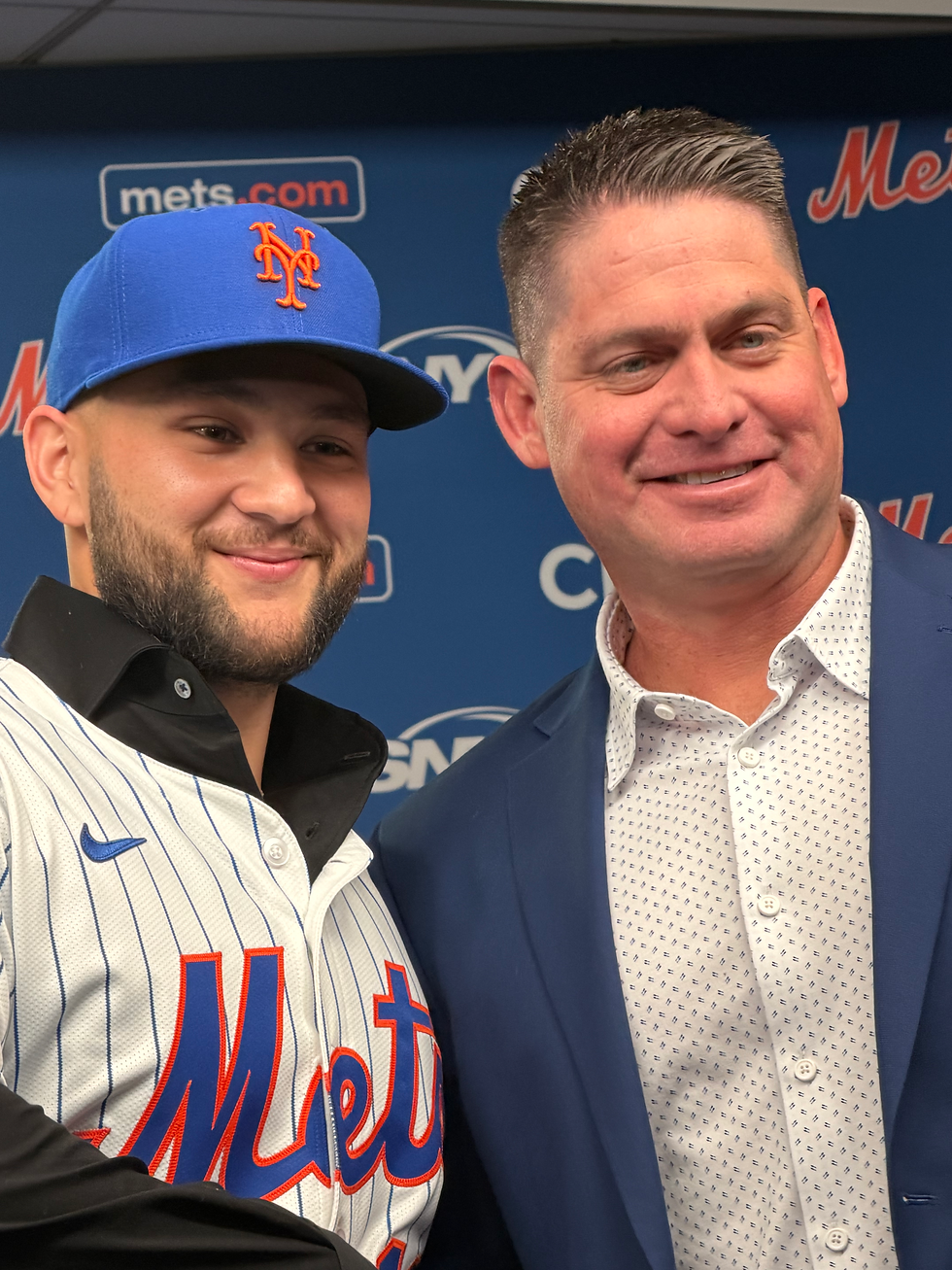
Mendoza made it clear this would be a group effort. Kai Correa, Tim Lipper, and Mendoza himself will all be involved, especially early on. Communication, he said, will be everything. Explaining the why before the ball is hit. Staying ahead of the learning curve rather than reacting to it. In describing the infield, Mendoza framed it simply. On many days, the Mets may be running out four players who came up as shortstops. That range and instinct is an advantage, even if it comes with a learning curve.
Asked to describe the Mets’ offseason, Mendoza paused, then landed on one word. Different. A lot different. When the season ended, even he did not know which way things would go. Now, he said, he likes the look of the team and where the organization is headed. That calm confidence carried over when he talked about Luis Robert Jr., a player Mendoza described as special when he is on the field. Keeping him healthy, Mendoza said, is the job, because the talent on both sides of the ball is undeniable.
He spoke just as confidently about Brett Baty’s willingness to move around the diamond. Mendoza recalled asking Baty to play second base last spring, a position he had never played, and watching him become a capable defender through preparation and buy in. That versatility, Mendoza believes, will translate to left field and first base as well. The theme kept repeating itself. Adaptability is not optional here. It is part of the plan.
In the breakout session, Bichette expanded on what that adaptability actually looks like. He said he is excited for the challenge of learning third base and understands exactly what it requires. Work. Repetition. Ground balls. Lots of them. He spoke about shortstop being one of the most demanding positions on the field and how that experience helps, but he did not pretend the transition would be automatic. The throw to first base is still a throw to first base, he said, but the positioning and the plays are different, and those are things he simply has not dealt with before. He views them as attainable, not intimidating.
Perhaps the most revealing comment came when he was asked what it says about him as a player to change positions as he enters his prime. Bichette shrugged off the premise entirely. Any ego he had about playing shortstop, he said, was thrown out the window during the World Series. He just wanted to win then, and the same applies now. The position is not the point. The outcome is.
There was also honesty in how he talked about moving on from his former team. Getting that close and falling short, he admitted, is not something you immediately get over. He was not sure he even had yet. But time creates space, and space opens up new opportunities. The Mets, he said, became an obvious choice as the process accelerated.
He did not point to one single factor that sealed the deal. Instead, he talked about alignment. A great team. A great organization. An owner doing everything possible to win. A roster filled with talent. Add it all together, and it made sense.
Bichette also spoke about leaning heavily on his father during the process, calling him his most trusted sounding board. That led to one of the lighter moments of the day. I asked Bichette about wearing number 19 and whether it was connected to his dad wearing it late in his career. Bichette explained that the number goes back to childhood. He wore 19 as a kid because of his dad, long before big league lockers were part of the picture. Toronto never made it an option because of José Bautista, but now, he said, it is cool to be back in the number.

I followed up with a question that caught him completely off guard. Did he ever ask his dad about the one game he played at third base in the majors. Bichette laughed and admitted he had no idea that ever happened. One game. One box score. A piece of family baseball trivia he was just discovering in real time. He said it would be interesting to watch.

It was a small exchange, but it fit the day perfectly. A player embracing a new position, wearing a familiar number from childhood, unknowingly brushing up against a sliver of his father’s path. The Mets did not manufacture that symmetry. Baseball just offered it up.
By the time Bichette finished, the picture was complete. Stearns talked about winning. Mendoza talked about the work. Bichette talked about embracing both. This was not a star arriving to have a team built around him. It was a star arriving ready to reshape himself for the team.
The Mets did not just introduce Bo Bichette on Monday. They introduced an idea. That winning requires flexibility. That comfort comes from preparation. And that sometimes the most important moves are the ones that ask great players to do hard things. For a franchise and a fan base long conditioned to wait for the other shoe to drop, this felt different. Not louder. Just more certain.
Videos :


A tremendous pick up by Sterns !! This guy can flat out play ball. Going to be a fan favorite