
Earned, Not Given: The Mets Are Starting to Find Out What They Have


There was a word that kept popping up around the Mets on Monday, even when nobody was actually saying it.
Earned.
Not given.
Not handed out because there happens to be an empty chair.
Not awarded because somebody in the front office needs to see what a kid can do before the season ends.
Earned.
And listening to Mets manager Andy Green and president of baseball operations David Stearns speak Monday, that philosophy came through loud and clear.
It started with Green, who was asked about two young pitchers who have become increasingly interesting parts of the Mets' future — Jonah Tong and Ryan Lambert — and whether it was important to get them some meaningful innings down the stretch.

I asked the question, specifically wondering whether the Mets should get those young arms some experience in meaningful games as the season moves toward September.
Green's answer wasn't exactly the standard, “Sure, let's see what the kid can do.”
“I don't know the answer to that where we sit right now,” Green said. “I think those guys earn their right to be here.”
And that distinction was important to him.
“When they do that, they come here and they pitch really well and they perform well,” Green said. “I don't think it's culturally a great thing to just say, hey, we have a good spot, come pitch.”
There is a lot packed into that answer.
Green wasn't saying Tong won't pitch at the big league level again. He wasn't saying Lambert won't get his opportunity. He certainly wasn't closing the door on either of them.
What he was saying was that the Mets don't want to create the perception that a player is in the major leagues simply because there happens to be an opening.
“You want people to feel they've earned the right to be on the field,” Green said.
That sounds simple.
It also sounds like something that has been learned the hard way over the years.
Green pointed to his experience managing the Padres and recalled how simply handing players opportunities because there was a hole on the roster didn't necessarily help them in the long run.
“Sometimes in baseball you have to do that,” he said. “But I think the people who earned their right to be there…”
He paused before bringing up Fernando Tatis Jr., who earned his opportunity in San Diego and then “performed incredibly well.”
The same philosophy, Green said, applies to the Mets' young players.
“They've all earned the right to be here,” he said. “And they've shown that they can outperform the minor leagues.”
That is particularly interesting when it comes to Tong.
The Mets clearly believe in him. Green made that abundantly clear.
“I think we have a deep belief in Jonah as a pitcher and have confidence that he's going to play a significant role in the future,” Green said.
But the future doesn't necessarily have to be tomorrow.

For now, Green believes Tong is exactly where he needs to be.
“He's still grinding, still getting better, still working, and so that's the right spot for him right now.”
Could that change?
“Absolutely,” Green said in essence, while stressing that simply having an opportunity doesn't mean a player automatically gets it.
And that brings us to David Stearns.
Because while Green was talking about young players earning their way into the major league lineup, Stearns was talking about something very similar from the front-office perspective: giving players time to show the Mets exactly what they have.
The Mets added a significant amount of talent at the trade deadline and through the draft, and many of those players have already moved up a level.
So now what?
That was my question to Stearns.
The Mets already did their homework before acquiring these players. They had scouting reports. They had evaluations. They had data.
But now the players are actually wearing Mets uniforms.
How does the evaluation change?
Stearns' answer was fascinating because it wasn't about immediately putting the newest acquisitions under a microscope.
It's about getting to know them.
“So much now is getting to know the player and the person,” Stearns said. “And it's trying to be patient, allowing our coaches and our player development staff to spend real quality time.”
Then came the most human part of the answer.
“When you acquire a player new to the organization the most important thing is take a deep breath,” Stearns said.
Why?
Because, as he pointed out, “That person has just gone through a massive life change that they didn't see coming.”
Think about that for a second.
One day you're playing professional baseball for one organization. The next day you're packing your stuff, changing cities, meeting a completely new group of coaches and teammates and trying to figure out where the batting cage is.
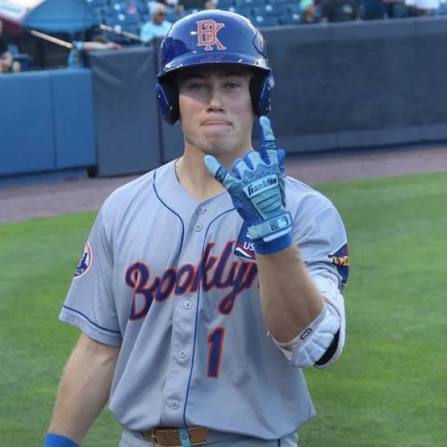
And somebody is already asking whether you're going to be part of the Mets' future.
Stearns' answer was essentially: Everybody take a breath.
“Let's allow them to get accustomed to us,” he said. “We can get to know them and then we can go from there.”
The goal isn't to force a conclusion.
“Let's make these folks feel welcome,” Stearns said. “Let's put them in the best position to succeed and allow their talents to speak for themselves.”
That may be the most revealing thing Stearns said Monday.
Let their talents speak.
Not the scouting report.
Not the trade that brought them here.
Not the pressure to justify a deadline deal.
Not the need to fill a hole.
Just let the player play.
And perhaps that is becoming the Mets' approach with the entire next generation.
Stearns pointed to the progress of young players already in the major leagues, including Carson Benge, Nolan McLean ,and others, saying the organization has seen “development at the major league level” and “progress at the major league level from a number of young players.”
What particularly encouraged him was that those players performed not only when things were going well, but also “when things weren't going great for us.”
That matters.
Anyone can look good when the train is rolling downhill.
The real evaluation comes when the train hits a pothole.
And the Mets have certainly found a few potholes this season.
The pitching development may be the most encouraging part of all.
Stearns said there are no rigid innings limits or even specific “innings guides” for McLean, Christian Scott and the other young starters.

Instead, the Mets are watching how each pitcher feels, how he recovers and what their testing tells them.
“At this point, we're in a good spot with all of them,” Stearns said. “We'll continue to monitor them.”
And as long as the pitchers continue to feel good and the testing backs that up, “we'll keep going.”
That dovetails almost perfectly with what Green said.
The Mets aren't blindly protecting their young pitchers.
But they're not blindly throwing them into the deep end either.
They're watching.
They're evaluating.
They're adjusting.
And they're trying to figure out what these young players can become without rushing them into becoming it.
Stearns acknowledged the importance of what McLean, Scott and the other young starters have already shown.
“They can compete at the Major League level,” he said, and in some cases they are “solidifying themselves as really good starting pitchers at the Major League level.”
That's a pretty important foundation to take into the winter.
Because eventually, the Mets are going to have to make decisions.
Who is part of the rotation?
Who is part of the bullpen?
Who needs more time?
Who has earned another opportunity?
Who has earned a bigger one?
Those answers won't come from a spreadsheet alone.
They'll come from what happens between now and the end of September.
And apparently, the Mets are perfectly comfortable letting the players provide the answers.
Which brings us back to Tong.
And Lambert.
And every other young player sitting in a clubhouse wondering when his name is going to be called.
Green didn't promise Tong another start.
Stearns didn't promise any of the newly acquired players a promotion.
Neither manager nor president offered the easy answer.
Instead, they offered something considerably more useful.
A chance.
But a chance that has to be earned.
Maybe that's the best kind.
Here are the full press conferences:


Comments