
The 2026 Mets Prediction Series: Bo Bichette

Updated: Mar 21

We are now less than 1 week away from Opening Day, which means across Mets Nation the annual ritual has begun.
No, not spring cleaning.
Prediction season.
From now until the first pitch of the season at Citi Field, we’re going to spend a few minutes each day here at Kiner’s Korner doing something Mets fans love almost as much as debating 50 years later whether Yogi Berra should have started George Stone in Game 6 and Tom Seaver in Game 7 of the 1973 World Series.
Trying to predict the future of the New York Mets.
And since none of us actually owns a functioning crystal ball mine was recalled in 1993 after predicting the Mets would win 110 games we’re going to lean on the next best things
the oddsmakers in Las Vegas and the statistical supercomputers that churn out projections all winter long.
So what do the baseball fortune tellers think about the 2026 Mets
Let’s continue with Bo Bichette.
If Nolan McLean represented intrigue on the mound, Bo Bichette represents something Mets fans have been craving for years in the infield certainty.
Not just he might be good. Not if everything breaks right.
Certainty.
Bichette arrives in Flushing at age 28, squarely in his prime, with a track record that reads like a metronome hit, hit, hit, occasional slump, then more hitting. And for a franchise that has spent the better part of the last decade trying to stabilize the left side of the infield somewhere between promising and please just make the routine play, this feels different.
There is, however, one significant twist to the story
Bichette is making the move from shortstop to third base.
And that matters.
It matters because it changes the conversation. At shortstop, his defense was always part of the debate. At third base, the bar shifts. The Mets are no longer asking him to be a premium defender at one of the toughest positions on the field. They are asking him to be steady, make the routine plays, and let his bat carry the value.
In many ways, it is a transition that could unlock the best version of Bichette. Less ground to cover. More focus on reaction and arm. And if it all clicks, the defensive question that followed him in Toronto might quietly fade into the background.
According to Baseball Reference, Bichette’s 2026 projection lands at a .288 batting average, 15 home runs, 70 RBI, and a .780 OPS over roughly 550 plate appearances. Solid. Dependable. The kind of numbers that do not necessarily lead SportsCenter but quietly win games.

FanGraphs, meanwhile, is a bit more enthusiastic pushing him closer to a .291 average, around 19 home runs, 80 plus RBI, and a 121 wRC plus, good for about 4 plus WAR. In other words not just good, but impact good. The kind of season where you stop thinking of him as the new guy sometime around May and start wondering how you ever lived without him.
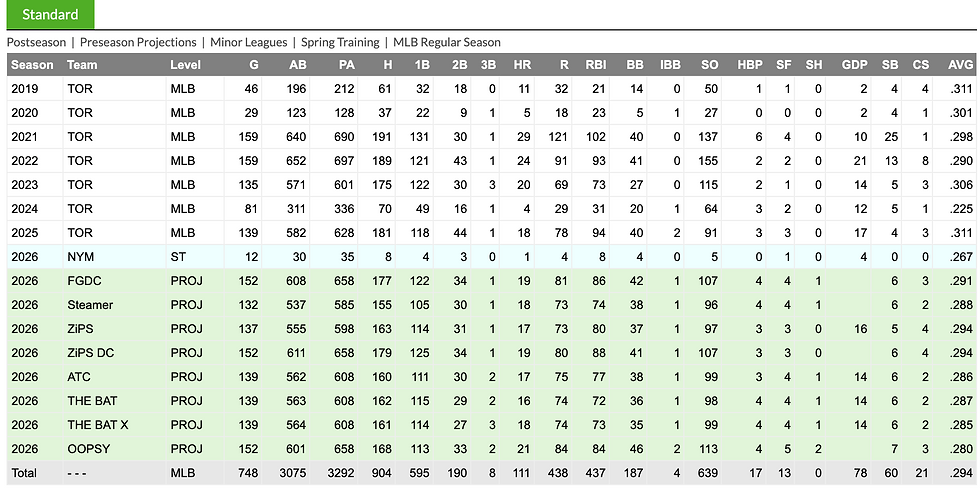
What stands out in both projections is the consistency of the profile. Bichette is not built on streaks or smoke and mirrors. He does not need to hit 40 home runs to matter. His game is rooted in contact, bat control, and an ability to turn at bats into small accumulating victories. A single here. A double there. A rally that suddenly has a pulse because he refused to give one away.
And yes, there are still questions because this is still the Mets and we are contractually obligated to worry.
How smooth will the transition to third base be. Will the footwork adjust. Will the arm play up across the diamond. These are not trivial things, especially in New York where every ground ball has a soundtrack. But the shift in position also feels like a smart alignment of strengths rather than a gamble.
Make no mistake this signing was about the bat.
This was about lengthening the lineup. About adding a professional hitter into the heart of the order. About giving this team another presence that does not blink in big spots.
So where do we land here at Kiner’s Korner, where optimism occasionally overrides logic but always brings a calculator
Blending the projections, the track record, and the reality of a position change that could actually help more than it hurts, we set the over under lines for Bichette’s 2026 season at
.295 batting average, 18.5 home runs, 82.5 RBI, and a .790 OPS.
What do you think
Bo Bichette Under/Over .295 Batting Average
0%Over
0%Under
Bo Bichette Under/Over 18.5 Home Runs
0%Over
0%Under
Bo Bichette Under/Over 82.5 RBI
0%Over
0%Under
The crystal ball, as always, is a little cloudy but here is what feels clear
Bo Bichette raises the floor.
He is not here to be the entire story. He does not have to carry the franchise on his back or hit one into the Shea Bridge every night. What he does is something just as valuable and often overlooked.
He shows up. He hits. He lengthens innings. He makes the lineup deeper, tougher, and far less forgiving.
If you’ve watched enough Mets baseball over the years and you have if you’re reading this you know this much is true, the difference between October baseball and an early winter is often just one more hitter like that in the lineup.
The kind you stop worrying about and start counting on.
We would love to hear what you think about Bo Bichette and what he brings to this Mets lineup. Drop your thoughts in the comments. And if you want to keep the conversation going, join our Kiner’s Korner Facebook group. It’s the perfect place to share opinions, predictions, and of course, a little healthy Mets debate.


Comments