
The Mets Need a "Long"-Term Answer at First— And Freddy Peralta Could Be the Key to Finding Him

There is nothing quite like Hall of Fame Weekend in Cooperstown.
For a few days, baseball is frozen in time.
The legends.
The stories.
The reminder of why we fell in love with this game in the first place.
Then you leave Cooperstown, head back toward reality, and for me that reality means a trip to Citi Field tonight — covering a Mets team facing one of the most important weeks of its recent history.

Because while Cooperstown celebrates the players and moments that built baseball’s past, the Mets are trying to figure out the future.
The trade deadline is one week away.
And this is no longer about saving 2026.
It is about reinventing 2027.
The first move should be:
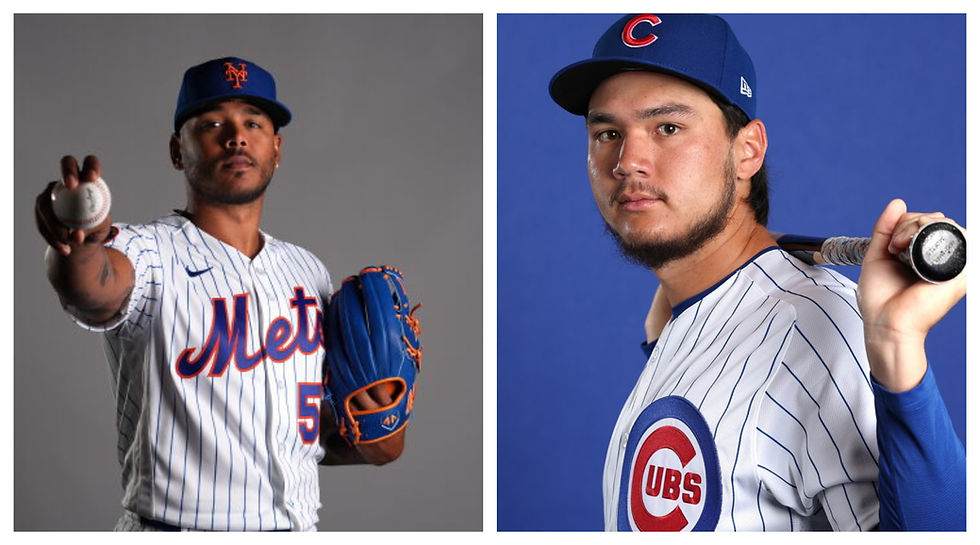
Trade Freddy Peralta to the Chicago Cubs.
Freddy Peralta?
The guy who was supposed to be the front-line ace?
The guy who was supposed to join Juan Soto, Francisco Lindor, and company as part of the next great Mets team?
The guy who has spent 2026 looking less like a Cy Young candidate and more like someone searching through couch cushions looking for his old fastball?
Exactly.
That is why this is the time.
Selling Low Sometimes Means Buying Smart
The hardest thing for any team — and any fan base — is admitting when reality has changed.
When the Mets acquired Peralta, the vision was easy to understand.
A dominant right-handed starter.
A pitcher entering his prime.
A proven postseason-caliber arm.
The type of pitcher every contender wants.
Unfortunately, baseball has a funny way of reminding everyone that yesterday’s certainty can become tomorrow’s question mark.
Peralta is having the worst season of his career.
His trade value has dropped.
And that is precisely why the Mets might actually be able to win this trade.
Because the best trades are not always made when a player’s value is at its highest.
Sometimes they are made when everyone else is looking at the same player and saying:
“Wait…is he still that guy?”
The Mets are not trying to save 2026.
They are a team looking to build 2027, 2028, and beyond.
And sometimes the first step forward is admitting a move backward is necessary.
Why Chicago Makes Too Much Sense:
The Chicago Cubs are sitting in the perfect position.
They currently hold a 4.5-game lead in the Wild Card race and are chasing the Milwaukee Brewers, who sit seven games ahead in the division.
They are not rebuilding.
They are not waiting.
They are trying to win now.
And their biggest problem?
Their rotation needs help.
Injuries have created holes, and their current group has plenty of question marks.
Their rotation:
Shota Imanaga: 3.72 ERA
Colin Rea: 4.85 ERA
Jameson Taillon: 5.92 ERA
Edward Cabrera: 5.10 ERA before landing on the injured list
Matthew Boyd: 3.81 ERA
There are some positives there, but there is also room for a playoff-caliber starter.
Even a struggling Freddy Peralta represents an upgrade.
Because the Cubs would not be acquiring the 2026 version.
They would be betting on the pitcher they believe can return.
And there is one massive reason Chicago may believe more than anyone else.
His name is Craig Counsell.
Before becoming the manager of the Cubs, Counsell was the man running the Milwaukee Brewers.

He was Freddy Peralta’s manager for the first six seasons of his major league career.
He knows him.
He knows his personality.
He knows his preparation.
He knows what makes him successful.
He knows what happens when Peralta is at his best.
That matters.
A struggling player going somewhere completely unfamiliar is one thing.
A struggling player going to a manager who already knows how to push the right buttons?
That is a different situation.
The Cubs would not just be acquiring an arm.
They would be acquiring a pitcher they believe they can fix.
The Mets’ Biggest Need Is Exactly What Chicago Has Too Much Of
This is where the potential trade becomes interesting.
The Mets desperately need to find their long-term answer at first base.
The Cubs?
They have a traffic jam.
Their current first baseman, Michael Busch, has quietly become one of baseball’s better young players.
Since arriving in Chicago, Busch has produced:
2024: 21 home runs, .775 OPS, 2.8 WAR
2025: 34 home runs, .866 OPS, 4.5 WAR
2026: 13 home runs, .772 OPS
He is under contract through 2030.
He is not going anywhere.

Which means the Cubs have flexibility.
And behind Busch?
The Cubs have several first-base prospects climbing toward Chicago.
Including:
Josiah Hartshorn
Owen Ayers
Jonathan Long
The Mets could take advantage of a situation where Chicago has more first-base depth than it needs.
That is exactly how smart teams operate.
They identify another organization’s surplus and turn it into their own need.
Jonathan Long Could Be the Hidden Gem
The player who interests me most is Jonathan Long.
Long is not the type of prospect who shows up on every national top-100 list.
He was a ninth-round pick.
He was not handed anything.
He earned his way.
And then he kept hitting.
At Triple-A Iowa, Long has shown the type of offensive profile teams dream on from a future first baseman. In 2025, he put together the kind of season that makes scouts start circling a name in red ink, hitting .305 with 157 hits, 20 home runs, 91 RBI and an .883 OPS. And because baseball has a funny way of testing every young player who starts getting noticed, Long came back in 2026 and proved it was no fluke, hitting .280 with 11 home runs and an .812 OPS while continuing to show the consistent approach that made him one of the Cubs’ most intriguing prospects.
Long’s game is built around patience, contact, and the ability to consistently produce.
He controls the strike zone.
He makes hard contact.
He has shown he can hit both right-handed and left-handed pitching.
Defensively, he is probably limited to first base, but that is not a problem.
The Mets are not looking for their next shortstop.
They are looking for their next first baseman.
And sometimes the best players are the ones who fit the need perfectly.
The Mets Need Their PCA Moment
The Cubs and Mets have done business before.
And Mets fans do not need to be reminded about the Javier Báez trade.
That one worked out pretty well for Chicago.
The Cubs received Pete Crow-Armstrong, who has developed into exactly the type of franchise player teams dream about.
The Mets received a short-term rental.
That cannot keep happening.
Eventually, the Mets need to be the team that finds the hidden value.
The team that identifies the next core piece.
The team that gets younger and better at the same time.
This could be that opportunity.
The Mets already have young position pieces to build around in Ewing, Benge, and Alvarez to go with veterans Soto and Lindor.
The goal now is not to collect names.
The goal is to build a roster that fits.
A first baseman.
More pitching depth.
More athleticism.
More players entering their prime together.
The 2027 Mets cannot be a team built around what used to be.
They need to be built around what comes next.
Freddy Peralta may very well return to being Freddy Peralta.
That is the risk.
But that risk is exactly why Chicago might pay more than other teams.
The Mets are not trading him because they believe he is finished.
They are trading him because he is entering free agency and they believe the best version of the 2027 Mets might not include him.
And sometimes the hardest move is also the smartest one.
The first domino has to fall.
Maybe it falls in Chicago.
Maybe it brings back a future first baseman.
Maybe it gives the Mets the first piece of their next great team.
Because after spending a weekend celebrating baseball’s past in Cooperstown…
it is time for the Mets to start building their future.
And that future should begin with a phone call to Chicago.


Comments